















































KI-Beratung Beta

  • Produktbild: Advanced Topics in System and Signal Theory
  • Produktbild: Advanced Topics in System and Signal Theory
Band 4

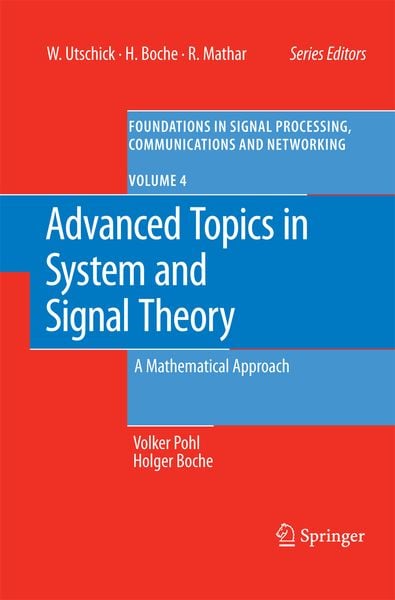
Advanced Topics in System and Signal Theory A Mathematical Approach

98,99 €

inkl. gesetzl. MwSt., Versandkostenfrei


Beschreibung

The requirement of causality in system theory is inevitably accompanied by the appearance of certain mathematical operations, namely the Riesz proj- tion,theHilberttransform,andthespectralfactorizationmapping.Aclassical exampleillustratingthisisthedeterminationoftheso-calledWiener?lter(the linear, minimum...

Beschreibung

The requirement of causality in system theory is inevitably accompanied by the appearance of certain mathematical operations, namely the Riesz proj- tion,theHilberttransform,andthespectralfactorizationmapping.Aclassical exampleillustratingthisisthedeterminationoftheso-calledWiener?lter(the linear, minimum means square error estimation ?lter for stationary stochastic sequences [88]). If the ?lter is not required to be causal, the transfer function of the Wiener ?lter is simply given by H(?)=? (?)/? (?),where ? (?) xy xx xx and ? (?) are certain given functions. However, if one requires that the - xy timation ?lter is causal, the transfer function of the optimal ?lter is given by 1 ? (?) xy H(?)= P ,?? (??,?] . + [? ] (?) [? ] (?) xx + xx? Here [? ] and [? ] represent the so called spectral factors of ? ,and xx + xx? xx P is the so called Riesz projection. Thus, compared to the non-causal ?lter, + two additional operations are necessary for the determination of the causal ?lter, namely the spectral factorization mapping ? ? ([? ] ,[? ] ),and xx xx + xx? the Riesz projection P .

Rezension

From the reviews:

“It is intended primarily for engineers working in the area of robustness problems under a casualty constraint. At the beginning it presents the mathematical methods, necessary to approaching theses problems. Then, some related classical results concerning the boundedness and continuity of the Hilbert transform and Riesz projection are presented. Finally, these methods and results are applied to selected topics from signal processing.” (Tzvetan Semerdjiev, Zentralblatt MATH, Vol. 1179, 2010)

“The monograph gives an elaborate treatment of some tools used in signal and system theory, which have applications in communications, stochastic processes and optimal filter theory. … Appropriate references are provided for the reader interested in details. … The book is a valuable addition to the mathematical literature related to signal processing, and should be useful to students in engineering as well as to mathematicians interested in applications.” (Amol J. Sasane, Mathematical Reviews, Issue 2010 j)

Produktdetails

Einband

Taschenbuch

Erscheinungsdatum

14.03.2012

Abbildungen

VIII, 241 p. 5 illus.

Verlag Springer Berlin

Produktdetails

Einband

Taschenbuch

Erscheinungsdatum

14.03.2012

Abbildungen

VIII, 241 p. 5 illus.

Verlag Springer Berlin
Seitenzahl

241

Maße (L/B/H)

23,5/15,5/1,4 cm

Gewicht

388 g

Auflage

2010

Sprache

Englisch

ISBN

978-3-642-26096-4

Herstelleradresse

Springer-Verlag KG
Sachsenplatz 4-6
1201 Wien
AT

Email: ProductSafety@springernature.com

Ein neues Kapitel für Ihre Bücher

Ein neues Kapitel für Ihre Bücher

Schenken Sie Ihren alten Schätzen ein zweites Leben und erhalten Sie dafür eine Thalia Geschenkkarte.

Jetzt verkaufen
Jetzt verkaufen

Noch keine Bewertungen vorhanden

Verfassen Sie die erste Bewertung zu diesem Artikel

Helfen Sie anderen Kundinnen und Kunden durch Ihre Meinung.

Kundinnen und Kunden meinen

Bewertungen (0)

  • Produktbild: Advanced Topics in System and Signal Theory
  • Produktbild: Advanced Topics in System and Signal Theory
  • I Mathematical Preliminaries.- Function Spaces and Operators.- Fourier Analysis and Analytic Functions.- Banach Algebras.- Signal Models and Linear Systems.- II Fundamental Operators.- Poisson Integral and Hilbert Transformation.- Causal Projections.- III Causality Aspects in Signal and System Theory.- Disk Algebra Bases.- Causal Approximations.- On Algorithms for Calculating the Hilbert Transform.- Spectral Factorization.