















































KI-Beratung Beta

Produktbild: Linking the Formal and Informal Economy

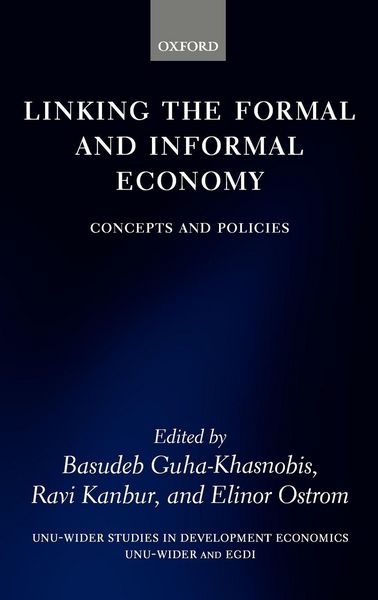
Linking the Formal and Informal Economy Concepts and Policies

217,99 €

inkl. gesetzl. MwSt., Versandkostenfrei


Beschreibung

Produktdetails

Einband

Gebundene Ausgabe

Erscheinungsdatum

21.09.2006

Abbildungen

35 line figures and tables

Herausgeber

Guha-Khasnobis Basudeb + weitere

Verlag

Oxford University Press

Seitenzahl

316

Maße (L/B/H)

24/16,1/2,2 cm

Gewicht

640 g

Sprache

Englisch

ISBN

978-0-19-920476-2

Beschreibung

Rezension

No matter how you divide up the developing world -- 'formal-informal',' legal -- 'extra-legal' --(my preference)one thing is not debatable: most people are poor, on the outside of the system looking in, and getting angrier every day. The message of this book is its time to stop talking and start designing reforms -- based on the informal practices and organizations that poor entrepreneurs already use. I second that motion. If you rebuild the system from the bottom-up, they will come -- with their enterprise, creativity, and piles of potential capital. Hernando de Soto, President, Institute for Liberty and Democracy, Peru

Produktdetails

Einband

Gebundene Ausgabe

Erscheinungsdatum

21.09.2006

Abbildungen

35 line figures and tables

Herausgeber

Verlag

Oxford University Press

Seitenzahl

316

Maße (L/B/H)

24/16,1/2,2 cm

Gewicht

640 g

Sprache

Englisch

ISBN

978-0-19-920476-2

Herstelleradresse

Libri GmbH
Europaallee 1
36244 Bad Hersfeld
DE

Email: gpsr@libri.de

Ein neues Kapitel für Ihre Bücher

Ein neues Kapitel für Ihre Bücher

Schenken Sie Ihren alten Schätzen ein zweites Leben und erhalten Sie dafür eine Thalia Geschenkkarte.

Jetzt verkaufen
Jetzt verkaufen

Noch keine Bewertungen vorhanden

Verfassen Sie die erste Bewertung zu diesem Artikel

Helfen Sie anderen Kundinnen und Kunden durch Ihre Meinung.

Kundinnen und Kunden meinen

Bewertungen (0)

  • Produktbild: Linking the Formal and Informal Economy

    • 1: Basudeb Guha-Khasnobis, Ravi Kanbur, and Elinor Ostrom: Beyond Formality and Informality


    • Concepts and Measurement


    • 2: Keith Hart: Bureaucratic Form and the Informal Economy


    • 3: Robert K. Christensen: The Global Path: Soft Law and Non-sovereigns Formalizing the Potency of the Informal Sector


    • 4: Alice Sindzingre: The Relevance of the Concepts of Formality and Informality: A Theoretical Appraisal


    • 5: Martha Alter Chen: Rethinking the Informal Economy: Linkages with the Formal Economy and the Formal Regulatory Environment


    • 6: M. R. Narayana: Formal and Informal Enterprises: Concept, Definition, and Measurement Issues in India


    • Empirical Studies of Policies and Interlinking


    • 7: Norman V. Loayza, Ana María Oviedo, and Luis Servén: The Impact of Regulation on Growth and Informality: Cross-Country Evidence


    • 8: Robert Lensink, Mark McGillivray, and Pham Thi Thu Trà: Financial Liberalization in Vietnam: Impact on Loans from Informal, Formal, and Semi-formal Providers


    • 9: Fredrik Söderbaum: Blocking Human Potential: How Formal Policies Block the Informal Economy in the Maputo Corridor


    • 10: Basudeb Guha-Khasnobis and Rajeev Ahuja: Microinsurance for the Informal Economy Workers in India


    • 11: Krister Andersson and Diego Pacheco: Turning to Forestry for a Way Out of Poverty: Is Formalizing Property Rights Enough?


    • 12: Jeffrey B. Nugent and Shailender Swaminathan: Voluntary Contributions to Informal Activities Producing Public Goods: Can These be Induced by Government and other Formal Sector Agents? Some Evidence from Indonesian Posyandus


    • 13: Amos Sawyer: Social Capital, Survival Strategies, and their Potential for Post-Conflict Governance in Liberia


    • 14: Sally Roever: Enforcement and Compliance in Lima's Street Markets: The Origins and Consequences of Policy Incoherence Toward Informal Traders


    • 15: Liz Alden Wily: Formalizing the Informal: Is There a Way to Safely Unlock Human Potential Through Land Entitlement? A Review of Changing Land Administration in Africa