















































KI-Beratung Beta

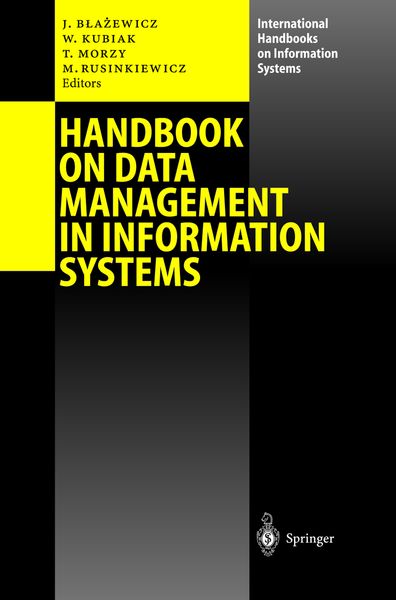
Produktbild: Handbook on Data Management in Information Systems
- 12%

Handbook on Data Management in Information Systems

12% sparen

187,99 € UVP 213,99 €

inkl. gesetzl. MwSt., Versandkostenfrei


Beschreibung

Produktdetails

Einband

Gebundene Ausgabe

Erscheinungsdatum

15.07.2003

Abbildungen

IX, 578 p.

Herausgeber

Jacek Blazewicz + weitere

Verlag

Springer Berlin

Seitenzahl

578

Maße (B/H)

15,5/23,5 cm

Gewicht

998 g

Auflage

1. Auflage

Sprache

Englisch

ISBN

978-3-540-43893-9

Beschreibung

Produktdetails

Einband

Gebundene Ausgabe

Erscheinungsdatum

15.07.2003

Abbildungen

IX, 578 p.

Herausgeber

Verlag

Springer Berlin

Seitenzahl

578

Maße (B/H)

15,5/23,5 cm

Gewicht

998 g

Auflage

1. Auflage

Sprache

Englisch

ISBN

978-3-540-43893-9

Herstelleradresse

Springer Heidelberg
Tiergartenstr. 17
69121 Heidelberg
DE
buchhandel-buch@springer.com

Ein neues Kapitel für Ihre Bücher

Ein neues Kapitel für Ihre Bücher

Schenken Sie Ihren alten Schätzen ein zweites Leben und erhalten Sie dafür eine Thalia Geschenkkarte.

Jetzt verkaufen
Jetzt verkaufen

Noch keine Bewertungen vorhanden

Verfassen Sie die erste Bewertung zu diesem Artikel

Helfen Sie anderen Kundinnen und Kunden durch Ihre Meinung.

Kundinnen und Kunden meinen

Bewertungen (0)

  • Produktbild: Handbook on Data Management in Information Systems
  • 1. Management of Data: State-of-the-Art and Emerging Trends.- 1 Introduction.- 2 Survey of the Volume.- 2. Database Systems: from File Systems to Modern Database Systems.- 1 Introduction — Database Concepts.- 2 Database System Generations.- 3 Network Database Systems.- 4 Hierarchical Database Systems.- 5 Relational Database Systems.- 6 Object-Oriented Database Systems.- 7 Federated, Mediated Database Systems and Data Warehouses.- 8 Conclusions.- 3. Data Modeling.- 1 Introduction.- 2 Early Concerns in Data Management.- 3 Abstraction in Data Modeling.- 4 Semantic Data Models.- 5 Models of Reality and Perception.- 6 Toward Cognition-Based Data Management.- 7 A Cognitive Approach to Data Modeling.- 8 Research Directions.- 4. Object-Oriented Database Systems.- 1 Introduction and Motivation.- 2 Object-Oriented Data Modeling.- 3 The Query Language OQL.- 4 Physical Object Management.- 5 Architecture of Client-Server-Systems.- 6 Indexing.- 7 Dealing with Set-Valued Attributes.- 8 Query Optimization.- 9 Conclusion.- 5. High Performance Parallel Database Management Systems.- 1 Introduction.- 2 Partitioning Strategies.- 3 Join Using Inter-Operator Parallelism.- 4 ORE: a Framework for Data Migration.- 5 Conclusions and Future Research Directions.- 6. Advanced Database Systems.- 1 Introduction.- 2 Preliminaries.- 3 Data Models and Modeling for Complex Objects.- 4 Advanced Query Languages.- 5 Advanced Database Server Capabilities.- 6 Conclusions and Outlook.- 7. Parallel and Distributed Multimedia Database Systems.- 1 Introduction.- 2 Media Fundamentals.- 3 MPEG as an Example of Media Compression.- 4 Organisation and Retrieval of Multimedia Data.- 5 Data Models for Multimedia Data.- 6 Multimedia Retrieval Sequence Using Images as an Example.- 7 Requirements for MultimediaApplications.- 8 Parallel and Distributed Processing of Multimedia Data.- 9 Parallel and Distributed Techniques for Multimedia Databases.- 10 Case Study: Cairo — Cluster Architecture for Image Retrieval and Organisation.- 11 Conclusions.- 8. Workflow Technology: the Support for Collaboration.- 1 Introduction.- 2 Application Scenario and Collaboration Requirements.- 3 Commercial Technologies Addressing Collaboration Requirements.- 4 Evaluation of Current Workflow Management Technology.- 5 Research Problems, Related Work, and Directions.- 6 Summary.- 9. Data Warehouses.- 1 Introduction.- 2 Basics.- 3 The Database of a Data Warehouse.- 4 The Data Warehouse Concept.- 5 Data Analysis of a Data Warehouse.- 6 Building a Data Warehouse.- 7 Future Research Directions.- 8 Conclusions.- 10. Mobile Computing.- 1 Introduction.- 2 Mobile Computing Infrastructure.- 3 Mobile Computing Software Architectures and Models.- 4 Disconnected Operation.- 5 Weak Connectivity.- 6 Data Delivery by Broadcast.- 7 Mobile Computing Resources and Pointers.- 8 Conclusions.- 11. Data Mining.- 1 Introduction.- 2 Mining Associations.- 3 Classification and Prediction.- 4 Clustering.- 5 Conclusions.- List of Contributors.