















































KI-Beratung Beta

Gutscheinbedingungen

Gültig bis 30.11.2026 | Gültig für nicht preisgebundene fremdsprachige Bücher | Einzelne Artikel können ausgeschlossen sein | Online auf thalia.de und in der Thalia App einlösbar | Click & Collect nur mit Online-Zahlung (Paypal/Kreditkarte) vorab | Nicht kombinierbar mit anderen Gutscheinen oder Preisaktionen | Nur einmal pro Einkauf einlösbar | Gutschein wird auf max. 500€ Bestellwert angerechnet | Keine Barauszahlung | Nicht gültig für Versandkosten und Services

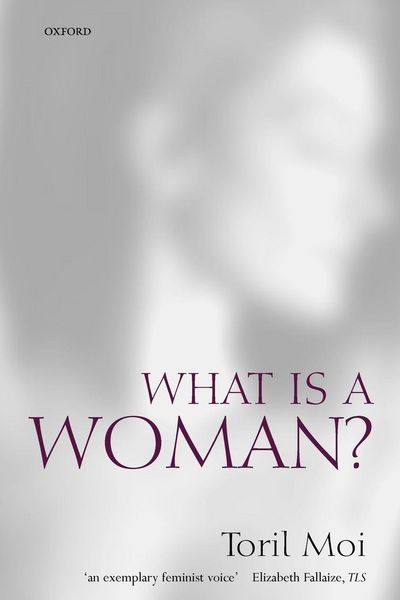
Produktbild: What is a Woman?

What is a Woman? And Other Essays

134,99 €

inkl. gesetzl. MwSt., Versandkostenfrei


Beschreibung

What is a woman? And what does it mean to be a feminist today? In her first full-scale engagement with feminist theory since her internationally renowned Sexual/Textual Politics (1985), Toril Moi challenges the dominant trends in contemporary feminist and cultural thought, arguing for a feminism of...

Beschreibung

What is a woman? And what does it mean to be a feminist today? In her first full-scale engagement with feminist theory since her internationally renowned Sexual/Textual Politics (1985), Toril Moi challenges the dominant trends in contemporary feminist and cultural thought, arguing for a feminism of freedom inspired by Simone de Beauvoir's The Second Sex. Written in a clear and engaging style What is a Woman? brings together two brand new book-length theoretical interventions, Moi's work on Freud and Bourdieu, and her studies of desire and knowledge in literature. In the controversial title-essay, Toril Moi radically rethinks current debates about sex, gender, and the body - challenging the commonly held belief that the sex/gender distinction is fundamental to all feminist theory. Moi rejects every attempt to define masculinity and femininity, including efforts to define femininity as that which 'cannot be defined'. In the second new book-length essay, 'I Am a Woman', Toril Moi reworks the relationship between the personal and the philosophical, pursuing ways to write theory that do not neglect the claims of the personal. Setting up an encounter between contemporary theory and Simone de Beauvoir, Moi radically rethinks the need, and difficulty, of finding one's own philosophical voice by placing it in new theoretical contexts. A sustained refusal to lay down theoretical or political requirements for femininity, and a powerful argument for a feminism of freedom, What is a Woman? is a deeply original contribution to feminist theory.

Produktdetails

Einband

Taschenbuch

Erscheinungsdatum

01.08.2001

Abbildungen

1 figure

Verlag Oxford Academic

Produktdetails

Einband

Taschenbuch

Erscheinungsdatum

01.08.2001

Abbildungen

1 figure

Verlag Oxford Academic
Seitenzahl

544

Maße (L/B/H)

23,4/15,6/2,9 cm

Gewicht

816 g

Sprache

Englisch

ISBN

978-0-19-818675-5

Herstelleradresse

Libri GmbH
Europaallee 1
36244 Bad Hersfeld
DE

Email: gpsr@libri.de

Ein neues Kapitel für Ihre Bücher

Ein neues Kapitel für Ihre Bücher

Schenken Sie Ihren alten Schätzen ein zweites Leben und erhalten Sie dafür eine Thalia Geschenkkarte.

Jetzt verkaufen
Jetzt verkaufen

Noch keine Bewertungen vorhanden

Verfassen Sie die erste Bewertung zu diesem Artikel

Helfen Sie anderen Kundinnen und Kunden durch Ihre Meinung.

Kundinnen und Kunden meinen

Bewertungen (0)

  • Produktbild: What is a Woman?
    • Preface
    • A Note on the Text
    • Part I: A Feminism of Freedom: Simone de Beauvoir
    • 1: What is a Woman? Sex, Gender, and the Body in Feminist Theory
    • 2: I Am a Woman: The Personal and the Philosophical
    • Part II: Appropriating Theory: Bourdieu and Freud
    • Introduction to Part II
    • 3: Appropriating Bourdieu: Feminist Theory and Pierre Bourdieu's Sociology of Culture
    • 4: The Challenge of the Particular Case: Bourdieu's Sociology of Culture and Literary Criticism
    • 5: The Missing Mother: René Girard's Oedipal Rivalries
    • 6: Representation of Patriarchy: Sexuality and Epistemology in Freud's iDora/i
    • 7: Patriarchal Thought and the Drive for Knowledge
    • 8: Is Anatomy Destiny? Freud and Biological Determinism
    • Part III: Desire and Knowledge: Reading Texts of Love
    • Introduction to Part III
    • 9: Desire in Language: Andreas Capellanus and the Controversy of Courtly Love
    • 10: She Died Because She Came Too Late: Knowledge, Doubles and Death in Thomas's iTristan/i
    • 11: Intentions and Effects: Rhetoric and Identification in Simone de Beauvoir's iThe Woman Destroyed/i
    • Works cited
    • Index