















































KI-Beratung Beta

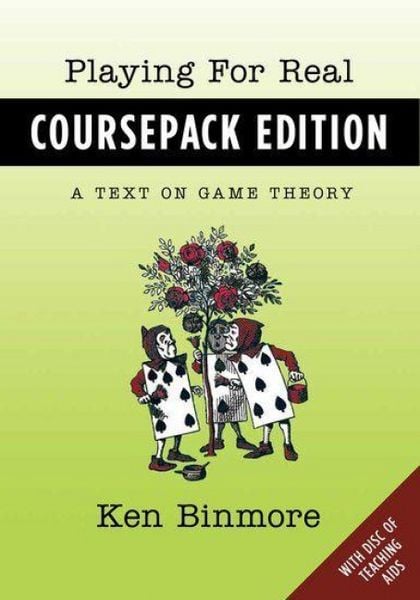
Produktbild: Playing for Real, Coursepack Edition

Playing for Real, Coursepack Edition A Text on Game Theory

83,99 €

inkl. gesetzl. MwSt., Versandkostenfrei


Produktdetails

Einband

Taschenbuch

Erscheinungsdatum

03.10.2012

Verlag

Oxford University Press

Seitenzahl

408

Maße (L/B/H)

25,3/17,9/2,5 cm

Gewicht

859 g

Sprache

Englisch

ISBN

978-0-19-992453-0

Produktdetails

Einband

Taschenbuch

Erscheinungsdatum

03.10.2012

Verlag

Oxford University Press

Seitenzahl

408

Maße (L/B/H)

25,3/17,9/2,5 cm

Gewicht

859 g

Sprache

Englisch

ISBN

978-0-19-992453-0

Herstelleradresse

Libri GmbH
Europaallee 1
36244 Bad Hersfeld
DE

Email: gpsr@libri.de

Ein neues Kapitel für Ihre Bücher

Ein neues Kapitel für Ihre Bücher

Schenken Sie Ihren alten Schätzen ein zweites Leben und erhalten Sie dafür eine Thalia Geschenkkarte.

Jetzt verkaufen
Jetzt verkaufen

Noch keine Bewertungen vorhanden

Verfassen Sie die erste Bewertung zu diesem Artikel

Helfen Sie anderen Kundinnen und Kunden durch Ihre Meinung.

Kundinnen und Kunden meinen

Bewertungen (0)

  • Produktbild: Playing for Real, Coursepack Edition
    • Lecture 1: Getting Locked In
    • In this introductory lecture, a famous game called the Prisoners' Dilemma is
    • introduced and used to illustrate how game theory can be used to clarify a
    • variety of strategic problems. The idea of a Nash equilibrium makes its first
    • appearance.
    • Lecture 2: Backing Up
    • This chapter starts to explain how one can specify the rules of a game by
    • introducing the idea of a game tree. We learn how some games can be solved
    • by backward induction.
    • Lecture 3: Taking Chances
    • Chance moves are introduced. Bayes rule for updating conditional probabilities
    • appears for the first time.
    • Lecture 4: Accounting for Tastes
    • We learn that a rational player in a risky situation will behave as though maximizing
    • the expected value of a Von Neumann and Morgenstern utility function.
    • Lecture 5: Planning Ahead
    • The ideas of an extensive and strategic form of a game are consolidated. We
    • learn the mechanics of successively deleting dominated strategies.
    • Lecture 6: Mixing Things Up
    • Rational players will sometimes need to randomoize their strategy choice to
    • keep their opponents guessing. This chapter explains how to work with such
    • mixed strategies.
    • Lecture 7: Buying Cheap and Selling Dear
    • This chapter is an introduction to the use of game theory in economics. Students
    • of economics will find most topics are treated from a different angle than
    • they have probably seem before.
    • Lecture 8: Repeating Yourself
    • Most of the games we play in real life are repeated over and over again. This
    • makes a big difference to how they get played.
    • Lecture 9: Getting Together
    • This chapter applies game theory to bargaining.
    • Lecture 10: Knowing What to Believe
    • One of the big successes of game theory lies in its ability to handle some
    • situations in which players have good reason to conceal information from each
    • other.
    • Lecture 11: Taking Charge
    • This lecture is an optional extra about auctions and mechanism design. It can
    • serve as a possible substitute for Lecture 8 or 9.