















































KI-Beratung Beta

Produktbild: Design Economics for the Built Environment

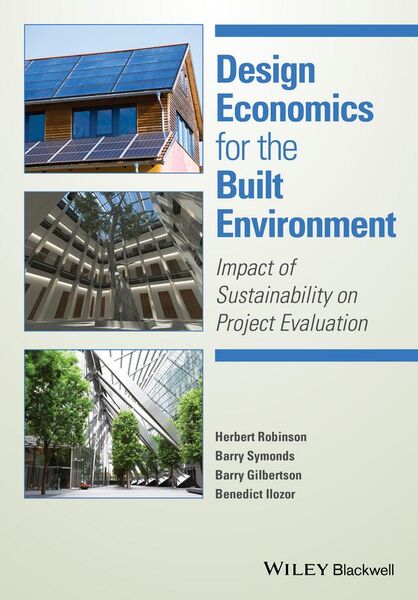
Design Economics for the Built Environment Impact of Sustainability on Project Evaluation

156,99 €

inkl. gesetzl. MwSt., Versandkostenfrei


Beschreibung

The drive towards environmentally friendly buildings and infrastructure has led to a growing interest in providing design solutions underpinned by the core principles of sustainability to balance economic, social and environmental factors.   Design Economics for the Built Environment: Impact of sustainability...

Beschreibung

The drive towards environmentally friendly buildings and infrastructure has led to a
growing interest in providing design solutions underpinned by the core principles of sustainability to balance economic, social and environmental factors.
 
Design Economics for the Built Environment: Impact of sustainability on project evaluation presents new directions, reflecting the need to recognise the impact of climate change and the
importance of sustainability in project evaluation. The aim is to provide a new approach to
understanding design economics in the context of the changing policy
environment, legislative and regulatory framework, and increasing economic,
environmental and social pressure as result of the sustainability agenda.
 
The book follows a structured approach from theories and principles in the earlier chapters,
to the practical applications and emerging techniques focusing on value and
social, economic and environmental considerations in making design decisions. It
starts with the policy context, building on various theories and principles
such as, capital cost, value of design and resource-based theories, the new rules of measurement (NRM) to explore cost planning, the relationship between height and costs, key
socio-economic and environmental variables for design appraisal, eco-cost/value ratio (EVR), whole life theory
and the treatment of carbon emission as external costs, productivity and
efficiency, fiscal drivers and legal framework for carbon reduction, procurement and allocation of risks in contracts.
 
Case studies, practical examples and frameworks throughout reinforce theories and
principles and relate them to current practice. The book is essential reading
for postgraduate students in architecture, building and quantity surveying and
is also a valuable resource for academics, consultants and policy-makers in the
built environment.

Produktdetails

Einband

Taschenbuch

Erscheinungsdatum

22.06.2015

Herausgeber Robinson Herbert + weitere
Verlag John Wiley & Sons Inc

Produktdetails

Einband

Taschenbuch

Erscheinungsdatum

22.06.2015

Herausgeber
Verlag John Wiley & Sons Inc
Seitenzahl

432

Maße (L/B/H)

23,9/17/2 cm

Gewicht

794 g

Auflage

1. Auflage

Sprache

Englisch

ISBN

978-0-470-65909-0

Herstelleradresse

Libri GmbH
Europaallee 1
36244 Bad Hersfeld
DE

Email: gpsr@libri.de

Ein neues Kapitel für Ihre Bücher

Ein neues Kapitel für Ihre Bücher

Schenken Sie Ihren alten Schätzen ein zweites Leben und erhalten Sie dafür eine Thalia Geschenkkarte.

Jetzt verkaufen
Jetzt verkaufen

Noch keine Bewertungen vorhanden

Verfassen Sie die erste Bewertung zu diesem Artikel

Helfen Sie anderen Kundinnen und Kunden durch Ihre Meinung.

Kundinnen und Kunden meinen

Bewertungen (0)

Die Leseprobe wird geladen.
  • Produktbild: Design Economics for the Built Environment
  • Editors and Contributors xii
     
    Foreword xxiii
     
    Preface xxv
     
    PART I THEORIES, PRINCIPLES AND APPROACHES 1
     
    1 Economic Context, Policy Environment and the Changing Role of Design Economists 3
    Herbert Robinson and Barry Symonds
     
    1.1 Introduction 3
     
    1.2 The economic context 4
     
    1.3 Globalisation of construction market 6
     
    1.4 The policy environment and the construction industry 9
     
    1.5 Current and emerging role of design economists 11
     
    2 Theories and Principles of Design Economics 16
    Herbert Robinson and Barry Symonds
     
    2.1 Introduction 16
     
    2.2 Factors affecting design costs and benefits 17
     
    2.3 Capital cost theory 18
     
    2.4 Whole life cost theory 21
     
    2.5 Value management theory 23
     
    2.6 Value of design theory 24
     
    2.7 Carter's model 26
     
    2.8 Resource?]based theory 27
     
    3 New Approaches and Rules of Measurement for Cost Estimating and Planning 31
    Barry Symonds, Peter Barnes and Herbert Robinson
     
    3.1 Introduction 31
     
    3.2 The standardisation of cost estimating 32
     
    3.3 The RICS NRM 1 33
     
    3.4 RIBA plan of work, RICS estimating, cost planning and NRM 1 34
     
    3.5 Cost estimating and cost planning 35
     
    3.6 Elemental Standard Form of Cost Analysis (SFCA) 40
     
    3.7 Benchmarking (cost limits) 41
     
    3.8 Building information modelling 43
     
    3.9 Concluding remarks 44
     
    4 The Relationship between Building Height and Construction Costs 47
    David Picken and Benedict Ilozor
     
    4.1 Introduction 47
     
    4.2 Research in the 1970s and 1980s 48
     
    4.3 More recent research in Hong Kong and Shanghai 50
     
    4.4 Conclusions 59
     
    5 Appraisal of Design to Determine Viability of Development Schemes 61
    Herbert Robinson
     
    5.1 Introduction 61
     
    5.2 Assessing costs and benefits of design alternatives 61
     
    5.3 Appraisal of design using discounting methods 63
     
    5.4 Appraisal of design using residual technique 65
     
    5.5 Case study of the blackfriars development project 69
     
    5.6 Concluding remarks 77
     
    6 Eco-cost Associated with Tall Buildings 80
    Peter de Jong and J.W.F. Hans Wamelink
     
    6.1 Introduction 80
     
    6.2 Overview of the Dutch housing market and land use planning 80
     
    6.3 Eco-costs/value ratio and the EVR model 82
     
    6.4 Applying the EVR model to housing 86
     
    6.5 EVR and tall buildings 88
     
    6.6 Embedding EVR in other sustainable ranking methods 89
     
    6.7 Conclusion 90
     
    7 Productivity in Construction Projects 93
    Shamil Naoum
     
    7.1 Introduction 93
     
    7.2 Concept and measurement of productivity 94
     
    7.3 Previous literature on factors affecting site productivity 94
     
    7.4 Productivity survey 100
     
    7.5 Proposed framework for site productivity 102
     
    7.6 Conclusion and further research 104
     
    8 Design Variables and Whole-Life Cost Modelling 107
    Andrea Pelzeter
     
    8.1 Introduction 107
     
    8.2 Whole-life cost modelling 108
     
    8.3 Steps in LCC modelling 110
     
    8.4 Design principles to optimise lcc 112
     
    8.5 A worked example of an office façade 116
     
    8.6 Inclusion of carbon emissions into wlc modelling 118
     
    8.7 Limitations of wlc 119
     
    8.8 Concluding remarks 119
     
    9 Procurement and Contract Strategy: Risks Allocation and Construction Cost 121
    John Adriaanse and Herbert Robinson
     
    9.1 Introduction 121
     
    9.2 Procurement strategy and contract selection 122
     
    9.3 Wembley stadium case study 123
     
    9.4 Allocation of