















































Solid State Chemistry and its Applications 2eStudent Edition
1-
- Taschenbuch ausgewählt
- eBook
-
Sprache:Englisch
55,99 €
inkl. gesetzl. MwSt.,
Beschreibung
Produktdetails
Einband
Taschenbuch
Erscheinungsdatum
28.02.2014
Verlag
John Wiley & Sons IncSeitenzahl
592
Maße (L/B/H)
25,4/20,3/3,1 cm
Gewicht
1239 g
Auflage
2nd Edition, Student Edition
Sprache
Englisch
ISBN
978-1-119-94294-8
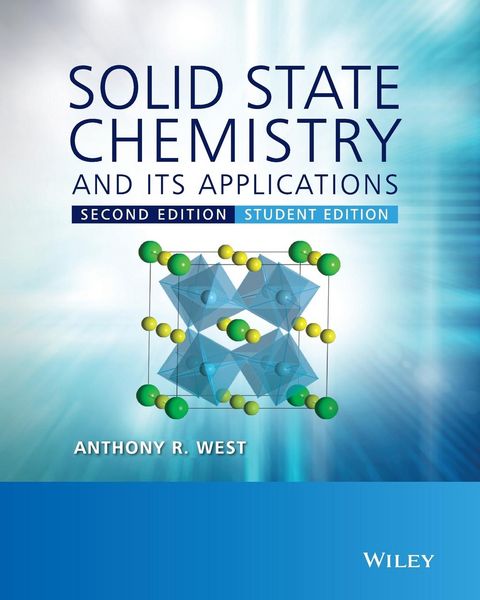
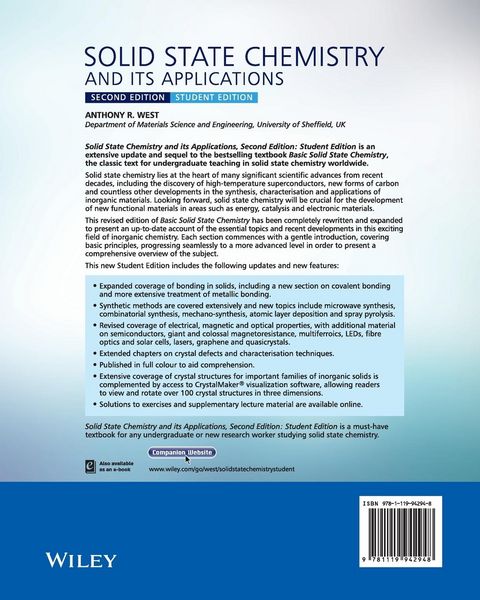
Solid State Chemistry and its Applications, 2nd Edition: Student Edition is an extensive update and sequel to the bestselling textbook Basic Solid State Chemistry, the classic text for undergraduate teaching in solid state chemistry worldwide.
Solid state chemistry lies at the heart of many significant scientific advances from recent decades, including the discovery of high-temperature superconductors, new forms of carbon and countless other developments in the synthesis, characterisation and applications of inorganic materials. Looking forward, solid state chemistry will be crucial for the development of new functional materials in areas such as energy, catalysis and electronic materials.
This revised edition of Basic Solid State Chemistry has been completely rewritten and expanded to present an up-to-date account of the essential topics and recent developments in this exciting field of inorganic chemistry. Each section commences with a gentle introduction, covering basic principles, progressing seamlessly to a more advanced level in order to present a comprehensive overview of the subject.
This new Student Edition includes the following updates and new features:
- Expanded coverage of bonding in solids, including a new section on covalent bonding and more extensive treatment of metallic bonding.
- Synthetic methods are covered extensively and new topics include microwave synthesis, combinatorial synthesis, mechano-synthesis, atomic layer deposition and spray pyrolysis.
- Revised coverage of electrical, magnetic and optical properties, with additional material on semiconductors, giant and colossal magnetoresistance, multiferroics, LEDs, fibre optics and solar cells, lasers, graphene and quasicrystals.
- Extended chapters on crystal defects and characterisation techniques.
- Published in full colour to aid comprehension.
- Extensive coverage of crystal structures for important families of inorganic solids is complemented by access to CrystalMaker® visualization software, allowing readers to view and rotate over 100 crystal structures in three dimensions.
- Solutions to exercises and supplementary lecture material are available online.
Solid State Chemistry and its Applications, 2nd Edition: Student Edition is a must-have textbook for any undergraduate or new research worker studying solid state chemistry.
Ein neues Kapitel für Ihre Bücher
Ein neues Kapitel für Ihre Bücher
Schenken Sie Ihren alten Schätzen ein zweites Leben und erhalten Sie dafür eine Thalia Geschenkkarte.
Kundinnen und Kunden meinen
Kurze Frage zu unserer Seite
Vielen Dank für Ihr Feedback
Wir nutzen Ihr Feedback, um unsere Produktseiten zu verbessern. Bitte haben Sie Verständnis, dass wir Ihnen keine Rückmeldung geben können. Falls Sie Kontakt mit uns aufnehmen möchten, können Sie sich aber gerne an unseren Kund*innenservice wenden.
zum Kundenservice