






































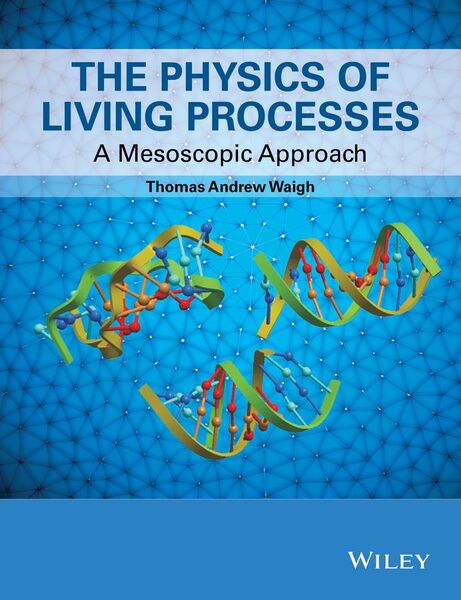
The Physics of Living Processes A Mesoscopic Approach
-
- Taschenbuch ausgewählt
- eBook
-
Sprache:Englisch
102,99 €
inkl. gesetzl. MwSt.,
Beschreibung
Produktdetails
Einband
Taschenbuch
Erscheinungsdatum
27.10.2014
Verlag
John Wiley & SonsSeitenzahl
624
Maße (L/B/H)
24,6/18,9/3 cm
Gewicht
1325 g
Auflage
1. Auflage
Sprache
Englisch
ISBN
978-1-118-44994-3
This full-colour undergraduate textbook, based on a two semester course, presents the fundamentals of biological physics, introducing essential modern topics that include cells, polymers, polyelectrolytes, membranes, liquid crystals, phase transitions, self-assembly, photonics, fluid mechanics, motility, chemical kinetics, enzyme kinetics, systems biology, nerves, physiology, the senses, and the brain.
The comprehensive coverage, featuring in-depth explanations of recent rapid developments, demonstrates this to be one of the most diverse of modern scientific disciplines.
The Physics of Living Processes: A Mesoscopic Approach is comprised of five principal sections:
- Building Blocks
- Soft Condensed Matter Techniques in Biology
- Experimental Techniques
- Systems Biology
- Spikes, Brains and the Senses
The unique focus is predominantly on the mesoscale - structures on length scales between those of atoms and the macroscopic behaviour of whole organisms. The connections between molecules and their emergent biological phenomena provide a novel integrated perspective on biological physics, making this an important text across a variety of scientific disciplines including biophysics, physics, physical chemistry, chemical engineering and bioengineering.
An extensive set of worked tutorial questions are included, which will equip the reader with a range of new physical tools to approach problems in the life sciences from medicine, pharmaceutical science and agriculture.
Ein neues Kapitel für Ihre Bücher
Ein neues Kapitel für Ihre Bücher
Schenken Sie Ihren alten Schätzen ein zweites Leben und erhalten Sie dafür eine Thalia Geschenkkarte.
Noch keine Bewertungen vorhanden
Verfassen Sie die erste Bewertung zu diesem Artikel
Helfen Sie anderen Kundinnen und Kunden durch Ihre Meinung.
Kurze Frage zu unserer Seite
Vielen Dank für Ihr Feedback
Wir nutzen Ihr Feedback, um unsere Produktseiten zu verbessern. Bitte haben Sie Verständnis, dass wir Ihnen keine Rückmeldung geben können. Falls Sie Kontakt mit uns aufnehmen möchten, können Sie sich aber gerne an unseren Kund*innenservice wenden.
zum Kundenservice