















































KI-Beratung Beta

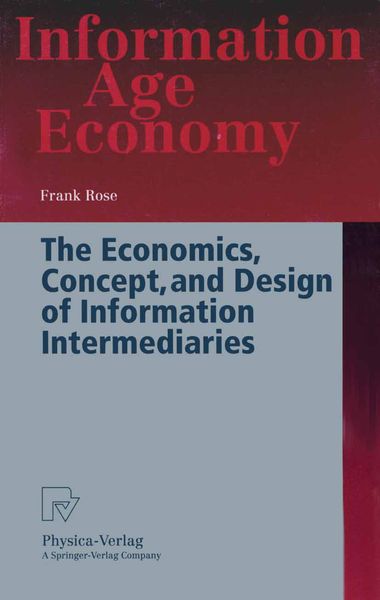
  • Produktbild: The Economics, Concept, and Design of Information Intermediaries
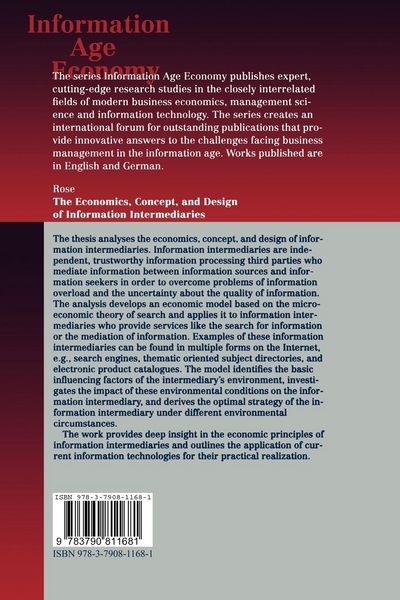
  • Produktbild: The Economics, Concept, and Design of Information Intermediaries
- 12%

The Economics, Concept, and Design of Information Intermediaries A Theoretic Approach

Aus der Reihe Information Age Economy
12% sparen

93,99 € UVP 106,99 €

inkl. gesetzl. MwSt., Versandkostenfrei


Beschreibung

The Internet provides an infrastructure that makes the steadily increasing amount of information accessible efficiently, quickly, and inexpensively. Closely connec ted with this opportunity is the danger that the available information will over charge the individual information seeker's capability to...

Beschreibung

The Internet provides an infrastructure that makes the steadily increasing amount of information accessible efficiently, quickly, and inexpensively. Closely connec ted with this opportunity is the danger that the available information will over charge the individual information seeker's capability to process the information and to judge its quality. In this situation, information intermediaries can take upon the role of an expert and a guarantor of quality similar to intermediaries in markets for physical goods or finances. Thus, information intermediaries can be a trust worthy, information processing third party, mediating between information seekers and information sources. The current technological development has created information technologies that are capable to efficiently process large amounts of information. However, the pro vision of intermediation services necessitates a thorough examination of the basic principles underlying the economics of information intermediaries as well as a sound foundation on information technologies. The present work by Frank Rose addresses the fundamental question concerning the economics of information intermediaries by means of an abstract model. The model focuses on services that concentrate on the search and mediation of information, and identifies the essential influencing factors of the intermediary's environment. The model is then employed to investigate the impact of environmental conditions on the information intermediary on the one hand, and the optimal strategy of the information intermediary as a reaction to environmental conditions on the other hand.

Produktdetails

Einband

Taschenbuch

Erscheinungsdatum

18.11.1998

Abbildungen

XVI, 266 p.

Verlag Physica

Produktdetails

Einband

Taschenbuch

Erscheinungsdatum

18.11.1998

Abbildungen

XVI, 266 p.

Verlag Physica
Seitenzahl

266

Maße (L/B/H)

23,5/15,5/1,6 cm

Gewicht

435 g

Auflage

Softcover reprint of the original 1st ed. 1999

Sprache

Englisch

ISBN

978-3-7908-1168-1

Herstelleradresse

Physica Verlag
Tiergartenstr. 17
69121 Heidelberg
DE

Email: ProductSafety@springernature.com

Ein neues Kapitel für Ihre Bücher

Ein neues Kapitel für Ihre Bücher

Schenken Sie Ihren alten Schätzen ein zweites Leben und erhalten Sie dafür eine Thalia Geschenkkarte.

Jetzt verkaufen
Jetzt verkaufen

Noch keine Bewertungen vorhanden

Verfassen Sie die erste Bewertung zu diesem Artikel

Helfen Sie anderen Kundinnen und Kunden durch Ihre Meinung.

Kundinnen und Kunden meinen

Bewertungen (0)

  • Produktbild: The Economics, Concept, and Design of Information Intermediaries
  • Produktbild: The Economics, Concept, and Design of Information Intermediaries
  • 1 Introduction.- 1.1 Information overload.- 1.2 The aim and procedure of the analysis.- 1.3 The organization of this thesis.- 2 Information.- 2.1 Basic aspects of information.- 2.2 Sources of information.- 2.3 The credibility of information and trust in the information source.- 2.4 Information and market efficiency.- 2.5 Information as an economic commodity.- 3 Intermediation.- 3.1 Basic concepts and functions of intermediaries.- 3.2 Justification of intermediaries.- 3.3 Intermediary contracts and sources of income.- 3.4 Effects of intermediation on markets.- 3.5 Market microstructure.- 4 An economic model of information intermediaries.- 4.1 Introduction.- 4.2 The economic theory of search.- 4.3 Model of an information intermediary.- 4.4 The influence of environmental conditions on the intermediary’s strategy.- 4.5 Competition between information intermediaries.- 4.6 Welfare effects through the information intermediary.- 4.7 Extensions to the basic intermediary model.- 4.8 Summary.- 5 Concepts and design of information intermediaries.- 5.1 Information intermediaries.- 5.2 Network-based intermediaries.- 5.3 Network-based information intermediaries.- 5.4 Summary: economic aspects of network-based information intermediaries.- 6 Conclusion.- 6.1 Summary.- 6.2 Outlook: the future of network-based intermediaries?.- 7 References.- 8 Appendix.- 8.1 Appendix A: development of the number of Internet hosts.- 8.2 Appendix B: simplification of (eq. 9) using integration by parts.- 8.3 Appendix C: transformation of (eq. 12) into (eq. 13).- 8.4 Appendix D: proof of the indifference property.- 8.5 Appendix E: number of solutions of the system of equations in the broker model.- 8.6 Appendix F: partial derivatives of intermediary’s profit.- 8.7 Appendix G: list of examples and URLs.-List of figures.- List of tables.- List of used symbols.- List of abbreviations.