















































KI-Beratung Beta

Gutscheinbedingungen

Gültig bis 30.11.2026 | Gültig für nicht preisgebundene fremdsprachige Bücher | Einzelne Artikel können ausgeschlossen sein | Online auf thalia.de und in der Thalia App einlösbar | Click & Collect nur mit Online-Zahlung (Paypal/Kreditkarte) vorab | Nicht kombinierbar mit anderen Gutscheinen oder Preisaktionen | Nur einmal pro Einkauf einlösbar | Gutschein wird auf max. 500€ Bestellwert angerechnet | Keine Barauszahlung | Nicht gültig für Versandkosten und Services

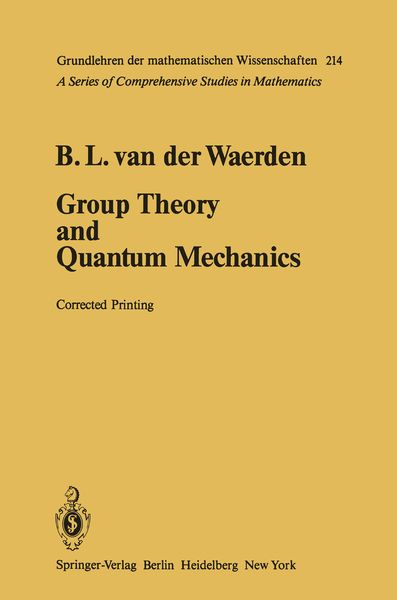
Produktbild: Group Theory and Quantum Mechanics
Band 214

Group Theory and Quantum Mechanics

49,99 €

inkl. gesetzl. MwSt., Versandkostenfrei


Beschreibung

The German edition of this book appeared in 1932 under the title "Die gruppentheoretische Methode in der Quantenmechanik". Its aim was, to explain the fundamental notions of the Theory of Groups and their Representations, and the application of this theory to the Quantum Mechanics of Atoms and Molecules....

Beschreibung

The German edition of this book appeared in 1932 under the title "Die gruppentheoretische Methode in der Quantenmechanik". Its aim was, to explain the fundamental notions of the Theory of Groups and their Representations, and the application of this theory to the Quantum Mechanics of Atoms and Molecules. The book was mainly written for the benefit of physicists who were supposed to be familiar with Quantum Mechanics. However, it turned out that it was also used by. mathematicians who wanted to learn Quantum Mechanics from it. Naturally, the physical parts were too difficult for mathematicians, whereas the mathematical parts were sometimes too difficult for physicists. The German language created an additional difficulty for many readers. In order to make the book more readable for physicists and mathe maticians alike, I have rewritten the whole volume. The changes are most notable in Chapters 1 and 6. In Chapter t, I have tried to give a mathematically rigorous exposition of the principles of Quantum Mechanics. This was possible because recent investigations in the theory of self-adjoint linear operators have made the mathematical foundation of Quantum Mechanics much clearer than it was in t 932. Chapter 6, on Molecule Spectra, was too much condensed in the German edition. I hope it is now easier to understand. In Chapter 2-5 too, numerous changes were made in order to make the book more readable and more useful.

Produktdetails

Einband

Taschenbuch

Erscheinungsdatum

11.11.2011

Abbildungen

VIII, 211 p.

Verlag Springer Berlin

Produktdetails

Einband

Taschenbuch

Erscheinungsdatum

11.11.2011

Abbildungen

VIII, 211 p.

Verlag Springer Berlin
Seitenzahl

211

Maße (L/B/H)

23,5/15,5/1,3 cm

Gewicht

347 g

Sprache

Englisch

ISBN

978-3-642-65862-4

Herstelleradresse

Springer-Verlag KG
Sachsenplatz 4-6
1201 Wien
AT

Email: ProductSafety@springernature.com

Ein neues Kapitel für Ihre Bücher

Ein neues Kapitel für Ihre Bücher

Schenken Sie Ihren alten Schätzen ein zweites Leben und erhalten Sie dafür eine Thalia Geschenkkarte.

Jetzt verkaufen
Jetzt verkaufen

Noch keine Bewertungen vorhanden

Verfassen Sie die erste Bewertung zu diesem Artikel

Helfen Sie anderen Kundinnen und Kunden durch Ihre Meinung.

Kundinnen und Kunden meinen

Bewertungen (0)

  • Produktbild: Group Theory and Quantum Mechanics
  • 1. Fundamental Notions of Quantum Mechanics.- § 1. Wave Functions.- § 2. Hilbert Spaces.- § 3. Linear Operators.- § 4. Hypermaximal Operators.- § 5. Separation of Variables.- § 6. One Electron in a Central Field.- § 7. Perturbation Theory.- § 8. Angular Momentum and Infinitesimal Rotations.- 2. Groups and Their Representations.- § 9. Linear Transformations.- § 10. Groups.- § 11. Equivalence and Reducibility of Representations.- § 12. Representations of Abelian Groups. Examples.- § 13. Uniqueness Theorems.- § 14. Kronecker’s Product Transformation.- § 15. The Operators Commuting with all Operators of a Given Representation.- § 16. Representations of Finite Groups.- § 17. Group Characters.- 3. Translations, Rotations and Lorentz Transformations.- § 18. Lie Groups and their Infinitesimal Transformations.- § 19. The Unitary Groups SU(2) and the Rotation Group O3.- § 20. Representations of the Rotation Group O3.- § 21. Examples and Applications.- § 22. Selection and Intensity Rules.- § 23. The Representations of the Lorentz Group.- IV. The Spinning Electron.- § 24. The Spin.- § 25. The Wave Function of the Spinning Electron.- § 26. Dirac’s Wave Equation.- § 27. Two-Component Spinors.- § 28. The Several Electron Problem. Multiplet Structure. Zeeman Effect.- V. The Group of Permutations and the Exclusion Principle.- § 29. The Resonance of Equal Particles.- § 30. The Exclusion Principle and the Periodical System.- § 31. The Eigenfunctions of the Atom.- § 32. The Calculation of the Energy Values.- § 33. Pure Spin Functions and their Transformation under Rotations and Permutations.- § 34. Representations of the Symmetric Group Sn.- VI. Molecule Spectra.- § 35. The Quantum Numbers of the Molecule.- § 36. The Rotation Levels.- § 37. The Caseof Two Equal Nuclei.- Author and Subject Index.