















































KI-Beratung Beta

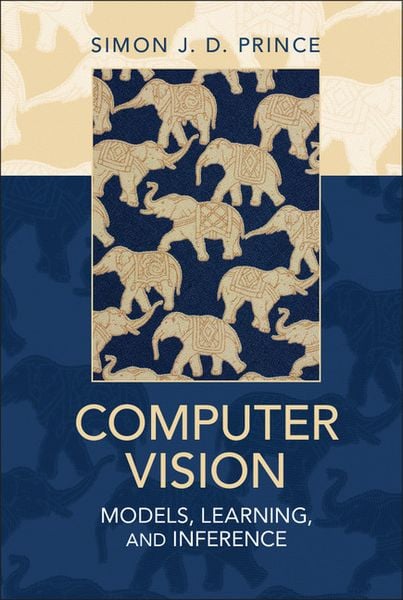
  • Produktbild: Computer Vision
  • Produktbild: Computer Vision

Computer Vision

163,99 €

inkl. gesetzl. MwSt., Versandkostenfrei


Beschreibung

Produktdetails

Einband

Gebundene Ausgabe

Erscheinungsdatum

22.03.2019

Abbildungen

357 colour illus. 5 tables 201 exercises

Verlag

Cambridge University Press

Seitenzahl

600

Maße (L/B/H)

26/18,3/3,6 cm

Gewicht

1246 g

Sprache

Englisch

ISBN

978-1-107-01179-3

Beschreibung

Rezension

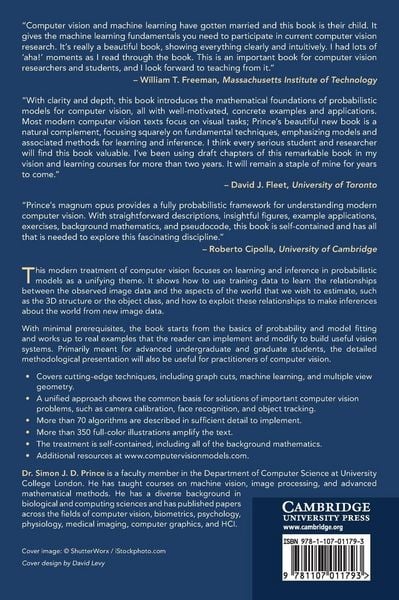
'Computer vision and machine learning have married and this book is their child. It gives the machine learning fundamentals you need to participate in current computer vision research. It's really a beautiful book, showing everything clearly and intuitively. I had lots of 'aha!' moments as I read through the book. This is an important book for computer vision researchers and students, and I look forward to teaching from it.' William T. Freeman, Massachusetts Institute of Technology

Produktdetails

Einband

Gebundene Ausgabe

Erscheinungsdatum

22.03.2019

Abbildungen

357 colour illus. 5 tables 201 exercises

Verlag

Cambridge University Press

Seitenzahl

600

Maße (L/B/H)

26/18,3/3,6 cm

Gewicht

1246 g

Sprache

Englisch

ISBN

978-1-107-01179-3

Herstelleradresse

Libri GmbH
Europaallee 1
36244 Bad Hersfeld
DE

Email: gpsr@libri.de

Ein neues Kapitel für Ihre Bücher

Ein neues Kapitel für Ihre Bücher

Schenken Sie Ihren alten Schätzen ein zweites Leben und erhalten Sie dafür eine Thalia Geschenkkarte.

Jetzt verkaufen
Jetzt verkaufen

Noch keine Bewertungen vorhanden

Verfassen Sie die erste Bewertung zu diesem Artikel

Helfen Sie anderen Kundinnen und Kunden durch Ihre Meinung.

Kundinnen und Kunden meinen

Bewertungen (0)

Die Leseprobe wird geladen.
  • Produktbild: Computer Vision
  • Produktbild: Computer Vision
  • Part I. Probability: 1. Introduction to probability; 2. Common probability distributions; 3. Fitting probability models; 4. The normal distribution; Part II. Machine Learning for Machine Vision: 5. Learning and inference in vision; 6. Modeling complex data densities; 7. Regression models; 8. Classification models; Part III. Connecting Local Models: 9. Graphical models; 10. Models for chains and trees; 11. Models for grids; Part IV. Preprocessing: 12. Image preprocessing and feature extraction; Part V. Models for Geometry: 13. The pinhole camera; 14. Models for transformations; 15. Multiple cameras; Part VI. Models for Vision: 16. Models for style and identity; 17. Temporal models; 18. Models for visual words; Part VII. Appendices: A. Optimization; B. Linear algebra; C. Algorithms.