
















































KI-Beratung Beta

Gutscheinbedingungen

Gültig bis 30.11.2026 | Gültig für nicht preisgebundene fremdsprachige Bücher | Einzelne Artikel können ausgeschlossen sein | Online auf thalia.de und in der Thalia App einlösbar | Click & Collect nur mit Online-Zahlung (Paypal/Kreditkarte) vorab | Nicht kombinierbar mit anderen Gutscheinen oder Preisaktionen | Nur einmal pro Einkauf einlösbar | Gutschein wird auf max. 500€ Bestellwert angerechnet | Keine Barauszahlung | Nicht gültig für Versandkosten und Services

  • Produktbild: Applied Functional Analysis
  • Produktbild: Applied Functional Analysis
Band 108

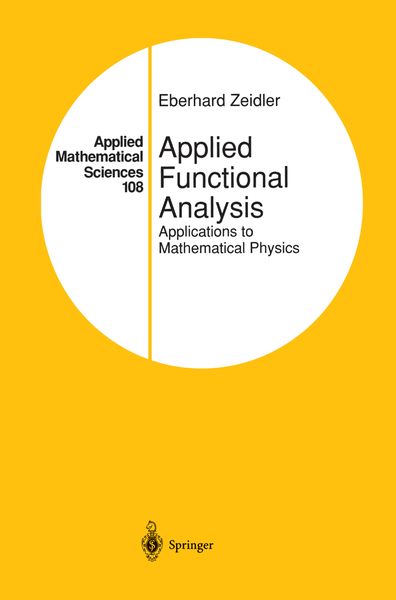
Applied Functional Analysis Applications to Mathematical Physics

117,99 €

inkl. gesetzl. MwSt., Versandkostenfrei


Beschreibung

A theory is the more impressive, the simpler are its premises, the more distinct are the things it connects, and the broader is its range of applicability. Albert Einstein There are two different ways of teaching mathematics, namely, (i) the systematic way, and (ii) the application-oriented way. More...

Beschreibung

A theory is the more impressive, the simpler are its premises, the more distinct are the things it connects, and the broader is its range of applicability. Albert Einstein There are two different ways of teaching mathematics, namely, (i) the systematic way, and (ii) the application-oriented way. More precisely, by (i), I mean a systematic presentation of the material governed by the desire for mathematical perfection and completeness of the results. In contrast to (i), approach (ii) starts out from the question "What are the most important applications?" and then tries to answer this question as quickly as possible. Here, one walks directly on the main road and does not wander into all the nice and interesting side roads. The present book is based on the second approach. It is addressed to undergraduate and beginning graduate students of mathematics, physics, and engineering who want to learn how functional analysis elegantly solves mathematical problems that are related to our real world and that have played an important role in the history of mathematics. The reader should sense that the theory is being developed, not simply for its own sake, but for the effective solution of concrete problems. viii Preface This introduction to functional analysis is divided into the following two parts: Part I: Applications to mathematical physics (the present AMS Vol. 108); Part II: Main principles and their applications (AMS Vol. 109).

Produktdetails

Einband

Taschenbuch

Erscheinungsdatum

06.10.2012

Abbildungen

XXIX, 481 p.

Verlag Springer Us

Produktdetails

Einband

Taschenbuch

Erscheinungsdatum

06.10.2012

Abbildungen

XXIX, 481 p.

Verlag Springer Us
Seitenzahl

481

Maße (L/B/H)

23,5/15,5/2,8 cm

Gewicht

774 g

Auflage

Softcover reprint of the original 1st ed. 1995

Sprache

Englisch

ISBN

978-1-4612-6910-6

Herstelleradresse

Springer-Verlag KG
Sachsenplatz 4-6
1201 Wien
AT

Email: ProductSafety@springernature.com

Ein neues Kapitel für Ihre Bücher

Ein neues Kapitel für Ihre Bücher

Schenken Sie Ihren alten Schätzen ein zweites Leben und erhalten Sie dafür eine Thalia Geschenkkarte.

Jetzt verkaufen
Jetzt verkaufen

Noch keine Bewertungen vorhanden

Verfassen Sie die erste Bewertung zu diesem Artikel

Helfen Sie anderen Kundinnen und Kunden durch Ihre Meinung.

Kundinnen und Kunden meinen

Bewertungen (0)

  • Produktbild: Applied Functional Analysis
  • Produktbild: Applied Functional Analysis
  • 1 Banach Spaces and Fixed-Point Theorems.- 1.1 Linear Spaces and Dimension.- 1.2 Normed Spaces and Convergence.- 1.3 Banach Spaces and the Cauchy Convergence Criterion.- 1.4 Open and Closed Sets.- 1.5 Operators.- 1.6 The Banach Fixed-Point Theorem and the Iteration Method.- 1.7 Applications to Integral Equations.- 1.8 Applications to Ordinary Differential Equations.- 1.9 Continuity.- 1.10 Convexity.- 1.11 Compactness.- 1.12 Finite-Dimensional Banach Spaces and Equivalent Norms.- 1.13 The Minkowski Functional and Homeomorphisms.- 1.14 The Brouwer Fixed-Point Theorem.- 1.15 The Schauder Fixed-Point Theorem.- 1.16 Applications to Integral Equations.- 1.17 Applications to Ordinary Differential Equations.- 1.18 The Leray-Schauder Principle and a priori Estimates.- 1.19 Sub- and Supersolutions, and the Iteration Method in Ordered Banach Spaces.- 1.20 Linear Operators.- 1.21 The Dual Space.- 1.22 Infinite Series in Normed Spaces.- 1.23 Banach Algebras and Operator Functions.- 1.24 Applications to Linear Differential Equations in Banach Spaces.- 1.25 Applications to the Spectrum.- 1.26 Density and Approximation.- 1.27 Summary of Important Notions.- 2 Hilbert Spaces, Orthogonality, and the Dirichlet Principle.- 2.1 Hilbert Spaces.- 2.2 Standard Examples.- 2.3 Bilinear Forms.- 2.4 The Main Theorem on Quadratic Variational Problems.- 2.5 The Functional Analytic Justification of the Dirichlet Principle.- 2.6 The Convergence of the Ritz Method for Quadratic Variational Problems.- 2.7 Applications to Boundary-Value Problems, the Method of Finite Elements, and Elasticity.- 2.8 Generalized Functions and Linear Functionals.- 2.9 Orthogonal Projection.- 2.10 Linear Functionals and the Riesz Theorem.- 2.11 The Duality Map.- 2.12 Duality for Quadratic Variational Problems.- 2.13 The Linear Orthogonality Principle.- 2.14 Nonlinear Monotone Operators.- 2.15 Applications to the Nonlinear Lax-Milgram Theorem and the Nonlinear Orthogonality Principle.- 3 Hilbert Spaces and Generalized Fourier Series.- 3.1 Orthonormal Series.- 3.2 Applications to Classical Fourier Series.- 3.3 The Schmidt Orthogonalization Method.- 3.4 Applications to Polynomials.- 3.5 Unitary Operators.- 3.6 The Extension Principle.- 3.7 Applications to the Fourier Transformation.- 3.8 The Fourier Transform of Tempered Generalized Functions.- 4 Eigenvalue Problems for Linear Compact Symmetric Operators.- 4.1 Symmetric Operators.- 4.2 The Hilbert-Schmidt Theory.- 4.3 The Fredholm Alternative.- 4.4 Applications to Integral Equations.- 4.5 Applications to Boundary-Eigenvalue Value Problems.- 5 Self-Adjoint Operators, the Friedrichs Extension and the Partial Differential Equations of Mathematical Physics.- 5.1 Extensions and Embeddings.- 5.2 Self-Adjoint Operators.- 5.3 The Energetic Space.- 5.4 The Energetic Extension.- 5.5 The Friedrichs Extension of Symmetric Operators.- 5.6 Applications to Boundary-Eigenvalue Problems for the Laplace Equation.- 5.7 The Poincaré Inequality and Rellich’s Compactness Theorem.- 5.8 Functions of Self-Adjoint Operators.- 5.9 Semigroups, One-Parameter Groups, and Their Physical Relevance.- 5.10 Applications to the Heat Equation.- 5.11 Applications to the Wave Equation.- 5.12 Applications to the Vibrating String and the Fourier Method.- 5.13 Applications to the Schrödinger Equation.- 5.14 Applications to Quantum Mechanics.- 5.15 Generalized Eigenfunctions.- 5.16 Trace Class Operators.- 5.17 Applications to Quantum Statistics.- 5.18 C*-Algebras and the Algebraic Approach to Quantum Statistics.- 5.19 The Fock Space in Quantum Field Theory and the Pauli Principle.- 5.20 A Look at Scattering Theory.- 5.21 The Language of Physicists in Quantum Physics and the Justification of the Dirac Calculus.- 5.22 The Euclidean Strategy in Quantum Physics.- 5.23 Applications to Feynman’s Path Integral.- 5.24 The Importance of the Propagator in Quantum Physics.- 5.25 A Look at Solitons and Inverse Scattering Theory.- Epilogue.- References.- Hints for Further Reading.- List of Symbols.- List of Theorems.- List of the Most Important Definitions.