















































KI-Beratung Beta

Gutscheinbedingungen

Gültig bis 30.11.2026 | Gültig für nicht preisgebundene fremdsprachige Bücher | Einzelne Artikel können ausgeschlossen sein | Online auf thalia.de und in der Thalia App einlösbar | Click & Collect nur mit Online-Zahlung (Paypal/Kreditkarte) vorab | Nicht kombinierbar mit anderen Gutscheinen oder Preisaktionen | Nur einmal pro Einkauf einlösbar | Gutschein wird auf max. 500€ Bestellwert angerechnet | Keine Barauszahlung | Nicht gültig für Versandkosten und Services

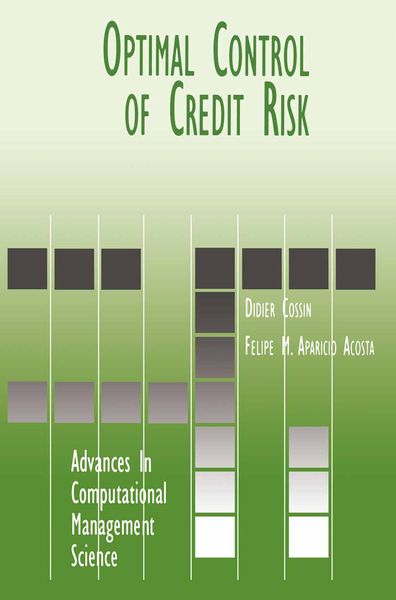
  • Produktbild: Optimal Control of Credit Risk
  • Produktbild: Optimal Control of Credit Risk
Band 3

Optimal Control of Credit Risk

97,99 €

inkl. gesetzl. MwSt., Versandkostenfrei


Beschreibung

Optimal Control of Credit Risk presents an alternative methodology to deal with a financial problem that has not been well analyzed yet: the control of credit risk. Credit risk has become recently the center of interest of the financial community, with new instruments (such as Credit Risk Derivatives)...

Beschreibung

Optimal Control of Credit Risk
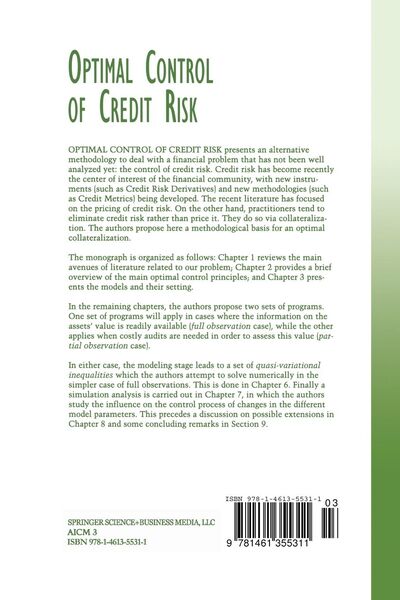
presents an alternative methodology to deal with a financial problem that has not been well analyzed yet: the control of credit risk. Credit risk has become recently the center of interest of the financial community, with new instruments (such as Credit Risk Derivatives) and new methodologies (such as Credit Metrics) being developed. The recent literature has focused on the pricing of credit risk. On the other hand, practitioners tend to eliminate credit risk rather than price it. They do so via collateralization. The authors propose here a methodological basis for an optimal collateralization.
The monograph is organized as follows: Chapter 1 reviews the main avenues of literature related to our problem; Chapter 2 provides a brief overview of the main optimal control principles; and Chapter 3 presents the models and their setting.
In the remaining chapters, the authors propose two sets of programs. One set of programs will apply in cases where the information on the assets=value is readily available (
full observation
case), while the other applies when costly audits are needed in order to assess this value (
partial observation
case).
In either case, the modeling stage leads to a set of
quasi-variational
inequalities
which the authors attempt to solve numerically in the simpler case of full observations. This is done in Chapter 6. Finally a simulation analysis is carried out in Chapter 7, in which the authors study the influence on the control process of changes in the different model parameters. This precedes a discussion on possible extensions in Chapter 8 and some concluding remarks in Section 9.

Produktdetails

Einband

Taschenbuch

Erscheinungsdatum

31.10.2012

Abbildungen

VII, 102 p.

Verlag Springer Us

Produktdetails

Einband

Taschenbuch

Erscheinungsdatum

31.10.2012

Abbildungen

VII, 102 p.

Verlag Springer Us
Seitenzahl

102

Maße (L/B/H)

23,5/15,5/0,7 cm

Gewicht

189 g

Auflage

Softcover reprint of the original 1st edition 2001

Sprache

Englisch

ISBN

978-1-4613-5531-1

Herstelleradresse

Springer-Verlag KG
Sachsenplatz 4-6
1201 Wien
AT

Email: ProductSafety@springernature.com

Ein neues Kapitel für Ihre Bücher

Ein neues Kapitel für Ihre Bücher

Schenken Sie Ihren alten Schätzen ein zweites Leben und erhalten Sie dafür eine Thalia Geschenkkarte.

Jetzt verkaufen
Jetzt verkaufen

Noch keine Bewertungen vorhanden

Verfassen Sie die erste Bewertung zu diesem Artikel

Helfen Sie anderen Kundinnen und Kunden durch Ihre Meinung.

Kundinnen und Kunden meinen

Bewertungen (0)

  • Produktbild: Optimal Control of Credit Risk
  • Produktbild: Optimal Control of Credit Risk
  • 1. Introduction.- 2. Literature Review.- 1. Guarantee valuation.- 2. Deposit insurance valuation.- 3. Control of guarantees.- 4. Other applications.- 3. Elements of Optimal Control.- 1. Optimal deterministic control.- 2. Optimal stochastic control.- 3. Stochastic impulse control.- 4. The Model.- 1. The underlying process behavior.- 2. Cost of credit risk.- 3. Cost of information.- 4. Forms of control.- 5. Solution Approaches.- 5. Full-Observation Case.- 1. The decision process.- 2. “Single jump” operator approach.- 3. QVI approach.- 6. Partial Observation Case.- 1. The decision process.- 2. QVI approach.- 7. Numerical Approaches.- 8. Simulation Experiments.- 1. Changes in parameters.- 2. Changes in the cost function.- 10. Appendix: Practical Cases.- 1. Guarantees in a private setting.- 2. Guarantees in a public setting.