















































KI-Beratung Beta

  • Produktbild: The Many Faces of the Sun
  • Produktbild: The Many Faces of the Sun
  • Produktbild: The Many Faces of the Sun

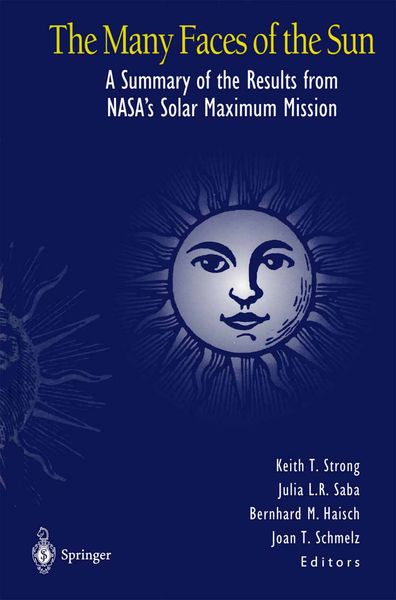
The Many Faces of the Sun A Summary of the Results from NASA’s Solar Maximum Mission

48,99 €

inkl. gesetzl. MwSt., Versandkostenfrei


Beschreibung

Produktdetails

Einband

Taschenbuch

Erscheinungsdatum

23.10.2012

Abbildungen

XXIV, 610 p.

Herausgeber

Keith T. Strong + weitere

Verlag

Springer Us

Seitenzahl

610

Maße (L/B/H)

23,5/15,5/3,5 cm

Gewicht

955 g

Auflage

Softcover reprint of the original 1st ed. 1999

Sprache

Englisch

ISBN

978-1-4612-7145-1

Beschreibung

Produktdetails

Einband

Taschenbuch

Erscheinungsdatum

23.10.2012

Abbildungen

XXIV, 610 p.

Herausgeber

Verlag

Springer Us

Seitenzahl

610

Maße (L/B/H)

23,5/15,5/3,5 cm

Gewicht

955 g

Auflage

Softcover reprint of the original 1st ed. 1999

Sprache

Englisch

ISBN

978-1-4612-7145-1

Herstelleradresse

Springer-Verlag KG
Sachsenplatz 4-6
1201 Wien
AT

Email: ProductSafety@springernature.com

Ein neues Kapitel für Ihre Bücher

Ein neues Kapitel für Ihre Bücher

Schenken Sie Ihren alten Schätzen ein zweites Leben und erhalten Sie dafür eine Thalia Geschenkkarte.

Jetzt verkaufen
Jetzt verkaufen

Noch keine Bewertungen vorhanden

Verfassen Sie die erste Bewertung zu diesem Artikel

Helfen Sie anderen Kundinnen und Kunden durch Ihre Meinung.

Kundinnen und Kunden meinen

Bewertungen (0)

  • Produktbild: The Many Faces of the Sun
  • Produktbild: The Many Faces of the Sun
  • Produktbild: The Many Faces of the Sun
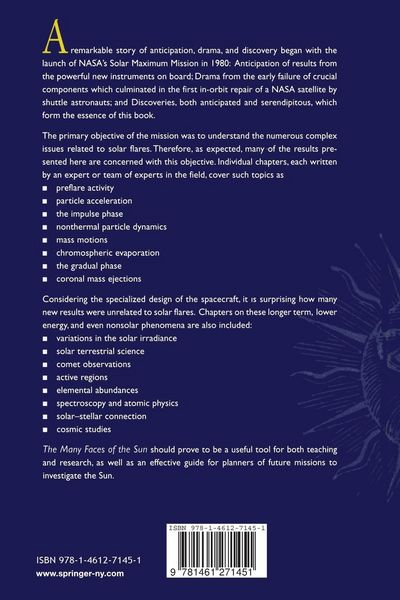
  • 1. The Solar Maximum Mission.- 1.1 The Origins of the Mission.- 1.2 Scientific Objectives of the Mission.- 1.3 The SMM Instrument Package.- 1.4 Scientific Discoveries.- 1.5 Concluding Remarks.- 2. Solar Irradiance Variations.- 2.1 Development of Solar Irradiance Monitors.- 2.2 Models of the Solar-Cycle TSI Variation.- 2.3 ACRIM I and Succeeding Observations.- 2.4 The Long-Term Climate TSI Data Base.- 3. Active Regions.- 3.1 Magnetic Field Strength and Structure.- 3.2 Dynamics and Heating of the Solar Corona.- 3.3 Transition Region Brightenings: UV Microflares.- 3.4 Sunspots.- 3.5 Prominences and Filaments.- 4. Coronal Abundances.- 4.1 Flare X-Ray Measurements from BCS.- 4.2 FCS Abundances.- 4.3 Determination of Solar Abundances by Solar Flare ?-Ray Spectrometry.- 4.4 Solar Energetic Particles.- 4.5 Theory of Abundance Fractionation.- 5. Coronal Mass Ejections.- 5.1 Nature and Structure of Coronal Mass Ejections.- 5.2 The Propagation of Mass Ejections Through the Corona.- 5.3 The Origin of Coronal Mass Ejections.- 5.4 Summary.- 6. Preflare Activity.- 6.1 General Activity in Active Regions.- 6.2 Precursors to Major Flares.- 6.3 Chromospheric Evaporation.- 6.4 The Onset of Coronal Mass Ejections.- 6.5 Surges.- 6.6 Conclusions.- 7. Particle Acceleration in Flares.- 7.1 The “Pre-SMM” Paradigm.- 7.2 High-Energy Flare Observations.- 7.3 Mechanisms for Particle Acceleration.- 7.4 Summary.- 8. Nonthermal Flare Emissions.- 8.1 Statistical Aspects of Hard X-Ray Flares.- 8.2 Particle Acceleration and Injection.- 8.3 Particle Trapping and Precipitation.- 8.4 Flare Diagnostics from Hard X-Ray/Radio Observations.- 9. Chromospheric Evaporation Theory.- 9.1 Pre-SMM Results.- 9.2 Early SMM Results.- 9.3 Later SMM Results.- 9.4 Future Developments.- 9.5 Conclusions.- 10. FlareDynamics.- 10.1 Results from Soft X-Ray Spectra.- 10.2 Chromospheric Evaporation.- 10.3 Nature of Nonthermal Line Broadenings.- 10.4 Concluding Remarks.- 11. Ultraviolet Flare Studies.- 11.1 UV Flare Plasma Diagnostics.- 11.2 UV and Hard X-Ray Bursts.- 11.3 Flare Topology: Interacting Loops.- 11.4 Discussion.- 12. The Gradual Phase of Flares.- 12.1 Heating and Cooling in the Gradual Phase.- 12.2 Emission Measure-Temperature Diagrams.- 12.3 Flaring Arches.- 12.4 Gradual Phase of Eruptive Flares.- 12.5 Postflare Giant Arches.- 12.6 Giant Arches: Modeling and Interpretation.- 13. Spectroscopy and Atomic Physics.- 13.1 Theory of Line Intensities.- 13.2 Density-Sensitive Line Ratios.- 13.3 Temperature-Sensitive Line Ratios.- 13.4 Element Abundances.- 13.5 Photospheric X-Ray Lines.- 13.6 Checking and Correcting Atomic Data.- 13.7 Summary and Future Directions.- 14. Solar-Terrestrial and Terrestrial Science.- 14.1 SMM’s Impact on Solar-Terrestrial Studies.- 14.2 ?-Rays from the Earth.- 14.3 Transient Radiation Belts from Orbiting Nuclear Reactors.- 14.4 Mesospheric Chemistry Studies with UVSP.- 15. Solar-Stellar Connection.- 15.1 Stellar Coronae and Acoustic Heating.- 15.2 The Dividing Line.- 15.3 The Rotation-Activity Relation: Calibrating the Dynamo.- 15.4 Age versus Activity: The Evolution of the Sun.- 15.5 Stellar Activity Cycles.- 15.6 Mapping Stellar Surfaces.- 15.7 Flares on Other Stars.- 15.8 What is the Range of Stellar Power Ratios?.- 15.9 Conclusion.- 16. Comet Observations.- 16.1 Comet Halley and Comet Machholz.- 16.2 Comet Machholz (1988 XV).- 16.3 Kreutz Family of Sungrazing Comets.- 16.4 Summary.- 17. Cosmic Studies.- 17.1 Hard X-Ray Sources.- 17.2 ?-Ray Bursts.- 17.3 ?-Ray Observations of Recent Supernovae.- 17.4 ?-Ray Observations of Recent Novae.- 17.5Searches for ?-Ray Transients.- 17.6 Galactic Observations.- 17.7 Summary of ?-Ray Line Observations.- References.- Acronyms.- Acknowledgment of Copyright.