















































KI-Beratung Beta

Gutscheinbedingungen

Gültig bis 30.11.2026 | Gültig für nicht preisgebundene fremdsprachige Bücher | Einzelne Artikel können ausgeschlossen sein | Online auf thalia.de und in der Thalia App einlösbar | Click & Collect nur mit Online-Zahlung (Paypal/Kreditkarte) vorab | Nicht kombinierbar mit anderen Gutscheinen oder Preisaktionen | Nur einmal pro Einkauf einlösbar | Gutschein wird auf max. 500€ Bestellwert angerechnet | Keine Barauszahlung | Nicht gültig für Versandkosten und Services

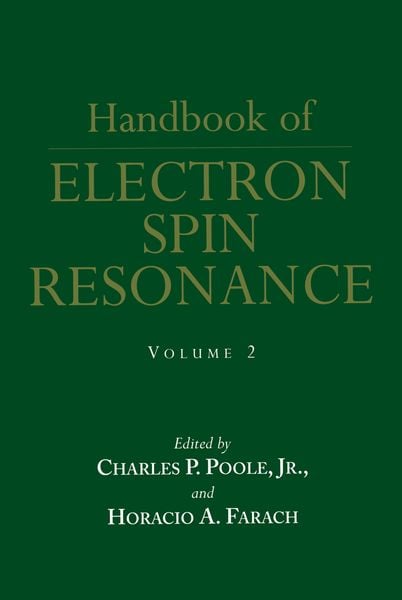
  • Produktbild: Handbook of Electron Spin Resonance
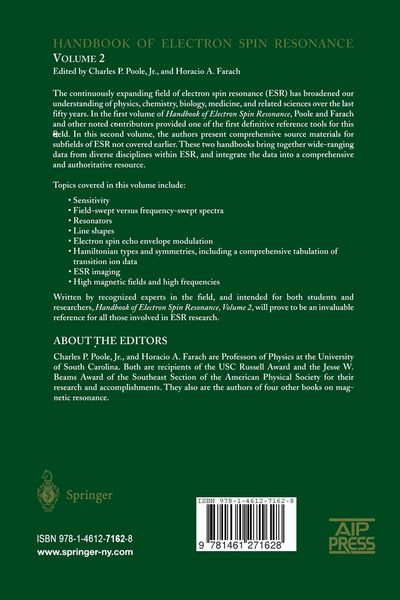
  • Produktbild: Handbook of Electron Spin Resonance
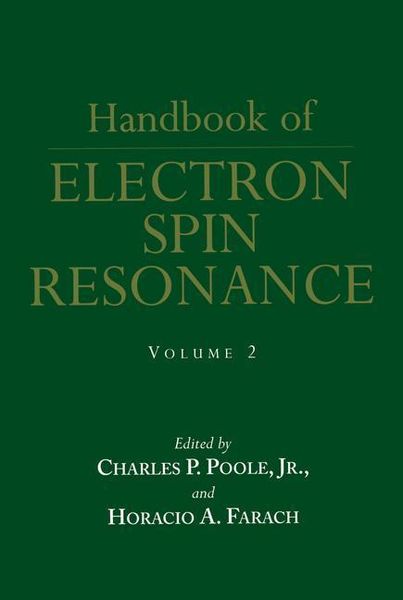
  • Produktbild: Handbook of Electron Spin Resonance
- 12%

Handbook of Electron Spin Resonance Volume 2

12% sparen

187,99 € UVP 213,99 €

inkl. gesetzl. MwSt., Versandkostenfrei


Beschreibung

The continuously expanding field of electron spin resonance (ESR) has broadened our understanding of physics, chemistry, biology, medicine and related sciences over the last fifty years. In the first volume Professors Poole and Farach provided one of the first definitive reference tools for this field....

Beschreibung

The continuously expanding field of electron spin resonance (ESR) has broadened our understanding of physics, chemistry, biology, medicine and related sciences over the last fifty years. In the first volume Professors Poole and Farach provided one of the first definitive reference tools for this field. These handbooks bring together wide- ranging data from diverse disciplines within ESR and integrate the data into a comprehesive and definitive resource. In this second volume of the Handbook of Electron Spin Resonance, the authors present a comprehensive source subfields of ESR not covered in the first volume. Topics covered in this volume include: * Sensitivity * Field Swept versus Frequency Swept Spectra * Resonators * Line Shapes * Electron Spin Echo Envelope Modulation * Hamiltonian types and symmetries, including a comprehensive tabulation of transition ion data * ESR Imaging * High Magnetic Fields and High Frequencies Written by recognized experts in the field, and intended for students and researchers, the Handbook of Electron Spin Resonance will prove to be an invaluable reference for all those involved in ESR research.

Produktdetails

Einband

Taschenbuch

Erscheinungsdatum

17.10.2012

Abbildungen

XI, 375 p.

Herausgeber Charles P. Jr. Poole + weitere

Produktdetails

Einband

Taschenbuch

Erscheinungsdatum

17.10.2012

Abbildungen

XI, 375 p.

Herausgeber
Verlag Springer Us
Seitenzahl

375

Maße (L/B/H)

23,5/15,5/2,2 cm

Gewicht

593 g

Auflage

Softcover reprint of the original 1st ed. 1999

Sprache

Englisch

ISBN

978-1-4612-7162-8

Herstelleradresse

Springer-Verlag GmbH
Europaplatz 3
69115 Heidelberg
DE

Email: ProductSafety@springernature.com

Ein neues Kapitel für Ihre Bücher

Ein neues Kapitel für Ihre Bücher

Schenken Sie Ihren alten Schätzen ein zweites Leben und erhalten Sie dafür eine Thalia Geschenkkarte.

Jetzt verkaufen
Jetzt verkaufen

Noch keine Bewertungen vorhanden

Verfassen Sie die erste Bewertung zu diesem Artikel

Helfen Sie anderen Kundinnen und Kunden durch Ihre Meinung.

Kundinnen und Kunden meinen

Bewertungen (0)

  • Produktbild: Handbook of Electron Spin Resonance
  • Produktbild: Handbook of Electron Spin Resonance
  • Produktbild: Handbook of Electron Spin Resonance
  • I. Sensitivity.- A. Introduction.- B. Minimum Number of Detectable Spins.- C. Predicted Frequency Dependence of ESR Signal, Noise, and Signal-to-Noise Ratio.- D. Performance of Real Systems.- E. Definitions and Derivations.- Acknowledgments.- References.- II. Field-Swept Versus Frequency-Swept Spectra.- A. Introduction.- B. Lineshapes.- C. Applications.- D. Concluding Remarks.- References.- III. Resonators.- A. Introduction.- B. Waveguides and Cavities.- C. Coupling Structures.- D. Velocity and Impedance.- E. Rectangular Resonant Cavity.- F. Cylindrical Resonant Cavity.- G. Special Purpose Cavities.- H. Quality and Filling Factors.- References.- IV. Lineshapes.- A. Introduction.- B. Lorentzian and Gaussian Shapes.- C. Moments and Widths of Resonant Lines.- D. Overlapping Resonances.- E. Convolution Shape.- F. Anisotropicg-Factors.- G. Hyperfine Powder Patterns.- H. Small Spin Clusters.- I. Amorphous and Semirandom Distributions.- J. Conduction Electrons.- K. Exchange.- L. Saturation.- References.- V. Electron Spin Echo Envelope Modulation.- A. Introduction.- B. Qualitative Description of the ESEEM Experiment.- C. Comparison of ESEEM and ENDOR.- D. HYSCORE.- E. Outlook.- References.- VI. Transition Series Ions.- A. Introduction.- B. First-Transition Series (3dnIron Group) Ions.- C. Second-and Third-Transition Series (4dnPalladium and5dnPlatinum Group) Ions.- D. Rare-Earth (4f “) Ions.- E. Actinide(5fn)Ions.- F. S-State (3d54d55d54f7) Ions.- References.- VII. Transition Ion HamiltonianS.- A. Introduction.- B. Site Symmetries.- C. Spin Hamiltonians.- References.- Appendix I. Spin Operators and Their Matrix Elements.- Appendix II. Descent of Symmetry.- Appendix III. Site Symmetries of Host Crystals.- VIII. Transition Ion Data Tabulation.- Tabulations.- References.- IX.Evaluation of Spin-Hamiltonian Parameters from Epr Data of Single Crystals.- A. Introduction.- B. Perturbation Approach.- C. Brute-Force Methods.- D. Least-Squares Fitting (LSF) Method.- E. Other Applications of the LSF Method.- a. Spin Hamiltonian.- b. Eigenvalues.- c. Evaluation of SHP by the LSF Technique.- d. Numerical Evaluation of the Derivatives Required in the LSF Procedure.- e. General Remarks.- F. Discussion.- References.- X. Esr Imaging.- Tabulations.- Acknowledgments.- References.- XI. High Magnetic Fields and High Frequencies.- Tabulations.- Acknowledgments.- References.