















































KI-Beratung Beta

Gutscheinbedingungen

Gültig bis 30.11.2026 | Gültig für nicht preisgebundene fremdsprachige Bücher | Einzelne Artikel können ausgeschlossen sein | Online auf thalia.de und in der Thalia App einlösbar | Click & Collect nur mit Online-Zahlung (Paypal/Kreditkarte) vorab | Nicht kombinierbar mit anderen Gutscheinen oder Preisaktionen | Nur einmal pro Einkauf einlösbar | Gutschein wird auf max. 500€ Bestellwert angerechnet | Keine Barauszahlung | Nicht gültig für Versandkosten und Services

  • Produktbild: Use of Proxies in Paleoceanography
  • Produktbild: Use of Proxies in Paleoceanography

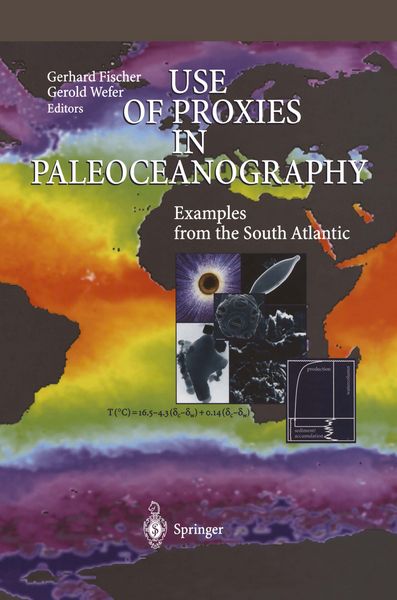
Use of Proxies in Paleoceanography Examples from the South Atlantic

325,99 €

inkl. gesetzl. MwSt., Versandkostenfrei


Beschreibung

Paleoceanographic proxies provide infonnation for reconstructions of the past, including climate changes, global and regional oceanography, and the cycles of biochemical components in the ocean. These prox ies are measurable descriptors for desired but unobservable environmental variables such as tempera...

Beschreibung

Paleoceanographic proxies provide infonnation for reconstructions of the past, including climate changes, global and regional oceanography, and the cycles of biochemical components in the ocean. These prox ies are measurable descriptors for desired but unobservable environmental variables such as tempera ture, salinity, primary productivity, nutrient content, or surface-water carbon dioxide concentrations. The proxies are employed in a manner analogous to oceanographic methods. The water masses are first characterized according to their specific physical and chemical properties, and then related to particular assemblages of certain organisms or to particular element or isotope distributions. We have a long-standing series of proven proxies available. Marine microfossil assemblages, for instance, are employed to reconstruct surface-water temperatures. The calcareous shells of planktonic and benthic microorgan isms contain a wealth of paleoceanographic information in their isotopic and elemental compositions. Stable oxygen isotope measurements are used to detennine ice volume, and MglCa ratios are related to water temperatures, to cite a few examples. Organic material may also provide valuable infonnation, e. g. , about past productivity conditions. Studying the stable carbon isotope composition of bulk organic matter or individual marine organic components may provide a measure of past surface-water CO 2 conditions within the bounds of certain assumptions. Within the scope of paleoceanographic investigations, the existing proxies are continuously evolving and improving, while new proxies are being studied and developed. The methodology is improved by analysis of samples from the water column and surface sediments, and through laboratory experiments.

Produktdetails

Einband

Taschenbuch

Erscheinungsdatum

23.10.2012

Abbildungen

X, 735 p. 339 illus., 20 illus. in color.

Herausgeber Gerhard Fischer + weitere

Produktdetails

Einband

Taschenbuch

Erscheinungsdatum

23.10.2012

Abbildungen

X, 735 p. 339 illus., 20 illus. in color.

Herausgeber
Verlag Springer Berlin
Seitenzahl

735

Maße (L/B/H)

23,5/15,5/4 cm

Gewicht

1112 g

Auflage

Softcover reprint of the original 1st edition 1999

Sprache

Englisch

ISBN

978-3-642-63681-3

Herstelleradresse

Springer-Verlag KG
Sachsenplatz 4-6
1201 Wien
AT

Email: ProductSafety@springernature.com

Ein neues Kapitel für Ihre Bücher

Ein neues Kapitel für Ihre Bücher

Schenken Sie Ihren alten Schätzen ein zweites Leben und erhalten Sie dafür eine Thalia Geschenkkarte.

Jetzt verkaufen
Jetzt verkaufen

Noch keine Bewertungen vorhanden

Verfassen Sie die erste Bewertung zu diesem Artikel

Helfen Sie anderen Kundinnen und Kunden durch Ihre Meinung.

Kundinnen und Kunden meinen

Bewertungen (0)

  • Produktbild: Use of Proxies in Paleoceanography
  • Produktbild: Use of Proxies in Paleoceanography
  • Clues to Ocean History: a Brief Overview of Proxies.- Surface Water Circulation.- Sea-Surface Temperature Estimations Using a Modern Analog Technique with Foraminiferal Assemblages from Western Atlantic Quaternary Sediments.- The Distribution of Living Planktic Foraminifera in Relation to Southeast Atlantic Oceanography.- Coccolithophores as Indicators of Ocean Water Masses, Surface-Water Temperature, and Paleoproductivity — Examples from the South Atlantic.- Calcareous Dinoflagellate Cysts as Paleo-Environmental Tools.- Oxygen Isotope Values of Planktic Foraminifera: A Tool for the Reconstruction of Surface Water Stratification.- Stable Isotopes of Pteropod Shells as Recorders of Sub-Surface Water Conditions: Comparison to the Record of G. ruber and to Measured Values.- On the Reconstruction of Paleosalinities.- Bottom- and Deep Water Circulation.- Stable Carbon Isotopes in Benthic Foraminifera: Proxies for Deep and Bottom Water Circulation and New Production.- Carbonate Dissolution in the Deep-Sea: Methods, Quantification and Paleoceanographic Application.- Kaolinite and Chlorite as Tracers of Modern and Late Quaternary Deep Water Circulation in the South Atlantic and the Adjoining Southern Ocean.- Paleoproductivity and Nutrients.- Organic Carbon and Carbonate as Paleoproductivity Proxies: Examples from High and Low Productivity Areas of the Tropical Atlantic.- Biogenic Barium as a Proxy for Paleoproductivity: Methods and Limitations of Application.- Variability in Export Production Documented by Downward Fluxes and Species Composition of Marine Planktic Diatoms: Observations from the Tropical and Equatorial Atlantic.- Reliability of the 231Pa/230 Th Activity Ratio as a Tracer for Bioproductivity of the Ocean.- Sediment Redistribution, 230Thex — Normalization andImplications for the Reconstruction of Particle Flux and Export Paleoproductivity.- The South Atlantic Carbon Isotope Record of Planktic Foraminifera.- Reconstruction of Surface Ocean Nitrate Utilization Using Stable Nitrogen Isotopes in Sinking Particles and Sediments.- CO2 in Oceans and Atmosphere.- Alkenone ?13C as a Proxy for Past PCO2 in Surface Waters: Results from the Late Quaternary Angola Current.- Reassessing Foraminiferal Stable Isotope Geochemistry: Impact of the Oceanic Carbonate System (Experimental Results).- Implications of a Carbonate Ion Effect on Shell Carbon and Oxygen Isotopes for Glacial Ocean Conditions.- Atmospherical Circulation.- Pollen and Spores in Marine Sediments from the East Atlantic — A View from the Ocean into the African Continent.- Terrestrial Organic Matter in Marine Sediments: Analytical Approaches and Eolian-Marine Records in the Central Equatorial Atlantic.- Environmental Magnetism.- The Magnetic View on the Marine Paleoenvironment: Parameters, Techniques, and Potentials of Rock Magnetic Studies as a Key to Paleoclimatic and Paleoceanographic Changes.- Using Rock Magnetic Proxy Records for Orbital Tuning and Extended Time Series Analyses into the Super- and Sub-Milankovitch Bands.- Geomagnetic Events and Relative Paleointensity Records — Clues to High-Resolution Paleomagnetic Chronostratigraphies of Late Quaternary Marine Sediments?.- Modelling.- Simulation of Oxygen Isotopes in a Global Ocean Model.- Reconstructing and Modelling the Last Glacial Maximum: Beyond CLIMAP.- Data Management.- Data Management of Proxy Parameters with PANGAEA.