















































KI-Beratung Beta

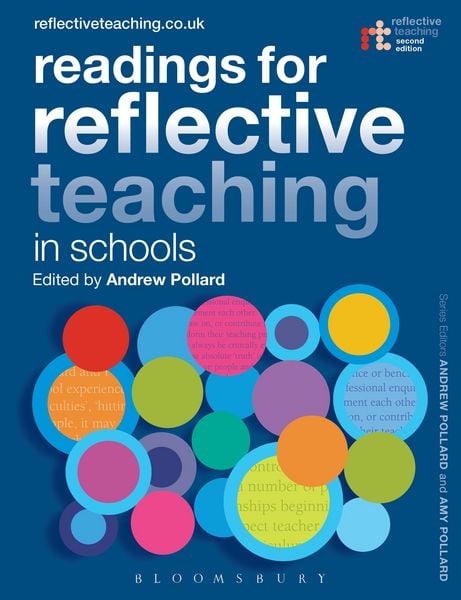
Produktbild: Readings for Reflective Teaching in Schools

Readings for Reflective Teaching in Schools

Aus der Reihe Reflective Teaching

42,99 €

inkl. gesetzl. MwSt., Versandkostenfrei


Beschreibung

Readings for Reflective Teaching in Schools provides a portable library of over a hundred readings to support teacher education and professional development. Extensively updated since earlier editions, the book concisely introduces both classic and contemporary research and understanding on teaching...

Beschreibung

Readings for Reflective Teaching in Schools provides a portable library of over a hundred readings to support teacher education and professional development. Extensively updated since earlier editions, the book concisely introduces both classic and contemporary research and understanding on teaching and learning. The selection reflects current issues and concerns in education and has been designed to support school-led teacher education as well as a wide range of school-university partnership arrangements. Uniquely, two types of reading are provided: - summaries enabling easy access to evidence on key classroom issues - including relationships, behaviour, curriculum planning, teaching strategies and assessment processes; - analyses of deeper forms of understanding about teaching and learning processes, to support the development of expertise throughout a teaching career. This collection of readings is edited by Andrew Pollard, former Director of the UK's Teaching and Learning Research Programme, with the advice of primary and secondary specialists from the University of Cambridge. Readings for Reflective Teaching in Schools is part of a fully integrated set of resources for primary and secondary education. Reflective Teaching in Schools focuses on how to achieve high-quality teaching and learning. By design, it offers both practical support for effective practice and routes towards deeper expertise. The website, reflectiveteaching.co.uk, offers supplementary resources including reflective activities, research briefings, advice on further reading and additional chapters. It also features a glossary, links to useful websites, and a conceptual framework for deepening expertise. This book is one of the Reflective Teaching Series - inspiring education through innovation in early years, schools, further, higher and adult education.

Produktdetails

Einband

Taschenbuch

Erscheinungsdatum

13.02.2014

Herausgeber Andrew Pollard
Verlag Bloomsbury Academic

Produktdetails

Einband

Taschenbuch

Erscheinungsdatum

13.02.2014

Herausgeber Andrew Pollard
Verlag Bloomsbury Academic
Seitenzahl

504

Maße (L/B/H)

24,6/18,7/3,2 cm

Gewicht

965 g

Auflage

2. Auflage

Sprache

Englisch

ISBN

978-1-4725-0974-1

Herstelleradresse

Libri GmbH
Europaallee 1
36244 Bad Hersfeld
DE

Email: gpsr@libri.de

Ein neues Kapitel für Ihre Bücher

Ein neues Kapitel für Ihre Bücher

Schenken Sie Ihren alten Schätzen ein zweites Leben und erhalten Sie dafür eine Thalia Geschenkkarte.

Jetzt verkaufen
Jetzt verkaufen

Noch keine Bewertungen vorhanden

Verfassen Sie die erste Bewertung zu diesem Artikel

Helfen Sie anderen Kundinnen und Kunden durch Ihre Meinung.

Kundinnen und Kunden meinen

Bewertungen (0)

Weitere Artikel finden Sie in

Die Leseprobe wird geladen.
  • Produktbild: Readings for Reflective Teaching in Schools
  • Introduction
    Part I: Becoming a Reflective Professional
    1. Identity. Who are we, and what do we stand for?
    2. Learning. How can we understand learner development?
    3. Reflection. How can we develop the quality of our teaching?
    4. Principles. What are the foundations of effective teaching and learning?
    Part II: Creating Conditions for Learning
    5. Contexts. What is, and what might be?
    6. Relationships. How are we getting on together?
    7. Engagement. How are we managing behaviour?
    8. Spaces. How are we creating environments for learning
    Part III: Teaching for Learning
    9. Curriculum. What is to be taught and learned?
    10. Planning. How are we implementing the curriculum?
    11. Pedagogy. How can we develop effective strategies?
    12. Communication. How does use of language support learning?
    13. Assessment. How can assessment enhance learning?
    Part IV: Reflecting on Consequences
    14. Outcomes. How do we monitor student learning achievements?
    15. Inclusion. How are we enabling learning opportunities?
    Part V: Deepening Understanding
    16. Expertise. Conceptual tools for career-long fascination?
    17. Professionalism. How does reflective teaching contribute to society?
    List of case-studies, checklists, figures and research briefings
    Bibliography
    Acknowledgements
    Index