















































KI-Beratung Beta

Gutscheinbedingungen

Gültig bis 30.11.2026 | Gültig für nicht preisgebundene fremdsprachige Bücher | Einzelne Artikel können ausgeschlossen sein | Online auf thalia.de und in der Thalia App einlösbar | Click & Collect nur mit Online-Zahlung (Paypal/Kreditkarte) vorab | Nicht kombinierbar mit anderen Gutscheinen oder Preisaktionen | Nur einmal pro Einkauf einlösbar | Gutschein wird auf max. 500€ Bestellwert angerechnet | Keine Barauszahlung | Nicht gültig für Versandkosten und Services

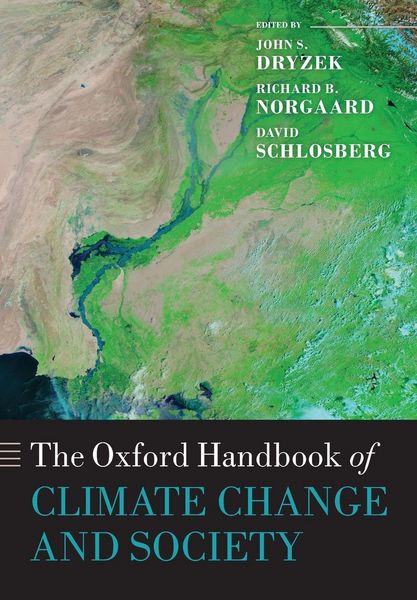
  • Produktbild: Oxford Handbook of Climate Change and Society
  • Produktbild: Oxford Handbook of Climate Change and Society

Oxford Handbook of Climate Change and Society

89,99 €

inkl. gesetzl. MwSt., Versandkostenfrei


Beschreibung

Climate change presents perhaps the most profound challenge ever confronted by human society. This volume is a definitive analysis drawing on the best thinking on questions of how climate change affects human systems, and how societies can, do, and should respond. Key topics covered include the history...

Beschreibung

Climate change presents perhaps the most profound challenge ever confronted by human society. This volume is a definitive analysis drawing on the best thinking on questions of how climate change affects human systems, and how societies can, do, and should respond. Key topics covered include the history of the issues, social and political reception of climate science, the denial of that science by individuals and organized interests, the nature of the social disruptions caused by climate change, the economics of those disruptions and possible responses to them, questions of human security and social justice, obligations to future generations, policy instruments for reducing greenhouse gas emissions, and governance at local, regional, national, international, and global levels.

Produktdetails

Einband

Taschenbuch

Erscheinungsdatum

22.08.2013

Herausgeber Dryzek John S. + weitere
Verlag Oxford University Press

Produktdetails

Einband

Taschenbuch

Erscheinungsdatum

22.08.2013

Herausgeber
Verlag Oxford University Press
Seitenzahl

742

Maße (L/B/H)

24,4/17/3,9 cm

Gewicht

1257 g

Sprache

Englisch

ISBN

978-0-19-968342-0

Herstelleradresse

Libri GmbH
Europaallee 1
36244 Bad Hersfeld
DE

Email: gpsr@libri.de

Ein neues Kapitel für Ihre Bücher

Ein neues Kapitel für Ihre Bücher

Schenken Sie Ihren alten Schätzen ein zweites Leben und erhalten Sie dafür eine Thalia Geschenkkarte.

Jetzt verkaufen
Jetzt verkaufen

Noch keine Bewertungen vorhanden

Verfassen Sie die erste Bewertung zu diesem Artikel

Helfen Sie anderen Kundinnen und Kunden durch Ihre Meinung.

Kundinnen und Kunden meinen

Bewertungen (0)

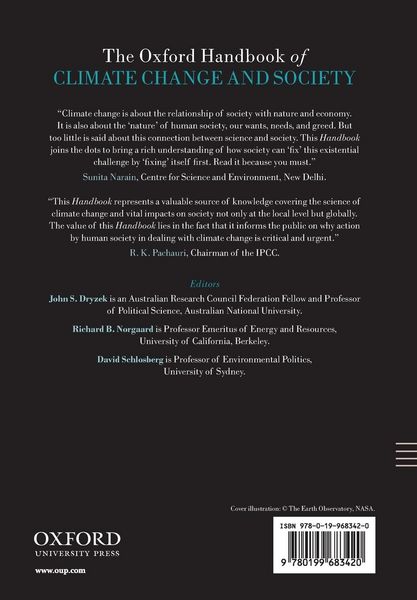
  • Produktbild: Oxford Handbook of Climate Change and Society
  • Produktbild: Oxford Handbook of Climate Change and Society
    • Contents
    • PART I: INTRODUCTION
    • 1: John S. Dryzek, Richard B. Norgaard, and David Schlosberg: Climate Change and Society: Approaches and Responses
    • PART II: THE CHALLENGE AND ITS HISTORY
    • 2: Will Steffen: A Truly Complex and Diabolical Policy Problem
    • 3: Dale Jamieson: The Nature of the Problem
    • 4: Mark Sagoff: The Poverty of Climate Economics
    • 5: Spencer Weart: The Development of the Concept of Dangerous Anthropogenic Climate Change
    • 6: Maarten A. Hajer and Wytske Versteeg: Voices of Vulnerability: The Reconfiguration of Policy Discourses
    • 7: Timothy W. Luke: Environmentality
    • PART III: SCIENCE, SOCIETY, AND PUBLIC OPINION
    • 8: Hans von Storch, Armin Bunde, and Nico Stehr: The Physical Sciences and Climate Politics
    • 9: Sheila Jasanoff: Cosmopolitan Knowledge: Climate Science and Global Civic Epistemology
    • 10: Riley E. Dunlap and Aaron M. McCright: Organized Climate Change Denial
    • 11: Susanne C. Moser and Lisa Dilling: Communicating Climate Change: Closing the Science-Action Gap
    • PART IV: SOCIAL IMPACTS
    • 12: Robert Mendelsohn: Economic Estimates of the Damages Caused by Climate Change
    • 13: Richard B. Norgaard: Weighing Climate Futures: A Critical Review of the Application of Economic Valuation
    • 14: Colin Polsky and Hallie Eakin: Global Change Vulnerability Assessments: Definitions, Challenges, and Opportunities
    • 15: Elizabeth G. Hanna: Health Hazards
    • 16: Robert Melchior Figueroa: Indigenous Peoples and Cultural Losses
    • PART V: SECURITY
    • 17: Nils Gilman, Doug Randall, and Peter Schwartz: Climate Change and "Security "
    • 18: Jon Barnett: Human Security
    • 19: Timothy Doyle and Sanjay Chaturvedi: Climate Refugees and Security: Conceptualizations, Categories, and Contestations
    • PART VI: JUSTICE
    • 20: Simon Dietz: From Efficiency to Justice: Utility as the Informational Basis for Climate Strategies, and Some Alternatives
    • 21: Stephen M. Gardiner: Climate Justice
    • 22: Paul Baer: International Justice
    • 23: Richard Howarth: Intergenerational Justice
    • PART VII: PUBLICS AND MOVEMENTS
    • 24: Matthew C. Nisbet: Public Opinion and Participation
    • 25: Ronnie D. Lipschutz and Corina McKendry: Social Movements and Global Civil Society
    • 26: Paul Routledge: Transnational Climate Justice Solidarities
    • 27: Kari Marie Norgaard: Climate Denial: Emotion, Psychology, Culture, and Political Economy
    • 28: Laurel Kearns: The Role of Religions in Activism
    • PART VIII: GOVERNMENT RESPONSES
    • 29: Peter Christoff and Robyn Eckersley: Comparing State Responses
    • 30: Miranda A. Schreurs: Climate Change Politics in an Authoritarian State: The Ambivalent Case of China
    • 31: Harriet Bulkeley: Cities and Subnational Governments
    • 32: Daniel A. Farber: Issues of Scale in Climate Governance
    • 33: Ian Gough and James Meadowcroft: Decarbonizing the Welfare State
    • 34: Sivan Kartha: Discourses of The Global South
    • PART IX: POLICY INSTRUMENTS
    • 35: David Harrison, Andrew Foss, Per Klevnas, and Daniel Radov: Economic Policy Instruments for Reducing Greenhouse Gas Emissions
    • 36: Andrew Jordan, David Benson, Rüdiger Wurzel, and Anthony Zito: Policy Instruments in Practice
    • 37: Clive L. Spash: Carbon Trading: A Critique
    • 38: Mark Diesendorf: Redesigning Energy Systems
    • PART X: PRODUCERS AND CONSUMERS
    • 39: Simone Pulver: Corporate Responses
    • 40: Andrew Szasz: Is Green Consumption Part of the Solution?
    • PART XI: GLOBAL GOVERNANCE
    • 41: Matthew Paterson: Selling Carbon: From International Climate Regime to Global Carbon Market
    • 42: Oran R. Young: Improving the Performance of the Climate Regime: Insights from Regime Analysis
    • 43: Paul G. Harris: Reconceptualizing Global Governance
    • 44: Walter F. Baber and Robert V. Bartlett: The Role of International Law in Global Governance
    • PART XII: RECONSTRUCTION
    • 45: Karin Bäckstrand: The Democratic Legitimacy of Global Governance After Copenhagen
    • 46: Frank Biermann: New Actors and Mechanisms of Global Governance
    • 47: W. Neil Adger, Katrina Brown, and James Waters: Resilience