















































KI-Beratung Beta

Gutscheinbedingungen

Gültig bis 30.11.2026 | Gültig für nicht preisgebundene fremdsprachige Bücher | Einzelne Artikel können ausgeschlossen sein | Online auf thalia.de und in der Thalia App einlösbar | Click & Collect nur mit Online-Zahlung (Paypal/Kreditkarte) vorab | Nicht kombinierbar mit anderen Gutscheinen oder Preisaktionen | Nur einmal pro Einkauf einlösbar | Gutschein wird auf max. 500€ Bestellwert angerechnet | Keine Barauszahlung | Nicht gültig für Versandkosten und Services

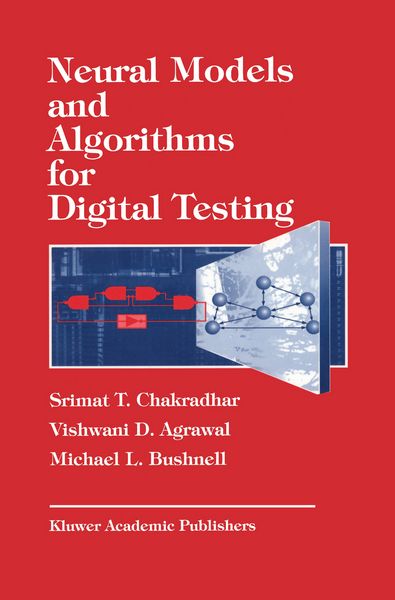
  • Produktbild: Neural Models and Algorithms for Digital Testing
  • Produktbild: Neural Models and Algorithms for Digital Testing
Band 140

Neural Models and Algorithms for Digital Testing

97,99 €

inkl. gesetzl. MwSt., Versandkostenfrei


Beschreibung

References . . . . . . . . . . . . . . . . . . . . . . . . . . . . 82 9 QUADRATIC 0-1 PROGRAMMING 8S 9. 1 Energy Minimization 86 9. 2 Notation and Tenninology . . . . . . . . . . . . . . . . . 87 9. 3 Minimization Technique . . . . . . . . . . . . . . . . . . 88 9. 4 An Example . . . . . . . . . . ....

Beschreibung

References . . . . . . . . . . . . . . . . . . . . . . . . . . . . 82 9 QUADRATIC 0-1 PROGRAMMING 8S 9. 1 Energy Minimization 86 9. 2 Notation and Tenninology . . . . . . . . . . . . . . . . . 87 9. 3 Minimization Technique . . . . . . . . . . . . . . . . . . 88 9. 4 An Example . . . . . . . . . . . . . . . . . . . . . . . . 92 9. 5 Accelerated Energy Minimization. . . . . . . . . . . . . 94 9. 5. 1 Transitive Oosure . . . . . . . . . . . . . . . . . 94 9. 5. 2 Additional Pairwise Relationships 96 9. 5. 3 Path Sensitization . . . . . . . . . . . . . . . . . 97 9. 6 Experimental Results 98 9. 7 Summary. . . . . . . . . . . . . . . . . . . . . . . . . . 100 References . . . . . . . . . . . . . . . . . . . . . . . . . . . . 100 10 TRANSITIVE CLOSURE AND TESTING 103 10. 1 Background . . . . . . . . . . . . . . . . . . . . . . . . 104 10. 2 Transitive Oosure Definition 105 10. 3 Implication Graphs 106 10. 4 A Test Generation Algorithm 107 10. 5 Identifying Necessary Assignments 112 10. 5. 1 Implicit Implication and Justification 113 10. 5. 2 Transitive Oosure Does More Than Implication and Justification 115 10. 5. 3 Implicit Sensitization of Dominators 116 10. 5. 4 Redundancy Identification 117 10. 6 Summary 119 References . . . . . . . . . . . . . . . . . . . . . . . . . . . . 119 11 POLYNOMIAL-TIME TESTABILITY 123 11. 1 Background 124 11. 1. 1 Fujiwara's Result 125 11. 1. 2 Contribution of the Present Work . . . . . . . . . 126 11. 2 Notation and Tenninology 127 11. 3 A Polynomial TlDle Algorithm 128 11. 3. 1 Primary Output Fault 129 11. 3. 2 Arbitrary Single Fault 135 11. 3. 3 Multiple Faults. . . . . . . . . . . . . . . . . . . 137 11. 4 Summary. . . . . . . . . . . . . . . . . . . . . . . . . . 139 References . . . . . . . . . . . . . . . . . . . . . . . . . . . . 139 ix 12 SPECIAL CASES OF HARD PROBLEMS 141 12. 1 Problem Statement 142 12. 2 Logic Simulation 143 12. 3 Logic Circuit Modeling . 146 12. 3. 1 Modelfor a Boolean Gate . . . . . . . . . . . . . 147 12. 3. 2 Circuit Modeling 148 12.

Produktdetails

Einband

Taschenbuch

Erscheinungsdatum

28.09.2012

Abbildungen

XIII, 184 p.

Verlag Springer Us

Produktdetails

Einband

Taschenbuch

Erscheinungsdatum

28.09.2012

Abbildungen

XIII, 184 p.

Verlag Springer Us
Seitenzahl

184

Maße (L/B/H)

23,5/15,5/1,2 cm

Gewicht

318 g

Auflage

Softcover reprint of the original 1st ed. 1991

Sprache

Englisch

ISBN

978-1-4613-6767-3

Herstelleradresse

Springer-Verlag KG
Sachsenplatz 4-6
1201 Wien
AT

Email: ProductSafety@springernature.com

Ein neues Kapitel für Ihre Bücher

Ein neues Kapitel für Ihre Bücher

Schenken Sie Ihren alten Schätzen ein zweites Leben und erhalten Sie dafür eine Thalia Geschenkkarte.

Jetzt verkaufen
Jetzt verkaufen

Noch keine Bewertungen vorhanden

Verfassen Sie die erste Bewertung zu diesem Artikel

Helfen Sie anderen Kundinnen und Kunden durch Ihre Meinung.

Kundinnen und Kunden meinen

Bewertungen (0)

  • Produktbild: Neural Models and Algorithms for Digital Testing
  • Produktbild: Neural Models and Algorithms for Digital Testing
  • 1 Introduction.- 1.1 What is Test Generation?.- 1.2 Why Worry About Test Generation?.- 1.3 How About Parallel Processing?.- 1.4 Neural Computing.- 1.5 A Novel Solution.- 1.6 Polynomial Time Test Problems.- 1.7 Application to Other NP-complete Problems.- 1.8 Organization of the Book.- References.- 2 Logic Circuits and Testing.- 2.1 Logic Circuit Preliminaries.- 2.2 Test Generation Problem.- 2.3 Test Generation Techniques.- 2.4 Parallelization.- References.- 3 Parallel Processing Preliminaries.- 3.1 Synchronous Parallel Computing.- 3.2 Parallel Test Generation.- References.- 4 Introduction to Neural Networks.- 4.1 Discrete Model of Neuron.- 4.2 Electrical Neural Networks.- References.- 5 Neural Modeling for Digital Circuits.- 5.1 Logic Circuit Model.- 5.2 Existence of Neural Models.- 5.3 Properties of Neural Models.- 5.4 Three-Valued Model.- 5.5 Summary.- References.- 6 Test Generation Reformulated.- 6.1 ATG Constraint Network.- 6.2 Fault Injection.- 6.3 Test Generation.- 6.4 Summary.- References.- 7 Simulated Neural Networks.- 7.1 Iterative Relaxation.- 7.2 Implementation and Results.- 7.3 Parallel Simulation.- 7.4 Summary.- References.- 8 Neural Computers.- 8.1 Feasibility and Performance.- 8.2 ANZA Neurocomputer.- 8.3 Energy Minimization.- 8.4 Enhanced Formulation.- 8.5 ANZA Neurocomputer Results.- 8.6 Summary.- References.- 9 Quadratic 0-1 Programming.- 9.1 Energy Minimization.- 9.2 Notation and Terminology.- 9.3 Minimization Technique.- 9.4 AnExample.- 9.5 Accelerated Eneigy Minimization.- 9.6 Experimental Results.- 9.7 Summary.- References.- 10 Transitive Closure and Testing.- 10.1 Background.- 10.2 Transitive Closure Definition.- 10.3 Implication Graphs.- 10.4 A Test Generation Algorithm.- 10.5 Identifying Necessary Assignments.- 10.6 Summary.- References.- 11 Polynomial-time Testability.- 11.1 Background.- 11.2 Notation and Terminology.- 11.3 A Polynomial Time Algorithm.- 11.4 Summary.- References.- 12 Special Cases of Hard Problems.- 12.1 Problem Statement.- 12.2 Logic Simulation.- 12.3 Logic Circuit Modeling.- 12.4 Simulation as a Quadratic 0-1 Program.- 12.5 Quadratic 0-1 Program as Simulation.- 12.6 Minimizing Special Cases.- 12.7 Summary.- References.- 13 Solving Graph Problems.- 13.1 Background.- 13.2 Notation and Terminology.- 13.3 Maximum Weighted Independent Sets.- 13.4 Conflict Graphs of Boolean Gates.- 13.5 AnExample.- 13.6 Summary.- References.- 14 Open Problems.- References.- 15 Conclusion.