
















































KI-Beratung Beta

  • Produktbild: Foundations of Knowledge Systems
  • Produktbild: Foundations of Knowledge Systems
Band 13 - 12%

Foundations of Knowledge Systems with Applications to Databases and Agents

12% sparen

139,99 € UVP 160,49 €

inkl. gesetzl. MwSt., Versandkostenfrei


Beschreibung

One of the main uses of computer systems is the management of large amounts of symbolic information representing the state of some application domain, such as information about all the people I communicate with in my personal address database, or relevant parts of the outer space in the knowledge base...

Beschreibung

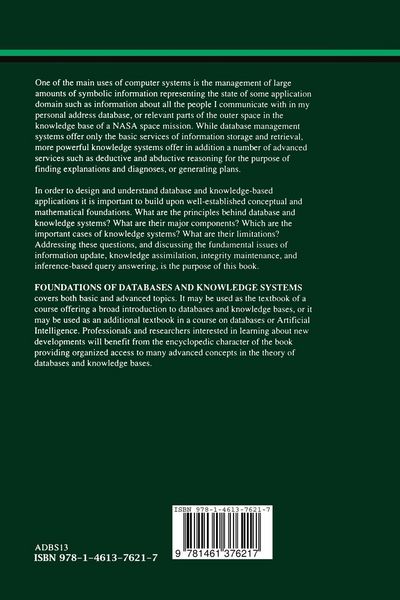
One of the main uses of computer systems is the management of large amounts of symbolic information representing the state of some application domain, such as information about all the people I communicate with in my personal address database, or relevant parts of the outer space in the knowledge base of a NASA space mission. While database management systems offer only the basic services of information storage and retrieval, more powerful knowledge systems offer, in addition, a number of advanced services such as deductive and abductive reasoning for the purpose of finding explanations and diagnoses, or generating plans.
In order to design and understand database and knowledge-based applications it is important to build upon well-established conceptual and mathematical foundations. What are the principles behind database and knowledge systems? What are their major components? Which are the important cases of knowledge systems? What are their limitations? Addressing these questions, and discussing the fundamental issues of information update, knowledge assimilation, integrity maintenance, and inference-based query answering, is the purpose of this book.
Foundations of Databases and Knowledge Systems
covers both basic and advanced topics. It may be used as the textbook of a course offering a broad introduction to databases and knowledge bases, or it may be used as an additional textbook in a course on databases or Artificial Intelligence. Professionals and researchers interested in learning about new developments will benefit from the encyclopedic character of the book, which provides organized access to many advanced concepts in the theory of databases and knowledge bases.

Rezension

`
...recommend the book to all people from database and knowledge communities who want to move their research and practice to more advanced innovative systems.
'
Zentralblatt MATH, 910 (1999)

Produktdetails

Einband

Taschenbuch

Erscheinungsdatum

29.10.2012

Abbildungen

XXIX, 296 p.

Verlag Springer Us

Produktdetails

Einband

Taschenbuch

Erscheinungsdatum

29.10.2012

Abbildungen

XXIX, 296 p.

Verlag Springer Us
Seitenzahl

296

Maße (L/B/H)

23,5/15,5/1,9 cm

Gewicht

505 g

Auflage

Softcover reprint of the original 1st ed. 1998

Sprache

Englisch

ISBN

978-1-4613-7621-7

Herstelleradresse

Springer-Verlag KG
Sachsenplatz 4-6
1201 Wien
AT

Email: ProductSafety@springernature.com

Ein neues Kapitel für Ihre Bücher

Ein neues Kapitel für Ihre Bücher

Schenken Sie Ihren alten Schätzen ein zweites Leben und erhalten Sie dafür eine Thalia Geschenkkarte.

Jetzt verkaufen
Jetzt verkaufen

Noch keine Bewertungen vorhanden

Verfassen Sie die erste Bewertung zu diesem Artikel

Helfen Sie anderen Kundinnen und Kunden durch Ihre Meinung.

Kundinnen und Kunden meinen

Bewertungen (0)

  • Produktbild: Foundations of Knowledge Systems
  • Produktbild: Foundations of Knowledge Systems
  • 1. Conceptual Modeling of Knowledge Bases.- 2. Relational Databases.- 3. Object-Relational Databases.- 4. Reaction Rules.- 5. Deduction Rules.- 6. Principles of Positive Knowledge Systems.- 7. Temporal Databases.- 8. Fuzzy Databases.- 9. Further Examples of Positive Knowledge Systems.- 10. Principles of Non-Positive Knowledge Systems.- 11. Relational Factbases.- 12. Possibilistic Databases.- 13. Further Examples of Non-Positive Knowledge Systems.- 14. Communication and Cooperation.- 15. Deductive Knowledge Systems.- 16. Advanced Knowledge and Reasoning Services.- Appendices.- A— Partial Logics with Two Kinds of Negation.- A.1 Preliminaries.- A.2 Partial Models.- A.3 Classical Logic as a Special Case of Partial Logic.- A.3.1 From Partial to Classical Logic.- A.3.2 Confusing Semi-Partial Logic with Classical Logic.- B— Compositional Possibilistic Logic.- B.1 Introduction.- B.2 Preliminaries.- B.3 The Logical Semantics Problem of Reasoning with Uncertainty.- B.3.1 A Natural Solution.- B.3.2 The Non-Compositional Possibility-Theoretic Approach.- B.4 Semi-Possibilistic Logic.- B.5 Compositional Possibilistic Logic.- C— On the Logic of Temporally Qualified Information.- C.1 Syntax.- C.2 Semantics.- C.3 From Timepoints to Timestamps and Vice Versa.- C.4 Minimal Models.- References.