















































KI-Beratung Beta

Produktbild: Model-Based Engineering of Embedded Systems

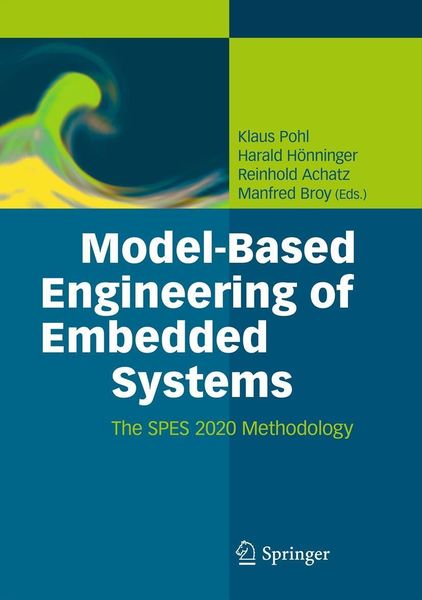
Model-Based Engineering of Embedded Systems The SPES 2020 Methodology

53,49 €

inkl. gesetzl. MwSt.

Beschreibung

Embedded systems have long become essential in application areas in which human control is impossible or infeasible. The development of modern embedded systems is becoming increasingly difficult and challenging because of their overall system complexity, their tighter and cross-functional integration,...

Beschreibung

Embedded systems have long become essential in application areas in which human control is impossible or infeasible. The development of modern embedded systems is becoming increasingly difficult and challenging because of their overall system complexity, their tighter and cross-functional integration, the increasing requirements concerning safety and real-time behavior, and the need to reduce development and operation costs.

This book provides a comprehensive overview of the Software Platform Embedded Systems (SPES) modeling framework and demonstrates its applicability in embedded system development in various industry domains such as automation, automotive, avionics, energy, and healthcare. In SPES 2020, twenty-one partners from academia and industry have joined forces in order to develop and evaluate in different industrial domains a modeling framework that reflects the current state of the art in embedded systems engineering.

The content of this book is structured in four parts. Part I "Starting Point" discusses the status quo of embedded systems development and model-based engineering, and summarizes the key requirements faced when developing embedded systems in different application domains. Part II "The SPES Modeling Framework" describes the SPES modeling framework. Part III "Application and Evaluation of the SPES Modeling Framework" reports on the validation steps taken to ensure that the framework met the requirements discussed in Part I. Finally, Part IV "Impact of the SPES Modeling Framework" summarizes the results achieved and provides an outlook on future work.

The book is mainly aimed at professionals and practitioners who deal with the development of embedded systems on a daily basis. Researchers in academia and industry may use it as a compendium for the requirements and state-of-the-art solution concepts for embedded systems development.

Portrait

Klaus Pohl is full professor for Software Systems Engineering at the Institute of Computer Science and Business Computing of the University of Duisburg-Essen in Germany, and director of paluno - The Ruhr Institute for Software Technology. He was scientific founding director of Lero, the Irish Software Engineering Institute, served as coordinator of the FP7 Network of Excellence S-Cube (Software Services and Systems Network) and is member of several steering committees and boards of directors including  the European Technology Platform NESSI (Networked European Software and Services Initiative) and the German Innovation Alliance SPES 2020.

Harald Hönninger is Vice President of Advance Engineering for Software-Intensive Systems at Corporate Research and Advanced Development with Robert Bosch GmbH. In his position, he is responsible for the pre-development of software-intensive systems and for corporate-wide software-, hardware- and systems engineering methods.

Reinhold Achatz recently joined ThyssenKrupp, where he leads the Corporate Center Technology, Innovation & Quality.  Before he was Corporate Vice President of Siemens AG and head of Corporate Research and Technologies as well as the Corporate Development Center. He has been honored as a "Siemens Top Innovator" for his outstanding innovations in software-based components for set-up, operations and execution accuracy of machine tools.

Manfred Broy is full professor for Software and Systems Engineering at the Institute for Computer Science of the Technical University of Munich. Among other awards, he received the Leibniz Preis, the highest scientific award of the Federal Republic of Germany, the Order of Merit of the Federal Republic of Germany and the Konrad-Zuse-Medal for extraordinary services in Computer Science. Manfred Broy is a Max-Planck-Fellow, member of the German Academy of Science and Engineering and member of the German National Academy of the Sciences "Leopoldina".

Produktdetails

Format

PDF

Kopierschutz

Nein

Family Sharing

Nein

Text-to-Speech

Nein

Produktdetails

Format

PDF

Format

eBooks im PDF-Format haben eine festgelegte Seitengröße und eignen sich daher nur bedingt zum Lesen auf einem tolino eReader oder Smartphone. Für den vollen Lesegenuss empfehlen wir Ihnen bei PDF-eBooks die Verwendung eines Tablets oder Computers.

Kopierschutz

Nein

Kopierschutz

Dieses eBook können Sie uneingeschränkt auf allen Geräten der tolino Familie, allen sonstigen eReadern und am PC lesen. Das eBook ist nicht kopiergeschützt und kann ein personalisiertes Wasserzeichen enthalten. Weitere Hinweise zum Lesen von eBooks mit einem personalisierten Wasserzeichen finden Sie unter Hilfe/Downloads.

Family Sharing

Nein

Family Sharing

Mit Family Sharing können Sie eBooks innerhalb Ihrer Familie (max. sechs Mitglieder im gleichen Haushalt) teilen. Sie entscheiden selbst, welches Buch Sie mit welchem Familienmitglied teilen möchten. Auch das parallele Lesen durch verschiedene Familienmitglieder ist durch Family Sharing möglich. Um eBooks zu teilen oder geteilt zu bekommen, muss jedes Familienmitglied ein Konto bei Thalia oder einem anderen tolino-Buchhändler haben. Weitere Informationen finden Sie unter Hilfe/Family-Sharing.

Text-to-Speech

Nein

Text-to-Speech

Bedeutet Ihnen Stimme mehr als Text? Mit der Funktion Text-to-Speech können Sie sich im tolino webReader und in der aktuellen Thalia – Lesen & Hören App das eBook vorlesen lassen. Weitere Informationen finden Sie unter Hilfe/Text-to-Speech.

Erscheinungsdatum

08.11.2012

Herausgeber
Verlag Springer
Seitenzahl

304 (Printausgabe)

Dateigröße

6174 KB

Sprache

Englisch

EAN

9783642346149

Barrierefreiheit
  • keine Information zur Barrierefreiheit bekannt

Noch keine Bewertungen vorhanden

Verfassen Sie die erste Bewertung zu diesem Artikel

Helfen Sie anderen Kundinnen und Kunden durch Ihre Meinung.

Kundinnen und Kunden meinen

Bewertungen (0)

Weitere Artikel finden Sie in

  • Produktbild: Model-Based Engineering of Embedded Systems
  • Part I Starting Situation.- Challenges in Engineering for Software-Intensive Embedded Systems.- Requirements from the Application Domains.- Part II The SPES Modeling Framework.- Introduction to the SPES Modeling Framework.- Requirements Viewpoint.- Functional Viewpoint.- Logical Viewpoint.- Technical Viewpoint.- Modeling Quality Aspects: Safety.- Modeling Quality Aspects: Real-Time.- Part III Application and Evaluation of the SPES Modeling Framework.- Overview of the SPES Evaluation Strategy.- Application and Evaluation in the Automation Domain.- Application and Evaluation in the Automotive Domain.- Application and Evaluation in the Avionics Domain.- Application and Evaluation in the Energy Domain.- Application and Evaluation in the Healthcare Domain.- Evaluation Summary.- Part IV Impact of the SPES Modeling Framework.- Lessons Learned.- Outlook.