















































KI-Beratung Beta

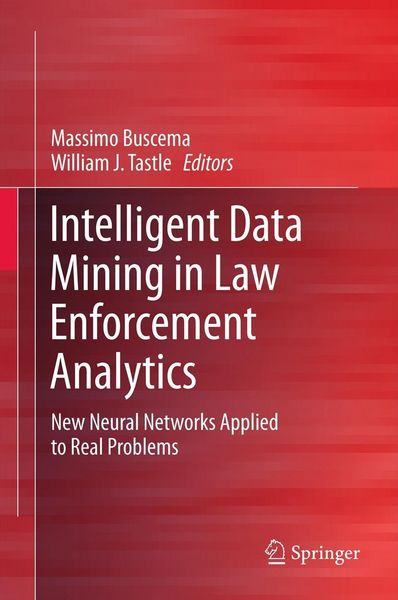
Produktbild: Intelligent Data Mining in Law Enforcement Analytics

Intelligent Data Mining in Law Enforcement Analytics New Neural Networks Applied to Real Problems

213,99 €

inkl. gesetzl. MwSt.

Beschreibung

Produktdetails

Format

PDF

Kopierschutz

Nein

Family Sharing

Nein

Text-to-Speech

Nein

Erscheinungsdatum

28.11.2012

Herausgeber

Paolo Massimo Buscema + weitere

Verlag

Springer Netherlands

Seitenzahl

518 (Printausgabe)

Dateigröße

12197 KB

Sprache

Englisch

EAN

9789400749146

Beschreibung

Portrait

Paolo Massimo Buscema is editor on the Editorial Board of various international journals. He is the director of Semeion Research Center of Sciences of Communication, Italy,  and Professor of University of Colorado, Dept of Mathematical and Statistical Sciences, CO, USA. He has designed, constructed developed new models and algorithms of Artificial Intelligence. Author of scientific publications on theoretical aspects of Natural Computation, with over 250 titles (scientific articles, essays, and books (23) on the same subject) and over 35 Software Systems used in many university and research Centres. Inventor of 20 international patents. Scientific Director of research projects on the application of artificial intelligence systems in the biomedical field, homeland security and safety (quakes and slides down). William J. Tastle is Professor of Information Systems at a private university in upstate New York, a Research Professor at the University of Iceland, Visiting Scientist at Los Alamos National Laboratory, a Fellow of the Association for Information Technology Processing, and a Research Fellow at Semeion Research Centre of Rome, Italy. His current research interests are in the application of artificial intelligence algorithms to highly complex problems, and the study and creation of measurements involving ordinal and nominal data. His PhD is in Advanced Technology with specialization in Systems Science from the University of New York at Binghamton. He is the retired managing editor of the International Journal of General Systems and an active journal reviewer. He is active in the area of fuzzy information systems.

Produktdetails

Format

PDF

eBooks im PDF-Format haben eine festgelegte Seitengröße und eignen sich daher nur bedingt zum Lesen auf einem tolino eReader oder Smartphone. Für den vollen Lesegenuss empfehlen wir Ihnen bei PDF-eBooks die Verwendung eines Tablets oder Computers.

Kopierschutz

Nein

Dieses eBook können Sie uneingeschränkt auf allen Geräten der tolino Familie, allen sonstigen eReadern und am PC lesen. Das eBook ist nicht kopiergeschützt und kann ein personalisiertes Wasserzeichen enthalten. Weitere Hinweise zum Lesen von eBooks mit einem personalisierten Wasserzeichen finden Sie unter Hilfe/Downloads.

Family Sharing

Nein

Mit Family Sharing können Sie eBooks innerhalb Ihrer Familie (max. sechs Mitglieder im gleichen Haushalt) teilen. Sie entscheiden selbst, welches Buch Sie mit welchem Familienmitglied teilen möchten. Auch das parallele Lesen durch verschiedene Familienmitglieder ist durch Family Sharing möglich. Um eBooks zu teilen oder geteilt zu bekommen, muss jedes Familienmitglied ein Konto bei Thalia oder einem anderen tolino-Buchhändler haben. Weitere Informationen finden Sie unter Hilfe/Family-Sharing.

Text-to-Speech

Nein

Bedeutet Ihnen Stimme mehr als Text? Mit der Funktion Text-to-Speech können Sie sich im tolino webReader und in der aktuellen Thalia – Lesen & Hören App das eBook vorlesen lassen. Weitere Informationen finden Sie unter Hilfe/Text-to-Speech.

Barrierefreiheit

  • keine Information zur Barrierefreiheit bekannt

Erscheinungsdatum

28.11.2012

Herausgeber

Verlag

Springer Netherlands

Seitenzahl

518 (Printausgabe)

Dateigröße

12197 KB

Sprache

Englisch

EAN

9789400749146

Noch keine Bewertungen vorhanden

Verfassen Sie die erste Bewertung zu diesem Artikel

Helfen Sie anderen Kundinnen und Kunden durch Ihre Meinung.

Kundinnen und Kunden meinen

Bewertungen (0)

Weitere Artikel finden Sie in

  • Produktbild: Intelligent Data Mining in Law Enforcement Analytics
  • Dedication.- Preface.- Chapter 1. Introduction to Artificial Networks and Law Enforcement Analytics; William J. Tastle.- Chapter 2. Law Enforcement and Artificial Intelligence; Massimo Buscema.- Chapter 3. The General Philosophy of Artificial Adaptive Systems; Massimo Buscema.- Chapter 4. A Brief Introduction to Evolutionary Algorithms and the Genetic Doping Algorithm; M. Buscema, M. Capriotti.- Chapter 5. Artificial Adaptive Systems in Data Visualization: Pro-Active data; Massimo Buscema.- Chapter 6. The Metropolitan Police Service Central Drug Trafficking Database: Evidence of Need; Geoffrey Monaghan and Stefano Terzi.- Chapter 7. Supervised Artificial neural Networks: Back Propagation Neural Networks; Massimo Buscema.- Chapter 8. Pre-Processing Tools for Non-Linear Data Sets; Massimo Buscema, Alessandra Mancini and Marco Breda.- Chapter 9. Metaclassifiers; Massimo Buscema, Stefano Terzi.- Chapter 10. Auto Identification of a Drug Seller Utilizing a Specialized Supervised Neural Network; Massimo Buscema and Marco Intraligi.- Chapter 11. Visualization and Clustering of Self-Organizing Maps; Giulia Massini.- Chapter 12. Self-Organizing Maps: Identifying Non-Linear Relationships in Massive Drug Enforcement Databases; Guila Massini.- Chapter 13. Theory of Constraint Satisfaction Neural Networks; Massimo Buscema.- Chapter 14. Application of the Constraint Satisfaction Network; Marco Intraligi and Massimo Buscema.- Chapter 15. Auto-Contractive Maps, h Function and the Maximally regular Graph: A new methodology for data mining; Massimo Buscema.- Chapter 16. Analysis of a Complex Dataset Using the Combined MST and Auto Contractive Map; Giovanni Pieri.- Chapter 17. Auto Contractive Mapsand Minimal Spanning tree: Organization of Complex datasets on criminal behavior to aid in the deduction of network connectivity; Giula Massini and Massimo Buscema.- Chapter 18. Data Mining Using Non-linear Auto Associative Artificial Neural Networks: The Arrestee Dataset; Massimo Buscema.- Chapter 19. Artificial Adaptive System for Parallel Querying of Multiple Databases; Massimo Buscema.-