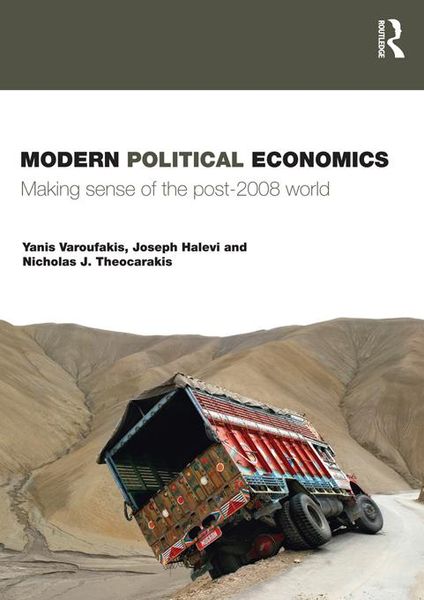
Modern Political Economics Making Sense of the Post-2008 World
-
- Taschenbuch
- eBook ausgewählt
-
Form:Einzelkauf Download
-
Sprache:Englisch
-
eBook Format:PDF
- ePUB 3 110,99 €
- PDF 110,99 € ausgewählt
110,99 €
inkl. gesetzl. MwSt.Beschreibung
Produktdetails
Format
Kopierschutz
Ja
Family Sharing
Nein
Text-to-Speech
Nein
Erscheinungsdatum
29.03.2012
Verlag
Taylor & Francis eBooksSeitenzahl
512 (Printausgabe)
Dateigröße
5269 KB
Sprache
Englisch
EAN
9781136814747
Once in a while the world astonishes itself. Anxious incredulity replaces intellectual torpor and a puzzled public strains its antennae in every possible direction, desperately seeking explanations for the causes and nature of what just hit it. 2008 was such a moment. Not only did the financial system collapse, and send the real economy into a tailspin, but it also revealed the great gulf separating economics from a very real capitalism. Modern Political Economics has a single aim: To help readers make sense of how 2008 came about and what the post-2008 world has in store.
The book is divided into two parts. The first part delves into every major economic theory, from Aristotle to the present, with a determination to discover clues of what went wrong in 2008. The main finding is that all economic theory is inherently flawed. Any system of ideas whose purpose is to describe capitalism in mathematical or engineering terms leads to inevitable logical inconsistency; an inherent error that stands between us and a decent grasp of capitalist reality. The only scientific truth about capitalism is its radical indeterminacy, a condition which makes it impossible to use science's tools (e.g. calculus and statistics) to second-guess it. The second part casts an attentive eye on the post-war era; on the breeding ground of the Crash of 2008. It distinguishes between two major post-war phases: The Global Plan (1947-1971) and the Global Minotaur (1971-2008).
This dynamic new book delves into every major economic theory and maps out meticulously the trajectory that global capitalism followed from post-war almost centrally planned stability, to designed disintegration in the 1970s, to an intentional magnification of unsustainable imbalances in the 1980s and, finally, to the most spectacular privatisation of money in the 1990s and beyond. Modern Political Economics is essential reading for Economics students and anyone seeking a better understanding of the 2008 economic crash.
Noch keine Bewertungen vorhanden
Verfassen Sie die erste Bewertung zu diesem Artikel
Helfen Sie anderen Kundinnen und Kunden durch Ihre Meinung.
Kurze Frage zu unserer Seite
Vielen Dank für Ihr Feedback
Wir nutzen Ihr Feedback, um unsere Produktseiten zu verbessern. Bitte haben Sie Verständnis, dass wir Ihnen keine Rückmeldung geben können. Falls Sie Kontakt mit uns aufnehmen möchten, können Sie sich aber gerne an unseren Kund*innenservice wenden.
zum Kundenservice