















































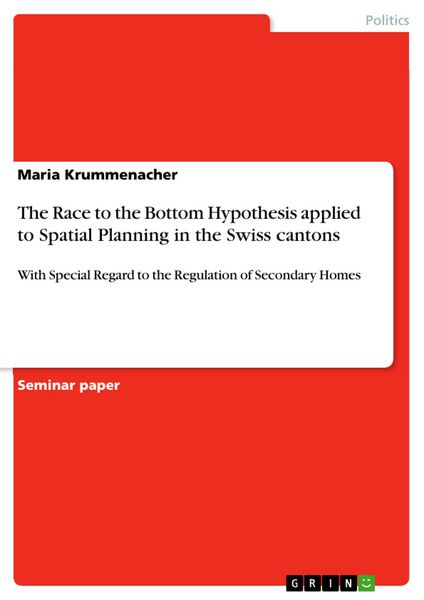
The Race to the Bottom Hypothesis applied to Spatial Planning in the Swiss cantons With Special Regard to the Regulation of Secondary Homes
-
- Taschenbuch
- eBook ausgewählt
-
Form:Einzelkauf Download
-
Sprache:Englisch
12,99 €
inkl. gesetzl. MwSt.Beschreibung
Produktdetails
Format
Kopierschutz
Nein
Family Sharing
Nein
Text-to-Speech
Nein
Erscheinungsdatum
24.07.2013
Verlag
GRINSeitenzahl
25 (Printausgabe)
Dateigröße
1169 KB
Auflage
1. Auflage
Sprache
Englisch
EAN
9783656465003
Seminar paper from the year 2013 in the subject Politics - Miscellaneous, grade: 1,0, Free University of Berlin (Otto-Suhr-Institut für Politikwissenschaft), language: English, abstract: It is an ongoing discussion in the political science literature whether a federalist country rather provides a valuable setting for policy experimentation in the subnational entities or whether too much autonomy leads to destructive competition among them. One often mentioned and tested approach to the field is the race to the bottom hypothesis. In this seminar paper the race to the bottom hypothesis will be tested for land use policy and therein the regulation of secondary residences in Switzerland.
The broader frame for the study is provided through the people ¿s legislative initiative on the federal level on secondary residences, the Zweitwohnungsinitiative. It has been submitted to a popular vote in Switzerland on 11 March 2012 and succeeded with a razor-thin majority of 50.6 % of total votes. The initiative demands that the share of secondary residences in the Swiss communities can not exceed 20 % of the total number of residences. In those communities that already have a higher share an immediate building freeze has to be enacted. Longchamp et al. showed that the share of secondary residences in a community is a good explanatory for the result of the popular vote. Those communities with a share already higher than 20 % mostly voted no, while the communities with less secondary residences rather voted yes. Hence, one can argue that those parts of Switzerland that will not be heavily affected by the implementation of the initiative imposed the building limitation on those parts that effectively will be. The direct democratic structure of Switzerland enables in it ¿s extremes an unaffected majority to dictate policies to a highly affected minority.
The paper will start with an introduction into the basic assumptions and implications of the race to the bottom hypothesis and point out the theoretical suggestions how a race to the bottom between subnational entities can be overcome (Chapter 2). Chapter 3 provides the empirical evidence in favour and against a race to the bottom in land use policy among the Swiss cantons. Building on the data we will be able to assess the overall robustness of the hypothesis for the regulation of secondary residences in Switzerland. Chapter 4 concludes with a resume of the findings, possible explanations and a classification of the Zweitwohnungsinitiative in the field.
Noch keine Bewertungen vorhanden
Verfassen Sie die erste Bewertung zu diesem Artikel
Helfen Sie anderen Kundinnen und Kunden durch Ihre Meinung.
Kurze Frage zu unserer Seite
Vielen Dank für Ihr Feedback
Wir nutzen Ihr Feedback, um unsere Produktseiten zu verbessern. Bitte haben Sie Verständnis, dass wir Ihnen keine Rückmeldung geben können. Falls Sie Kontakt mit uns aufnehmen möchten, können Sie sich aber gerne an unseren Kund*innenservice wenden.
zum Kundenservice