















































KI-Beratung Beta

Produktbild: Basic Aspects of Hearing
Band 787

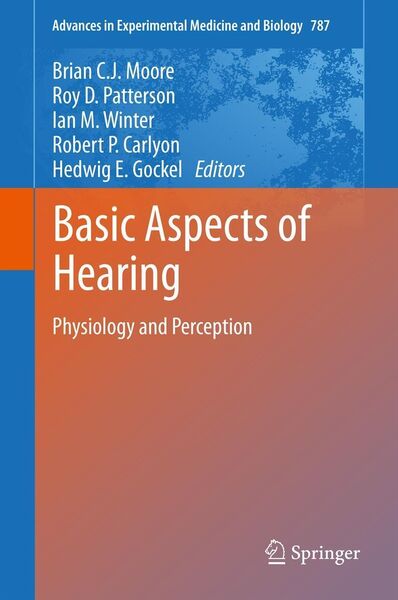
Basic Aspects of Hearing Physiology and Perception

213,99 €

inkl. gesetzl. MwSt.

Beschreibung

The International Symposium on Hearing is a highly-prestigious, triennial event where world-class scientists present and discuss the most recent advances in the field of hearing research in animals and humans. Presented papers range from basic to applied research, and are of interest neuroscientists,...

Beschreibung

The International Symposium on Hearing is a highly-prestigious, triennial event where world-class scientists present and discuss the most recent advances in the field of hearing research in animals and humans. Presented papers range from basic to applied research, and are of interest neuroscientists, otolaryngologists, psychologists, and artificial intelligence researchers.

Basic Aspects of Hearing: Physiology and Perception includes the best papers from the 2012 International Symposium on Hearing. Over 50 chapters focus on the relationship between auditory physiology, psychoacoustics, and computational modeling.

Produktdetails

Format

PDF

Kopierschutz

Nein

Family Sharing

Nein

Text-to-Speech

Nein

Produktdetails

Format

PDF

Format

eBooks im PDF-Format haben eine festgelegte Seitengröße und eignen sich daher nur bedingt zum Lesen auf einem tolino eReader oder Smartphone. Für den vollen Lesegenuss empfehlen wir Ihnen bei PDF-eBooks die Verwendung eines Tablets oder Computers.

Kopierschutz

Nein

Kopierschutz

Dieses eBook können Sie uneingeschränkt auf allen Geräten der tolino Familie, allen sonstigen eReadern und am PC lesen. Das eBook ist nicht kopiergeschützt und kann ein personalisiertes Wasserzeichen enthalten. Weitere Hinweise zum Lesen von eBooks mit einem personalisierten Wasserzeichen finden Sie unter Hilfe/Downloads.

Family Sharing

Nein

Family Sharing

Mit Family Sharing können Sie eBooks innerhalb Ihrer Familie (max. sechs Mitglieder im gleichen Haushalt) teilen. Sie entscheiden selbst, welches Buch Sie mit welchem Familienmitglied teilen möchten. Auch das parallele Lesen durch verschiedene Familienmitglieder ist durch Family Sharing möglich. Um eBooks zu teilen oder geteilt zu bekommen, muss jedes Familienmitglied ein Konto bei Thalia oder einem anderen tolino-Buchhändler haben. Weitere Informationen finden Sie unter Hilfe/Family-Sharing.

Text-to-Speech

Nein

Text-to-Speech

Bedeutet Ihnen Stimme mehr als Text? Mit der Funktion Text-to-Speech können Sie sich im tolino webReader und in der aktuellen Thalia – Lesen & Hören App das eBook vorlesen lassen. Weitere Informationen finden Sie unter Hilfe/Text-to-Speech.

Erscheinungsdatum

29.05.2013

Herausgeber
Verlag Springer New York
Seitenzahl

549 (Printausgabe)

Dateigröße

14052 KB

Sprache

Englisch

EAN

9781461415909

Barrierefreiheit
  • keine Information zur Barrierefreiheit bekannt

Noch keine Bewertungen vorhanden

Verfassen Sie die erste Bewertung zu diesem Artikel

Helfen Sie anderen Kundinnen und Kunden durch Ihre Meinung.

Kundinnen und Kunden meinen

Bewertungen (0)

Weitere Artikel finden Sie in

  • Produktbild: Basic Aspects of Hearing
  • Topic 1: Peripheral processing.- Chapter 1. Mosaic evolution of the mammalian auditory periphery.- Chapter 2. A computer model of the auditory periphery and its application to the study of hearing.- Chapter 3. A probabilistic account of absolute auditory thresholds and its possible physiological basis.- Chapter 4. Cochlear compression: Recent insights from behavioural experiments.- Chapter 5. Improved psychophysical methods to estimate peripheral gain and compression.- Chapter 6. Contralateral efferent regulation of human cochlear tuning: Behavioural observations and computer model simulations.- Chapter 7. Modeling effects of precursor duration on behavioral estimates of cochlear gain.- Chapter 8. Is overshoot caused by an efferent reduction in cochlear gain?.- Chapter 9. Accurate estimation of compression in simultaneous masking enables the simulation of hearing impairment for normal-hearing listeners.- Chapter 10. Modelling the distortion produced by cochlear compression.- Topic 2: Temporal fine structure and pitch.- Chapter 11. How independent are the pitch and the interaural-time-difference mechanisms that rely on temporal fine structure information?.- Chapter 12. On the limit of neural phase-locking to fine-structure in humans.- Chapter 13. Effects of sensorineural hearing loss on temporal coding of harmonic and inharmonic tone complexes in the auditory nerve.- Chapter 14. A glimpsing account of the role of temporal fine structure information in speech recognition.- Chapter 15. Assessing the possible role of frequency-shift detectors in the ability to hear out partials in complex tones.- Chapter 16. Pitch perception: Dissociating frequency from fundamental-frequency discrimination.- Chapter 17. Pitch perception for sequences of impulse responses whose scaling alternates at every cycle.- Chapter 18. Putting the tritone paradox into context: insights from neural population decoding and human psychophysics.- Topic 3: Enhancement and perceptual compensation.- Chapter 19. Spectral and level effects in auditory enhancement.- Chapter 20. Enhancement of increments in spectral amplitude: further evidence for a mechanism based on central adaptation.- Chapter 21. Differential sensitivity to appearing and disappearing objects in complex acoustic scenes.- Chapter 22. Perceptual compensation when isolated test words are heard in room reverberation.- Chapter 23. A new approach to sound source identification.- Topic 4: Binaural processing.- Chapter 24. Maps of ITD in the Nucleus Laminaris of the Barn Owl.- Chapter 25. The influence of the envelope waveform on binaural tuning of neurons in the inferior colliculus and its relation to binaural perception.- Chapter 26. No evidence for ITD-specific adaptation in the frequency following response.- Chapter 27. Interaural time difference thresholds as a function of frequency.- Chapter 28. Interaural time processing when stimulus bandwidth differs at the two ears C.A. Brown,.- Chapter 29. Neural correlates of the perception of sound source separation.- Chapter 30. When and how envelope "rate-limitations" affect processing of interaural temporal disparities conveyed by high-frequency stimuli.- Chapter 31. The sound source distance dependence of the acoustical cues to location and their encoding by neurons in the inferior colliculus - implications for the Duplex theory.- Chapter 32. Cochlear contributions to the precedence effect.- Chapter 33. Off-frequency BMLD: the role of monaural processing.- Chapter 34. Measuring the apparent width of auditory sources in normal and impaired hearing.- Chapter 35. Psychophysics of human echolocation.- Topic 5: Speech and temporal processing.- Chapter 36. Formant-frequency variation and its effects on across-formant grouping in speech perception.- Chapter 37. Do we need STRFs for cocktail parties? - On the relevance of physiologically motivated features for human speech perception derived from automatic speech recognition.- Chapter 38. Modeling speech intelligibility in adverse conditions.- Chapter 39. Better temporal neural coding with cochlear implants in awake animals.- Chapter 40. Effects of auditory nerve refractoriness and adaptation on auditory perception.- Chapter 41. Robust cortical encoding of slow temporal modulations of speech.- Chapter 42. Wideband monaural envelope correlation perception.- Chapter 43. Detection thresholds for amplitude modulations of tones in budgerigar (Melopsittacus undulatus).- Chapter 44. Phase discrimination ability in Mongolian gerbils provides evidence for possible processing mechanism of mistuning detection.- Topic 6: Auditory cortex and beyond. Chapter 45.- Stimulus-specific adaptation beyond pure tones.- Chapter 46. Mapping tonotopy in human auditory cortex.- Chapter 47. Cortical activity associated with the perception of temporal asymmetry in ramped and damped noises.- Chapter 48. Cortical representation of the combination of monaural and binaural unmasking.- Chapter 49. Processing of short auditory stimuli: The Rapid Audio Sequential Presentation paradigm (RASP).- Chapter 50. Integration of auditory and tactile inputs in musical meter perception.- Chapter 51. A dynamic system for the analysis of the acoustic features and valence of aversive sounds in the human brain.- Topic 7: Auditory scene analysis.- Chapter 52. Can comodulation masking release occur when frequency changes would promote perceptual segregation of the on-frequency and flanking bands?.- Chapter 53. Illusory auditory continuity despite neural evidence to the contrary.- Chapter 54. High-acuity spatial stream segregation .- Chapter 55. How early aging and environment interact in everyday listening: From brainstem to behaviour through modeling.- Chapter 56. Energetic and informational masking in a simulated restaurant environment.- Chapter 57. A computational model for the dynamic aspects of primitive auditory scene analysis.- Chapter 58. A naturalistic approach to the cocktail party.- Chapter 59. Temporal coherence and the streaming of complex sounds.- Index.