















































KI-Beratung Beta

Gutscheinbedingungen

Gültig bis 30.11.2026 | Gültig für nicht preisgebundene fremdsprachige Bücher | Einzelne Artikel können ausgeschlossen sein | Online auf thalia.de und in der Thalia App einlösbar | Click & Collect nur mit Online-Zahlung (Paypal/Kreditkarte) vorab | Nicht kombinierbar mit anderen Gutscheinen oder Preisaktionen | Nur einmal pro Einkauf einlösbar | Gutschein wird auf max. 500€ Bestellwert angerechnet | Keine Barauszahlung | Nicht gültig für Versandkosten und Services

Produktbild: Deadly Medicines and Organised Crime

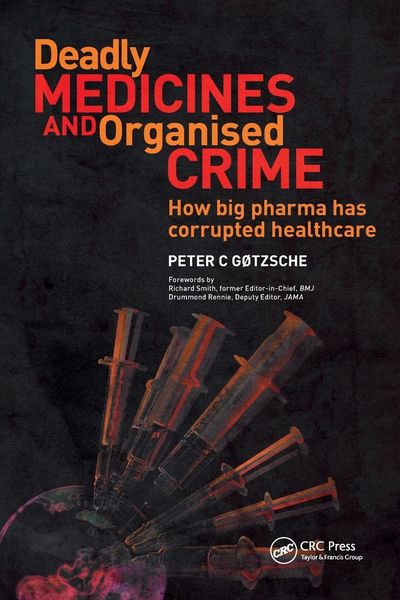
Deadly Medicines and Organised Crime How Big Pharma Has Corrupted Healthcare

65,99 €

inkl. gesetzl. MwSt., Versandkostenfrei


Beschreibung

PRESCRIPTION DRUGS ARE THE THIRD LEADING CAUSE OF DEATH AFTER HEART DISEASE AND CANCER. In his latest ground-breaking book, Peter C Gotzsche exposes the pharmaceutical industries and their charade of fraudulent behaviour, both in research and marketing where the morally repugnant disregard for human...

Beschreibung

PRESCRIPTION DRUGS ARE THE THIRD LEADING CAUSE OF DEATH AFTER HEART DISEASE AND CANCER. In his latest ground-breaking book, Peter C Gotzsche exposes the pharmaceutical industries and their charade of fraudulent behaviour, both in research and marketing where the morally repugnant disregard for human lives is the norm. He convincingly draws close comparisons with the tobacco conglomerates, revealing the extraordinary truth behind efforts to confuse and distract the public and their politicians. The book addresses, in evidence-based detail, an extraordinary system failure caused by widespread crime, corruption, bribery and impotent drug regulation in need of radical reforms. "The main reason we take so many drugs is that drug companies don't sell drugs, they sell lies about drugs. This is what makes drugs so different from anything else in life...Virtually everything we know about drugs is what the companies have chosen to tell us and our doctors...the reason patients trust their medicine is that they extrapolate the trust they have in their doctors into the medicines they prescribe. The patients don't realise that, although their doctors may know a lot about diseases and human physiology and psychology, they know very, very little about drugs that hasn't been carefully concocted and dressed up by the drug industry...If you don't think the system is out of control, please email me and explain why drugs are the third leading cause of death...If such a hugely lethal epidemic had been caused by a new bacterium or a virus, or even one-hundredth of it, we would have done everything we could to get it under control." FROM THE INTRODUCTION

Produktdetails

Einband

Taschenbuch

Erscheinungsdatum

28.08.2013

Verlag Taylor & Francis
Seitenzahl

324

Produktdetails

Einband

Taschenbuch

Erscheinungsdatum

28.08.2013

Verlag Taylor & Francis
Seitenzahl

324

Maße (L/B/H)

23,4/15,6/1,8 cm

Gewicht

494 g

Sprache

Englisch

ISBN

978-1-84619-884-7

Herstelleradresse

Libri GmbH
Europaallee 1
36244 Bad Hersfeld
DE

Email: gpsr@libri.de

Ein neues Kapitel für Ihre Bücher

Ein neues Kapitel für Ihre Bücher

Schenken Sie Ihren alten Schätzen ein zweites Leben und erhalten Sie dafür eine Thalia Geschenkkarte.

Jetzt verkaufen
Jetzt verkaufen

Noch keine Bewertungen vorhanden

Verfassen Sie die erste Bewertung zu diesem Artikel

Helfen Sie anderen Kundinnen und Kunden durch Ihre Meinung.

Kundinnen und Kunden meinen

Bewertungen (0)

Die Leseprobe wird geladen.
  • Produktbild: Deadly Medicines and Organised Crime
  • Foreword by Richard Smith. Foreword by Drummond Rennie. About the author. Introduction. Confessions from an insider. Asthma deaths were caused by asthma inhalers. Shady marketing and research. Organised crime, the business model of big pharma. Hoffman-La Roche, the biggest drug pusher. Hall of Shame for big pharma. The crimes are repetitive. It's organised crime. Very few patients benefit from the drugs they take. Clinical trials, a broken social contract with patients. Conflicts of interest at medical journals. The corruptive influence of easy money. What do thousands of doctors on industry payroll do? Seeding trials. Rent a key opinion leader to 'give advice'. Rent a key opinion leader to 'educate'. Hard sell. Clinical trials are marketing in disguise. Ghostwriting. The marketing machine. Hard sell ad nauseam. Highly expensive drugs. Excesses in hypertension. Patient organisations. NovoSeven for bleeding soldiers. Impotent drug regulation. Conflicts of interest at drug agencies. Corruption at drug agencies. The unbearable lightness of politicians. Drug regulation builds on trust. Inadequate testing of new drugs. Too many warnings and too many drugs. Public access to data at drug agencies. Our breakthrough at the EMA in 2010. Access to data at other drug agencies. Deadly slimming pills. Neurontin, an epilepsy drug for everything. Merck, where the patients die first. Fraudulent celecoxib trial and other lies. Marketing is harmful. Switching cheap drugs into expensive ones in the same patients. Novo Nordisk switches patients to expensive insulin. Astra-Zeneca switches patients to expensive me-again omeprazole. Blood glucose was fine but the patients died. Novo Nordisk interferes with an academic publication. Psychiatry, the drug industry's paradise. Are we all crazy or what? Psychiatrists as drug pushers. The chemical imbalance hoax. Screening for psychiatric disorders. Unhappy pills. Prozac, a terrible Eli Lilly drug turned into a blockbuster. Exercise is a good intervention. Further lies about happy pills. Pushing children into suicide with happy pills. Glaxo study 329. Concealing suicides and suicide attempts in clinical trials. Lundbeck's evergreening of citalopram. Antipsychotic drugs. Zyprexa, another terrible Eli Lilly drug turned into a blockbuster. The bottomline of psychotropic drugs. Intimidation and threats to protect sales. Busting the industry myths. General system failure calls for a revolution. Our drugs kill us. How much medicine do we really need and at what cost? For-profit is the wrong model. Clinical trials. Drug regulatory agencies. Drug formulary and guideline committees. Drug marketing. Doctors and their organisations. Patients and their organisations. Medical journals. Journalists. Having the last laugh at big pharma. Money don't smell. Creating diseases. Index.