















































KI-Beratung Beta

Gutscheinbedingungen

Gültig bis 30.11.2026 | Gültig für nicht preisgebundene fremdsprachige Bücher | Einzelne Artikel können ausgeschlossen sein | Online auf thalia.de und in der Thalia App einlösbar | Click & Collect nur mit Online-Zahlung (Paypal/Kreditkarte) vorab | Nicht kombinierbar mit anderen Gutscheinen oder Preisaktionen | Nur einmal pro Einkauf einlösbar | Gutschein wird auf max. 500€ Bestellwert angerechnet | Keine Barauszahlung | Nicht gültig für Versandkosten und Services

  • Produktbild: Water Analysis
  • Produktbild: Water Analysis
- 10%

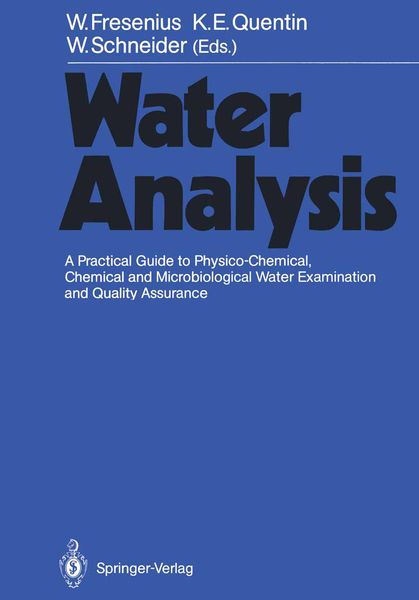
Water Analysis A Practical Guide to Physico-Chemical, Chemical and Microbiological Water Examination and Quality Assurance

10% sparen

104,99 € UVP 117,69 €

inkl. gesetzl. MwSt., Versandkostenfrei


Beschreibung

1977 saw the publication of "A Collection of Methods for Water Analysis", a three-volume work in ring-binder form compiled by W. Fresenius and W. Schneider for the GTZ (Deutsche Gesellschaft fUr Technische Zusammenarbeit), 6236 Eschborn 1, FRG. This publication was geared to the needs of a project in...

Beschreibung

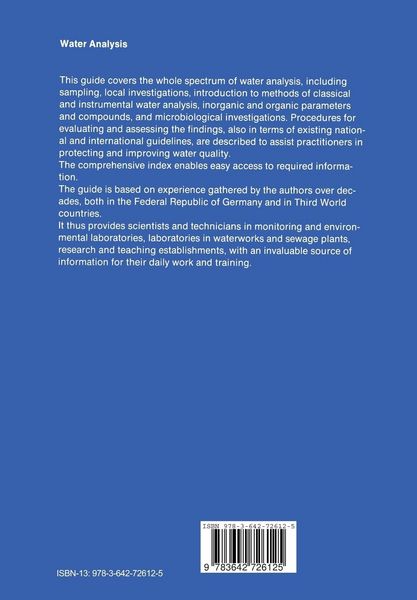
1977 saw the publication of "A Collection of Methods for Water Analysis", a three-volume work in ring-binder form compiled by W. Fresenius and W. Schneider for the GTZ (Deutsche Gesellschaft fUr Technische Zusammenarbeit), 6236 Eschborn 1, FRG. This publication was geared to the needs of a project in Algeria. More recently, the editors were requested by the GTZ to produce, on the basis of the previous collection of the water analysis methods, which was published in French, an updated and revised version to be used in different partner countries and for publication in 1985/86. This was not only to take account of advances in water analysis and instrumental techniques, but also to include simple methods of analysis for use in the field, and methods suitable for use in laboratories with relatively unsophisticated equipment. The approach envisaged by the GTZ was to divide up information on water, water supplies and water analysis into three broad groups, namely: 1. Simple modules on the physics and chemistry of water, water hygiene and water analysis capable of being understood and applied in practice by the layman using suitable chemi cals and equipment (W. Schneider). 2. Information to supplement work by Rump-Krist, also commissioned by the GTZ, on water analysis methods which could be used in laboratories with simple equipment, particularly in the Third World (Verlag Chemie, Weinheim, FRG, 1986).

Portrait

Wilhelm Schneider ist Professor am Institut für Strömungslehre und Wärmeübertragung der Technischen Universität Wien. Er wurde im Laufe seiner wissenschaftlichen Karriere vielfach geehrt, u.a. erhielt er die höchste Auszeichnung der Deutschen Gesellschaft für Luft- und Raumfahrt (DGLR) für seine herausragenden Leistungen in Forschung und Lehre auf dem Gesamtgebiet der Thermofluiddynamik. Besonders seine Forschungsarbeiten zu Über- und Hyperschallströmungen, zur Strahlungsgasdynamik, zu Konvektionsströmungen und zu Strömungen mit Phasenumwandlungen wurden gewürdigt.

Produktdetails

Einband

Taschenbuch

Erscheinungsdatum

10.12.2011

Abbildungen

XXVI, 804 p.

Herausgeber Wilhelm Fresenius + weitere

Produktdetails

Einband

Taschenbuch

Erscheinungsdatum

10.12.2011

Abbildungen

XXVI, 804 p.

Herausgeber
Verlag Springer Berlin
Seitenzahl

804

Maße (L/B/H)

24,2/17/4,5 cm

Gewicht

1401 g

Auflage

Softcover reprint of the original 1st edition 1988

Übersetzt von
  • A. Gledhill
  • Richard Holland
  • T.J. Oliver
Sprache

Englisch

ISBN

978-3-642-72612-5

Herstelleradresse

Springer-Verlag KG
Sachsenplatz 4-6
1201 Wien
AT

Email: ProductSafety@springernature.com

Ein neues Kapitel für Ihre Bücher

Ein neues Kapitel für Ihre Bücher

Schenken Sie Ihren alten Schätzen ein zweites Leben und erhalten Sie dafür eine Thalia Geschenkkarte.

Jetzt verkaufen
Jetzt verkaufen

Noch keine Bewertungen vorhanden

Verfassen Sie die erste Bewertung zu diesem Artikel

Helfen Sie anderen Kundinnen und Kunden durch Ihre Meinung.

Kundinnen und Kunden meinen

Bewertungen (0)

  • Produktbild: Water Analysis
  • Produktbild: Water Analysis
  • 1 Introduction, Sampling, Local Testing, etc..- 1.1 General.- 1.2 Local inspection and sampling of water.- 1.3 Techniques of water sampling.- 1.4 Water sampling in practice.- 1.5 Special instructions for sampling water of various origins and for various investigation purposes.- 1.6 Local investigations (see also 1.7).- 1.7 Local analyses (see also 1.6).- 2 Theoretical Introduction to Selected Methods of Water Analysis (Classic and Instrumental Methods).- 2.1 Concentration processes such as evaporation, distillation, precipitation, coprecipitation, adsorption, ion exchange and extraction.- 2.2 Electrochemical processes of analysis.- 2.3 Spectrophotometry (or photometry).- 2.4 Flame-emission spectrophotometry (FES).- 2.5 Emission spectrum analysis.- 2.6 X-ray Fluorescence Analysis.- 2.7 Atomic Absorption Spectrometry (AAS).- 2.8 Atomic Emission Spectrometry with Inductively Coupled Plasma Excitation (ICP-AES).- 2.9 Fluorescence Spectrometry.- 2.10 Infrared Spectroscopy.- 2.11 Chromatographic methods.- 2.12 Introduction to gas chromatography.- 2.13 Gas-chromatographic headspace analysis (cf. also Chapter 4).- 2.14 High-performance liquid chromatography (HPLC).- 2.15 Ion chromatography.- 2.16 Radiochemical analysis of water samples (Introduction).- 2.17 Enzymatic Analysis.- 3 Inorganic Parameters.- 3.1 Total parameters.- 3.2 Anions.- 3.3 Cations.- 3.4 Trace substances (inorganic) (For ICP-AES determination of 24 elements see Section 3.3.12).- 3.5 Undissociated substances (for H2S see also Sections 3.1 and 3.6).- 3.6 Gaseous Substances.- 3.7 Radioactivity measurements in water (see also Chapter 2).- 4 Organic Parameters.- 4.1 Overall organic parameters.- 4.2 Organic compounds.- 5 Biological Analysis.- 5.1 Significance of biological and ecological investigations when evaluating the quality of flowing water.- 5.2 Microbiological water analysis.- 5.3 Biological toxicity tests.- 6 Evaluation of Analysis Data.- 6.1 Introduction to statistical evaluation.- 6.2 Applications of statistical methods in water analysis.- 6.3 Quality control.- 6.4 Data evaluation.- 6.5 Time-series analyses.- 6.6 Technical advice.- 6.7 Assessment of water analysis findings.- 7 Subject Index.