















































KI-Beratung Beta

Gutscheinbedingungen

Gültig bis 30.11.2026 | Gültig für nicht preisgebundene fremdsprachige Bücher | Einzelne Artikel können ausgeschlossen sein | Online auf thalia.de und in der Thalia App einlösbar | Click & Collect nur mit Online-Zahlung (Paypal/Kreditkarte) vorab | Nicht kombinierbar mit anderen Gutscheinen oder Preisaktionen | Nur einmal pro Einkauf einlösbar | Gutschein wird auf max. 500€ Bestellwert angerechnet | Keine Barauszahlung | Nicht gültig für Versandkosten und Services

  • Produktbild: Logics for Databases and Information Systems
  • Produktbild: Logics for Databases and Information Systems
Band 436 - 13%

Logics for Databases and Information Systems

13% sparen

185,99 € UVP 213,99 €

inkl. gesetzl. MwSt., Versandkostenfrei


Beschreibung

Time is ubiquitous in information systems. Almost every enterprise faces the problem of its data becoming out of date. However, such data is often valu able, so it should be archived and some means to access it should be provided. Also, some data may be inherently historical, e.g., medical, cadastral,...

Beschreibung

Time is ubiquitous in information systems. Almost every enterprise faces the problem of its data becoming out of date. However, such data is often valu able, so it should be archived and some means to access it should be provided. Also, some data may be inherently historical, e.g., medical, cadastral, or ju dicial records. Temporal databases provide a uniform and systematic way of dealing with historical data. Many languages have been proposed for tem poral databases, among others temporal logic. Temporal logic combines ab stract, formal semantics with the amenability to efficient implementation. This chapter shows how temporal logic can be used in temporal database applica tions. Rather than presenting new results, we report on recent developments and survey the field in a systematic way using a unified formal framework [GHR94; Ch094]. The handbook [GHR94] is a comprehensive reference on mathematical foundations of temporal logic. In this chapter we study how temporal logic is used as a query and integrity constraint language. Consequently, model-theoretic notions, particularly for mula satisfaction, are of primary interest. Axiomatic systems and proof meth ods for temporal logic [GHR94] have found so far relatively few applications in the context of information systems. Moreover, one needs to bear in mind that for the standard linearly-ordered time domains temporal logic is not re cursively axiomatizable [GHR94]' so recursive axiomatizations are by necessity incomplete.

Portrait

Gunter Saake ist Professor für Informatik mit dem Schwerpunkt Datenbanktechnik an der Universität Magdeburg.

Produktdetails

Einband

Taschenbuch

Erscheinungsdatum

21.10.2012

Abbildungen

XIII, 430 p.

Herausgeber Jan Chomicki + weitere

Produktdetails

Einband

Taschenbuch

Erscheinungsdatum

21.10.2012

Abbildungen

XIII, 430 p.

Herausgeber
Verlag Springer Us
Seitenzahl

430

Maße (L/B/H)

23,5/15,5/2,5 cm

Gewicht

674 g

Sprache

Englisch

ISBN

978-1-4613-7582-1

Herstelleradresse

Springer-Verlag KG
Sachsenplatz 4-6
1201 Wien
AT

Email: ProductSafety@springernature.com

Ein neues Kapitel für Ihre Bücher

Ein neues Kapitel für Ihre Bücher

Schenken Sie Ihren alten Schätzen ein zweites Leben und erhalten Sie dafür eine Thalia Geschenkkarte.

Jetzt verkaufen
Jetzt verkaufen

Noch keine Bewertungen vorhanden

Verfassen Sie die erste Bewertung zu diesem Artikel

Helfen Sie anderen Kundinnen und Kunden durch Ihre Meinung.

Kundinnen und Kunden meinen

Bewertungen (0)

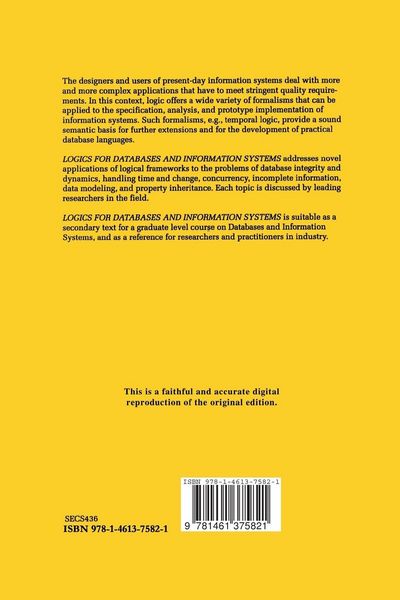
  • Produktbild: Logics for Databases and Information Systems
  • Produktbild: Logics for Databases and Information Systems
  • 1 Introduction to Logics for Databases and Information Systems.- References.- 2 A Logic Primer.- 2.1 Introduction.- 2.2 First-Order Logic (FOL).- 2.3 Modal Logics.- 2.4 Logic Programming.- 2.5 Conclusion.- References.- 3 Temporal Logic in Information Systems.- 3.1 Introduction.- 3.2 Temporal Databases.- 3.3 Temporal Queries.- 3.4 Temporal Integrity Constraints.- 3.5 Multidimensional Time.- 3.6 Beyond First-order Temporal Logic.- 3.7 Conclusions.- References.- 4 The Role of Deontic Logic in the Specification of Information Systems.- 4.1 Introduction: Soft Constraints and Deontic Logic.- 4.2 Standard Deontic Logic (SDL).- 4.3 The Paradoxes of Deontic Logic.- 4.4 A Diagnosis of the Problems.- 4.5 A Solution to the ‘Ought-to-Be’ Version of the Chisholm Paradox: S5O(n).- 4.6 Ought-to-Do: The Dynamic Perspective.- 4.7 An Integrated Logic of Ought-to-Be and Ought-to-Do Constraints.- 4.8 Applications.- References.- 5 A Logic for Programming Database Transactions.- 5.1 Introduction.- 5.2 Overview and Introductory Examples.- 5.3 Syntax.- 5.4 Elementary Operations.- 5.5 Model Theory.- 5.6 Proof Theory.- 5.7 Related Work.- References.- 6 Logics for Specifying Concurrent Information Systems.- 6.1 Introduction.- 6.2 Overview.- 6.3 Local Logic L.- 6.4 Distributed Logics.- 6.5 Reduction.- 6.6 Extended Example.- 6.7 Related Work.- 6.8 Concluding Remarks.- References.- 7 Evolving Logical Specification in Information Systems.- 7.1 Introduction.- 7.2 Motivation and Language.- 7.3 Syntax and Semantics of the Logic.- 7.4 Translation of Language into Logic.- 7.5 Using the Logical Framework.- 7.6 Concluding Remarks.- References.- 8 Description Logics for Conceptual Data Modeling.- 8.1 Introduction.- 8.2 Description Logics.- 8.3 Semantic Data Models.- 8.4 Object-Oriented Data Models.- 8.5Support for Data Modeling.- 8.6 Conclusions.- References.- 9 Integrity Constraints: Semantics and Applications.- 9.1 Introduction.- 9.2 Background.- 9.3 Semantics of Integrity Constraints.- 9.4 Reasoning with Integrity Constraints.- 9.5 Applications of Integrity Constraints.- 9.6 Conclusion and Future Directions.- References.- 10 Logical Approaches to Incomplete Information: A Survey.- 10.1 Introduction.- 10.2 Sources of Indefiniteness.- 10.3 A Semantic Framework for Incomplete Databases.- 10.4 Algebraic Models of Nulls.- 10.5 Logical Databases.- 10.6 Complexity of Queries.- 10.7 Negative Information.- 10.8 Integrity Constraints.- 10.9 Updates of Incomplete Databases.- 10.10 Other Issues.- 10.11 Incomplete Information in Current Technology.- References.- 11 Declarative Frameworks for Inheritance.- 11.1 Introduction.- 11.2 Motivation for Inheritance.- 11.3 Main Issues and Problems.- 11.4 Logic-based Approaches to Inheritance.- 11.5 Research Directions.- References.- 12 On Logical Foundations of Active Databases.- 12.1 Introduction.- 12.2 Basics of Active Rules.- 12.3 Research on Foundations of Active Rules.- 12.4 A Deductive State-Oriented Core Language.- 12.5 A Framework for Active Rules.- 12.6 Conclusion.- References.