















































KI-Beratung Beta

Gutscheinbedingungen

Gültig bis 30.11.2026 | Gültig für nicht preisgebundene fremdsprachige Bücher | Einzelne Artikel können ausgeschlossen sein | Online auf thalia.de und in der Thalia App einlösbar | Click & Collect nur mit Online-Zahlung (Paypal/Kreditkarte) vorab | Nicht kombinierbar mit anderen Gutscheinen oder Preisaktionen | Nur einmal pro Einkauf einlösbar | Gutschein wird auf max. 500€ Bestellwert angerechnet | Keine Barauszahlung | Nicht gültig für Versandkosten und Services

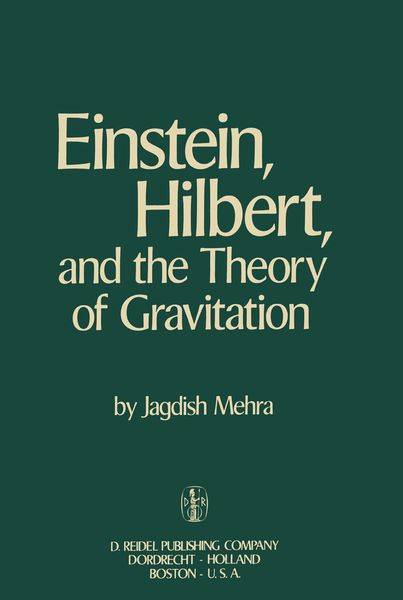
Produktbild: Einstein, Hilbert, and The Theory of Gravitation
- 13%

Einstein, Hilbert, and The Theory of Gravitation Historical Origins of General Relativity Theory

13% sparen

78,99 € UVP 90,94 €

inkl. gesetzl. MwSt., Versandkostenfrei


Beschreibung

Some time ago I published a small piece * dealing with a charming little essay on 'the state of ether in magnetic fields', which the sixteen-year-old Einstein had written while he was awaiting admission to the E. T. H. in Zurich. This paper sought to trace the continuity between Einstein's early interest...

Beschreibung

Some time ago I published a small piece * dealing with a charming little essay on 'the state of ether in magnetic fields', which the sixteen-year-old Einstein had written while he was awaiting admission to the E. T. H. in Zurich. This paper sought to trace the continuity between Einstein's early interest in electrodynamics and his later work on the special and general relativity theories. On reading this paper, Professor Eugene Wigner asked me whether David Hilbert had not independently discovered the field equations of gravitation. ** His impression from his stay in Gottingen (where Wigner had been Hilbert's assistant for one year in the late nineteen-twenties) was that Hilbert had indeed done so, and he asked me if it was true. I replied to Professor Wigner about Hilbert's contribution to the theory of gravitation. t He kindly encouraged me to expand my account to deal with the intricate and exciting details of the early years in the formulation of the general relativity theory of gravitation. This is what I have sought to do in this study. Albert Einstein created the general relativity theory of gravitation and dominated its development through the rest of his life. His early work on the theory of gravitation, from 1912 to 1916, had the drama of high adventure. It culminated in the establishment of its foundations which have remained unassailed by the theoretical and experimental work of succeeding decades.

Produktdetails

Einband

Taschenbuch

Erscheinungsdatum

30.11.1974

Abbildungen

96 p.

Verlag Springer Netherland

Produktdetails

Einband

Taschenbuch

Erscheinungsdatum

30.11.1974

Abbildungen

96 p.

Verlag Springer Netherland
Seitenzahl

96

Maße (L/B/H)

23,5/15,5/0,6 cm

Gewicht

166 g

Auflage

Softcover reprint of the original 1st ed. 1974

Sprache

Englisch

ISBN

978-90-277-0440-5

Herstelleradresse

Springer-Verlag KG
Sachsenplatz 4-6
1201 Wien
AT

Email: ProductSafety@springernature.com

Ein neues Kapitel für Ihre Bücher

Ein neues Kapitel für Ihre Bücher

Schenken Sie Ihren alten Schätzen ein zweites Leben und erhalten Sie dafür eine Thalia Geschenkkarte.

Jetzt verkaufen
Jetzt verkaufen

Noch keine Bewertungen vorhanden

Verfassen Sie die erste Bewertung zu diesem Artikel

Helfen Sie anderen Kundinnen und Kunden durch Ihre Meinung.

Kundinnen und Kunden meinen

Bewertungen (0)

  • Produktbild: Einstein, Hilbert, and The Theory of Gravitation
  • 1. Introduction.- 2. Steps Towards a New Theory of Gravitation.- 2.1 The Principles of Equivalence and Relativity.- 2.2 Abraham’s Objections.- 2.3 Nordström’s Theory.- 2.4 Einstein and Grossmann: Search for the Mathematical Tools of General Relativity.- 2.5 The Foundation of General Relativity.- 3. Physics and Geometry.- 3.1 The Role of Axiomatization in Hilbert’s Work.- 3.2 Concepts of Space and Geometry.- 3.3 Space-Time and Invariants.- 3.4 Mie’s Field Theory of Matter.- 3.5 Hilbert’s Communication to the Göttingen Academy.- 3.6 Axioms of Hilbert’s Theory of Matter.- 3.7 Hilbert’s Fundamental Theorem, Energy Conservation and the World Function.- 4. Completion of the Theory of Gravitation.- 4.1 General Covariance and the Equivalence Principle.- 4.2 Theory of the Gravitational Field.- 4.3 Consequences and Applications of the Theory of Gravitation.- 4.4 The Cosmological Term.- 5. Physical Interpretation of General Covariance.- 5.1 Axiom of Physical Interpretability.- 5.2 Restrictions due to Causality.- 5.3 Hilbert’s Conclusion.- 6. Hamilton’s Principle and the Conservation Laws.- 6.1 Lorentz and the Hamilton Principle in Einstein’s Theory.- 6.2 Einstein and the Hamilton Principle.- 7. General Covariance and Conservation Laws.- 7.1 Energy Conservation and the Theory of Invariants.- 7.2 Identities from General Covariance.- 7.3 Bianchi Identities and Hilbert’s Constraint Conditions.- 8. Extension of General Relativity.- 8.1 Generalization of Riemannian Geometry.- 8.2 Weyl’s Unified Theory.- 8.3 Five-Dimensional Relativity.- 9. ‘Ein Bleibender Kern’ — An Enduring Core.- References and Notes.- Index of names.