
















































KI-Beratung Beta

  • Produktbild: Burning the Reichstag
  • Produktbild: Burning the Reichstag

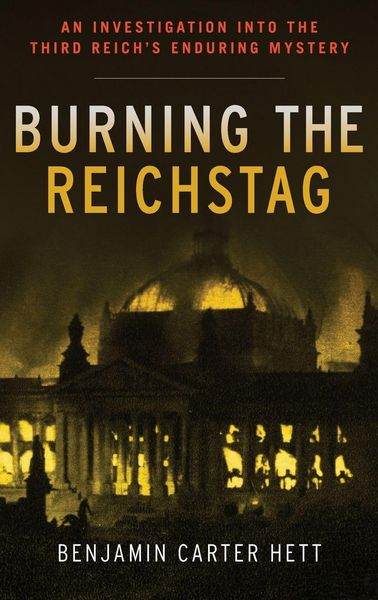
Burning the Reichstag An Investigation Into the Third Reich's Enduring Mystery

36,99 €

inkl. gesetzl. MwSt., Versandkostenfrei


Beschreibung

In February 1933, Adolf Hitler had only a tenuous grasp on power. Chancellor of Germany for merely four weeks, he led a fragile coalition government. The Nazis had lost seats in the Reichstag in the recent election, and claimed only three of thirteen cabinet posts. Then on February 27th, arson sent the...

Beschreibung

In February 1933, Adolf Hitler had only a tenuous grasp on power. Chancellor of Germany for merely four weeks, he led a fragile coalition government. The Nazis had lost seats in the Reichstag in the recent election, and claimed only three of thirteen cabinet posts. Then on February 27th, arson sent the Reichstag, the home and symbol of German democracy, up in flames. Immediately blaming the Communists, Hitler's new government approved a decree that tore the heart out of the democratic constitution of the Weimar Republic and cancelled the rule of law. Five thousand people were immediately arrested. The Reichstag fire marked the true beginning of the Third Reich, which ruled for 12 more years. The controversy surrounding the fire's origins has endured for 80.
In Burning the Reichstag, Benjamin Hett offers a gripping account of Hitler's rise to dictatorship-one that challenges orthodoxy and recovers the true significance of the part the fire played. At the scene the police arrested 23-year-old Marinus van der Lubbe, a Dutch Communist stonemason. Though he was initially dismissed abroad as a Nazi tool, post-war historians since the 1950s have largely judged him solely guilty-a lone arsonist exploited by Hitler. Hett's book reopens the case, providing vivid portraits of key figures, including Rudolf Diels, Hermann Goering, Joseph Goebbels, and the historian Fritz Tobias, whose account of the fire has, until now, been the standard. Making use of a number of new sources and archives, Hett sets the Reichstag fire in a wider context, revealing how and why it has remained one of the last mysteries of the Nazi period, and one of the most controversial and contested events in the 20th century. Burning the Reichstag will stand as the landmark work on this subject.

Rezension

It is an impressive piece of work that presents fresh evidence ... It is well written and highly readable. London Review of Books

Produktdetails

Einband

Gebundene Ausgabe

Erscheinungsdatum

03.01.2014

Abbildungen

16 black & white illustrations

Verlag Oxford University Press

Produktdetails

Einband

Gebundene Ausgabe

Erscheinungsdatum

03.01.2014

Abbildungen

16 black & white illustrations

Verlag Oxford University Press
Seitenzahl

424

Maße (L/B/H)

24,1/16,1/3,5 cm

Gewicht

830 g

Sprache

Englisch

ISBN

978-0-19-932232-9

Herstelleradresse

Libri GmbH
Europaallee 1
36244 Bad Hersfeld
DE

Email: gpsr@libri.de

Ein neues Kapitel für Ihre Bücher

Ein neues Kapitel für Ihre Bücher

Schenken Sie Ihren alten Schätzen ein zweites Leben und erhalten Sie dafür eine Thalia Geschenkkarte.

Jetzt verkaufen
Jetzt verkaufen

Noch keine Bewertungen vorhanden

Verfassen Sie die erste Bewertung zu diesem Artikel

Helfen Sie anderen Kundinnen und Kunden durch Ihre Meinung.

Kundinnen und Kunden meinen

Bewertungen (0)

Die Leseprobe wird geladen.
  • Produktbild: Burning the Reichstag
  • Produktbild: Burning the Reichstag
    • Prologue I: Hannover, Sunday, July 20, 2008
    • Prologue II: Berlin, Monday, February 27, 1933
    • Chapter 1: "Satanic Nose ": Rudolf Diels
    • Chapter 2: "SA + Me ": Joseph Goebbels
    • Chapter 3: "What Just Went On Here is an Absolute Outrage ": Rumors
    • Chapter 4: "Those Who Know Nothing Are Better Off ": The Investigation
    • Chapter 5: "Stand Up, van der Lubbe! " The Trial and What Followed
    • Chapter 6: "Nuremberg History ": The Prosecutors' Tale
    • Chapter 7: "Persil Letters ": The Gestapists' Tale
    • Chapter 8: "The Feared One ": Fritz Tobias and His "Clients "
    • Chapter 9: "Snow From Yesterday ": Blackmail and the Institute for Contemporary History
    • Epilogue: Decadence of a Controversy