















































KI-Beratung Beta

Gutscheinbedingungen

Gültig bis 30.11.2026 | Gültig für nicht preisgebundene fremdsprachige Bücher | Einzelne Artikel können ausgeschlossen sein | Online auf thalia.de und in der Thalia App einlösbar | Click & Collect nur mit Online-Zahlung (Paypal/Kreditkarte) vorab | Nicht kombinierbar mit anderen Gutscheinen oder Preisaktionen | Nur einmal pro Einkauf einlösbar | Gutschein wird auf max. 500€ Bestellwert angerechnet | Keine Barauszahlung | Nicht gültig für Versandkosten und Services

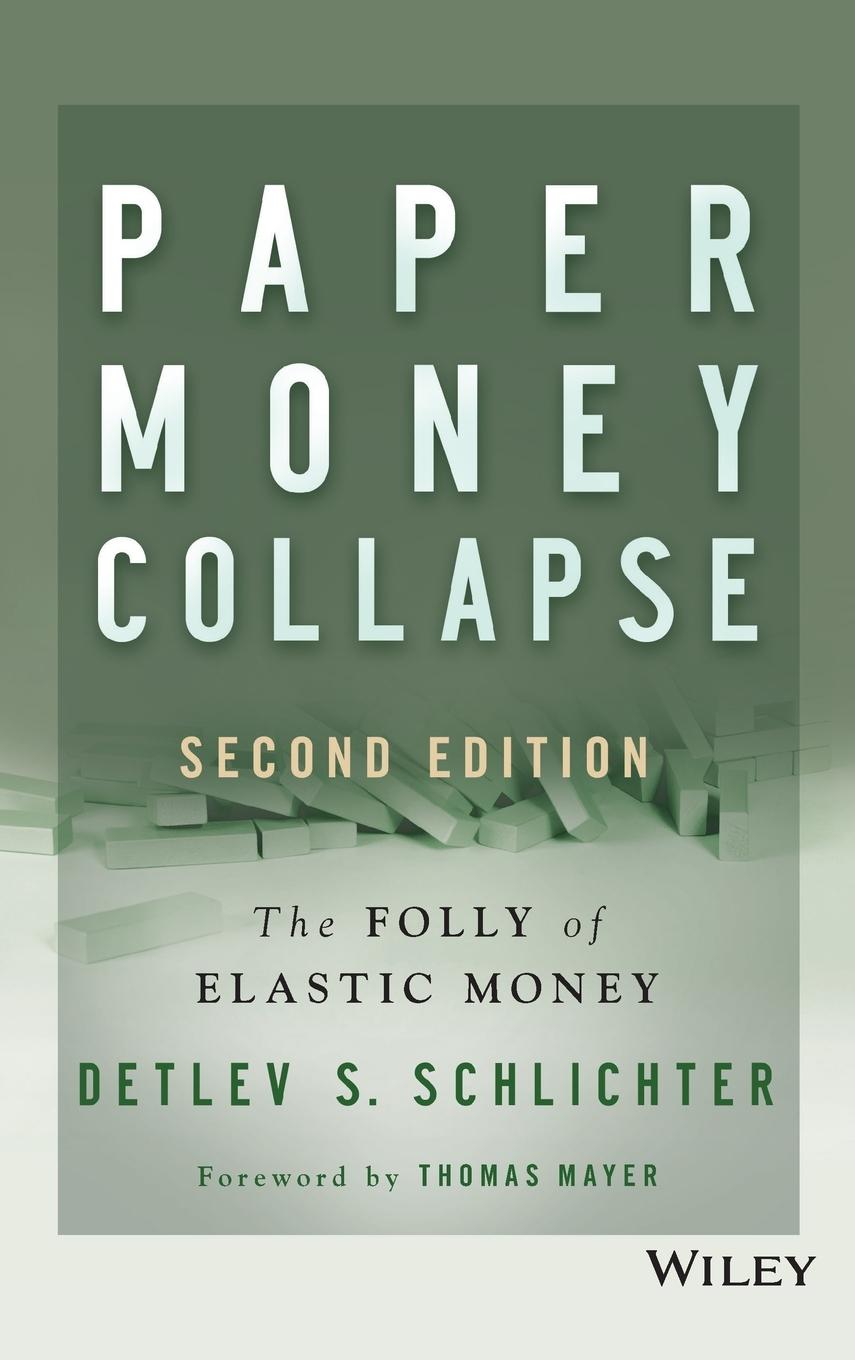
Produktbild: Money Collapse 2e

Money Collapse 2e

37,99 €

inkl. gesetzl. MwSt., Versandkostenfrei


Beschreibung

Explore the inevitable collapse of the fiat monetary system   Paper Money Collapse: The Folly of Elastic Money, Second Edition challenges the mainstream consensus on money and monetary policy. While it is today generally believed that the transition from 'hard' and inflexible commodity money (such as a...

Beschreibung

Explore the inevitable collapse of the fiat monetary system
 
Paper Money Collapse: The Folly of Elastic Money, Second Edition challenges the mainstream consensus on money and monetary policy. While it is today generally believed that the transition from 'hard' and inflexible commodity money (such as a gold standard) to entirely flexible and potentially unlimited fiat money under national central banks allows for superior economic stability, Paper Money Collapse shows that the opposite is true. Systems of highly elastic and constantly expanding money are not only unnecessary, even for growing economies, they are always extremely destabilizing. Over time, they must lead to substantial imbalances, including excessive levels of debt and distorted asset prices, that will require ever faster money production to sustain. Ultimately, however, there is no alternative to a complete liquidation of these distortions. Based on insights of many renowned economists and in particular of the Austrian School of Economics, the book explains through rigorous logic and in precise language why our system of flexible fiat money is incompatible with a market economy and therefore unsustainable. Paper money systems have always led to economic disintegration--without exception--throughout history. It will not be different for our system and we may be closer to the endgame than many think.
 
The updated second edition incorporates:
* A new introduction and an extended outlook section that discusses various "endgames"
* Responses to criticisms, alternative views, and a critical assessment of 'solutions'
* Comments on recent policy trends, including attempts to exit the 'easy money' policy mode
* An evaluation of new crypto-currency Bitcoin
 
Paper Money Collapse: The Folly of Elastic Money, Second Edition clarifies the problem of paper money clearly and eloquently, and proposes multiple routes to a solution.

Produktdetails

Einband

Gebundene Ausgabe

Erscheinungsdatum

21.07.2014

Verlag John Wiley & Sons Inc
Seitenzahl

336

Produktdetails

Einband

Gebundene Ausgabe

Erscheinungsdatum

21.07.2014

Verlag John Wiley & Sons Inc
Seitenzahl

336

Maße (L/B/H)

23,5/15,7/2,3 cm

Gewicht

643 g

Auflage

2nd edition

Sprache

Englisch

ISBN

978-1-118-87732-6

Herstelleradresse

Libri GmbH
Europaallee 1
36244 Bad Hersfeld
DE

Email: gpsr@libri.de

Ein neues Kapitel für Ihre Bücher

Ein neues Kapitel für Ihre Bücher

Schenken Sie Ihren alten Schätzen ein zweites Leben und erhalten Sie dafür eine Thalia Geschenkkarte.

Jetzt verkaufen
Jetzt verkaufen

Noch keine Bewertungen vorhanden

Verfassen Sie die erste Bewertung zu diesem Artikel

Helfen Sie anderen Kundinnen und Kunden durch Ihre Meinung.

Kundinnen und Kunden meinen

Bewertungen (0)

Die Leseprobe wird geladen.
  • Produktbild: Money Collapse 2e
  • Foreword xiii
     
    Acknowledgments xvii
     
    Prologue Contra the Mainstream Consensus--What This Book Is About 1
     
    The Ruling Mainstream Consensus on Money 2
     
    The Growth-versus-Inflation Trade-Off 7
     
    What This Book Shows 8
     
    Understanding Our Fiat Money System 11
     
    What Is Different from the First Edition? 14
     
    Support from Eminent Economists 19
     
    A Note on Pronouns in the Text 20
     
    Notes 21
     
    Part One The Basics of Money
     
    Chapter 1 The Fundamentals of Money and Money Demand 25
     
    The Origin and Purpose of Money 26
     
    An Anthropologist's Challenge 29
     
    What Gives Money Value? 34
     
    (Almost) Any Quantity of Money Will Do 36
     
    The Demand for Money 38
     
    Are "Sticky" Prices a Problem? 42
     
    Other Functions of Money 46
     
    The Unique Position of the Paper Money Producer 51
     
    The Monetary Asset versus Other Goods 54
     
    Notes 61
     
    Chapter 2 The Fundamentals of Fractional-Reserve Banking 65
     
    The Origin and Basics of Fractional-Reserve Banking 69
     
    Who Owns "Deposited" Money? 74
     
    Exposing Misconceptions about Fractional-Reserve Banking 77
     
    "Free Banking" Is Limited Banking 83
     
    Summary of Part One 87
     
    Notes 89
     
    Part Two The Effects of Money Injections
     
    Chapter 3 Money Injections without Credit Markets 95
     
    Even, Instant, and Transparent Money Injection 95
     
    Even and Nontransparent Money Injection 98
     
    Uneven and Nontransparent Money Injection 102
     
    Notes 107
     
    Chapter 4 Money Injections via Credit Markets 109
     
    Consumption, Saving, and Investing 110
     
    Interest 111
     
    Interest Rates Are Not Determined by Factor Productivity 113
     
    Money Injection via the Loan Market 119
     
    The Process in More Detail 120
     
    Policy Implications of the Austrian Theory 130
     
    Addendum: Gordon Tullock's Critique of the Austrian Business Cycle Theory and Some Words on "Forced Saving" 133
     
    An Example: U.S. Housing Boom and Bust 143
     
    Summary of Part Two 150
     
    Notes 154
     
    Part Three Fallacies about the Price Level and Price-Level Stabilization
     
    Chapter 5 Common Misconceptions Regarding the Price Level 159
     
    The Fallacy That a Stable Price Level Means "Neutral" Money 160
     
    The Fallacy That Hard Money Is Unstable Money, Part 1--History 164
     
    The Fallacy That Hard Money Is Unstable Money, Part 2--Theory 170
     
    Notes 179
     
    Chapter 6 The Policy of Stabilization 181
     
    Problems with Price Index Stabilization 181
     
    Addendum: The "Free Bankers" and the Theory of Immaculate Fractional-Reserve Banking 187
     
    Summary of Part Three 193
     
    Notes 195
     
    Part Four A History of Paper Money and How We Got to Where We Are Now
     
    Chapter 7 A Legacy of Failure 199
     
    Paper Money Experiments 201
     
    1914-2014: A Century of Monetary Decay 206
     
    Notes 215
     
    Part Five Beyond the Cycle: Paper Money's Endgame and the Future of Money
     
    Chapter 8 The Beneficiaries of the Paper Money System 221
     
    Paper Money and the Banks 223
     
    Paper Money and the State 225
     
    Paper Money and the Professional Economist 231
     
    Notes 234
     
    Chapter 9 The Intellectual Superstructure of the Present System 235
     
    The Alternative View: Individualism and Laissez-Faire 237
     
    The Mainstream View: Collectivism and Interventionism 241
     
    The Political Appeal of Mainstream Macroeconomics 244
     
    The Myth That Everybody Benefits from "Stimulus" 247
    &n