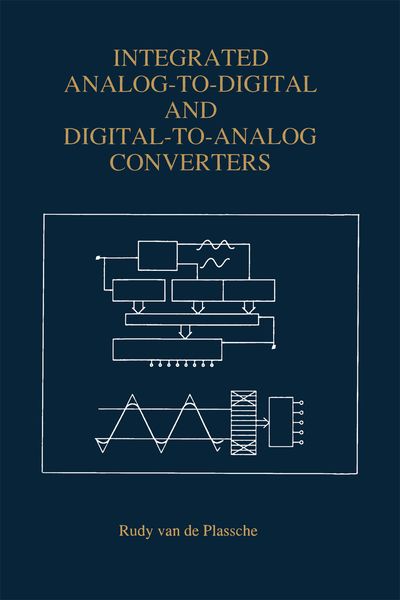
Integrated Analog-To-Digital and Digital-To-Analog Converters
-
- Taschenbuch ausgewählt
- eBook
-
Sprache:Englisch
48,99 €
inkl. gesetzl. MwSt.,
Beschreibung
Produktdetails
Einband
Taschenbuch
Erscheinungsdatum
05.11.2012
Abbildungen
XLIV, 501 p.
Verlag
Springer UsSeitenzahl
501
Maße (L/B/H)
24/16/3 cm
Gewicht
865 g
Auflage
Softcover reprint of the original 1st ed. 1994
Sprache
Englisch
ISBN
978-1-4613-6186-2
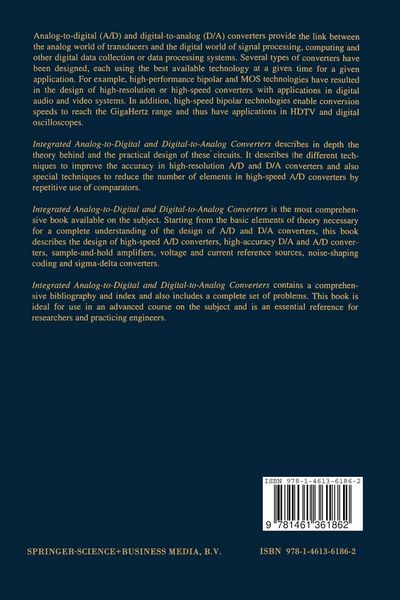
Analog-to-digital (A/D) and digital-to-analog (D/A) converters provide the link between the analog world of transducers and the digital world of signal processing, computing and other digital data collection or data processing systems. Several types of converters have been designed, each using the best available technology at a given time for a given application. For example, high-performance bipolar and MOS technologies have resulted in the design of high-resolution or high-speed converters with applications in digital audio and video systems. In addition, high-speed bipolar technologies enable conversion speeds to reach the gigaHertz range and thus have applications in HDTV and digital oscilloscopes.
Integrated Analog-to-Digital and Digital-to-Analog Converters
describes in depth the theory behind and the practical design of these circuits. It describes the different techniques to improve the accuracy in high-resolution A/D and D/A converters and also special techniques to reduce the number of elements in high-speed A/D converters by repetitive use of comparators.
Integrated Analog-to-Digital and Digital-to-Analog Converters
is the most comprehensive book available on the subject. Starting from the basic elements of theory necessary for a complete understanding of the design of A/D and D/A converters, this book describes the design of high-speed A/D converters, high-accuracy D/A and A/D converters, sample-and-hold amplifiers, voltage and current reference sources, noise-shaping coding and sigma-delta converters.
Integrated Analog-to-Digital and Digital-to-Analog Converters
contains a comprehensive bibliography and index and also includes a complete set of problems. This book is ideal for use in an advanced course on the subject and is an essential reference for researchers and practicing engineers.
Ein neues Kapitel für Ihre Bücher
Ein neues Kapitel für Ihre Bücher
Schenken Sie Ihren alten Schätzen ein zweites Leben und erhalten dafür eine Thalia Geschenkkarte.
Noch keine Bewertungen vorhanden
Verfassen Sie die erste Bewertung zu diesem Artikel
Helfen Sie anderen Kundinnen und Kunden durch Ihre Meinung.
Kurze Frage zu unserer Seite
Vielen Dank für Ihr Feedback
Wir nutzen Ihr Feedback, um unsere Produktseiten zu verbessern. Bitte haben Sie Verständnis, dass wir Ihnen keine Rückmeldung geben können. Falls Sie Kontakt mit uns aufnehmen möchten, können Sie sich aber gerne an unseren Kund*innenservice wenden.
zum Kundenservice