















































KI-Beratung Beta

Gutscheinbedingungen

Gültig bis 30.11.2026 | Gültig für nicht preisgebundene fremdsprachige Bücher | Einzelne Artikel können ausgeschlossen sein | Online auf thalia.de und in der Thalia App einlösbar | Click & Collect nur mit Online-Zahlung (Paypal/Kreditkarte) vorab | Nicht kombinierbar mit anderen Gutscheinen oder Preisaktionen | Nur einmal pro Einkauf einlösbar | Gutschein wird auf max. 500€ Bestellwert angerechnet | Keine Barauszahlung | Nicht gültig für Versandkosten und Services

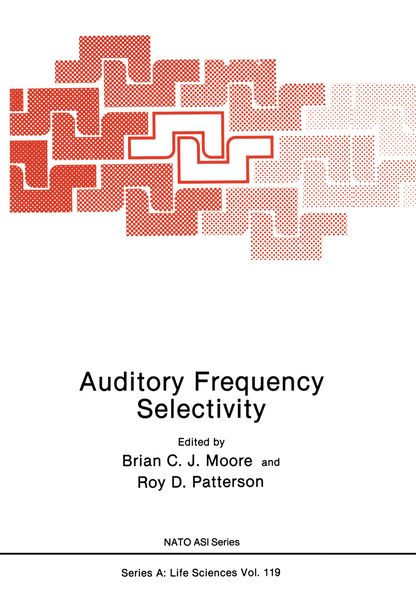
  • Produktbild: Auditory Frequency Selectivity
  • Produktbild: Auditory Frequency Selectivity
Band 119

Auditory Frequency Selectivity

Aus der Reihe NATO Science Series A:

97,99 €

inkl. gesetzl. MwSt., Versandkostenfrei


Beschreibung

One of the most fundamental aspects of the auditory system is its frequency selectivity - the ability to resolve a complex sound into frequency compOhents. This ability plays a role in many aspects of auditory perception, including: the masking of one sound by another; the perception of pitch for pure...

Beschreibung

One of the most fundamental aspects of the auditory system is its frequency selectivity - the ability to resolve a complex sound into frequency compOhents. This ability plays a role in many aspects of auditory perception, including: the masking of one sound by another; the perception of pitch for pure tones and complex tones; the perception of timbre; the perception of the relative phase of components in complex sounds; and the perception of loudness. Over the last decade, there have been considerable advances in our understanding of frequency selectivity, both at the physiological and psychophysical level, and rapid progress continues to be made. This book summarizes the proceedings of a NATO Advanced Research Workshop on Auditory Frequency Selectivity which was held in Wolfson College, Cambridge from June 23rd to 27th, 1986. The Workshop brought together leading researchers from all disciplines relevant to the topic, with the aim of reviewing and consolidating the latest research findings, and identifying areas of uncertainty or controversy where further research is needed. The book is aimed primarily at research scientists and research students in the fields of psychology, audiology, auditory physiology, biophysics, medicine, acoustical engineering, noise control, communication and speech science. It should also be useful for advanced undergraduates in these disciplines. A feature of the book is that it includes summaries of the discussions which followed the presentation of each paper at the Workshop.

Portrait

Brian Moore wurde 1921 in Belfast geboren. Sein schriftstellerisches Werk wurde mit zahlreichen Literaturpreisen ausgezeichnetes und zum Teil verfilmt. Der Autor verstarb 1999 in Kalifornieren.

Produktdetails

Einband

Taschenbuch

Erscheinungsdatum

12.12.2012

Abbildungen

X, 456 p. 24 illus.

Herausgeber Brian Moore

Produktdetails

Einband

Taschenbuch

Erscheinungsdatum

12.12.2012

Abbildungen

X, 456 p. 24 illus.

Herausgeber Brian Moore
Verlag Springer Us
Seitenzahl

456

Maße (L/B/H)

25,4/17,8/2,6 cm

Gewicht

873 g

Auflage

Softcover reprint of the original 1st ed. 1986

Sprache

Englisch

ISBN

978-1-4612-9316-3

Herstelleradresse

Springer-Verlag KG
Sachsenplatz 4-6
1201 Wien
AT

Email: ProductSafety@springernature.com

Ein neues Kapitel für Ihre Bücher

Ein neues Kapitel für Ihre Bücher

Schenken Sie Ihren alten Schätzen ein zweites Leben und erhalten Sie dafür eine Thalia Geschenkkarte.

Jetzt verkaufen
Jetzt verkaufen

Noch keine Bewertungen vorhanden

Verfassen Sie die erste Bewertung zu diesem Artikel

Helfen Sie anderen Kundinnen und Kunden durch Ihre Meinung.

Kundinnen und Kunden meinen

Bewertungen (0)

  • Produktbild: Auditory Frequency Selectivity
  • Produktbild: Auditory Frequency Selectivity
  • Cochlear Mechanics and Otoacoustic Emissions.- Changes in Cochlear Frequency Selectivity Produced by Tectorial-Membrane Manipulation.- Basilar Membrane Tuning in the Pigeon Ear.- Ultra-High Frequency Selectivity in the Horseshoe Bat: Does the Bat Use an Acoustic Interference Filter?.- Asymmetry in Reflection of Cochlear Waves.- The Effects of Temperature on Otoacoustic Emission Tuning Properties.- Spontaneous Oto-acoustic Emissions, Threshold in Quiet, and Just Noticeable Amplitude Modulation at Low Levels.- Mechanical and Electrical Tuning in Hair Cells.- The Evolution of Mechanisms of Frequency Selectivity in Vertebrates.- Harmonic Components in Hair Cell Responses.- Membrane Currents in Solitary Turtle Hair Cells.- Correlation Between the Kinetic Properties of Ionic Channels and the Frequency of Membrane-Potential Resonance in Hair Cells of the Bullfrog.- Direct Evidence for an Active Mechanical Process in Mammalian Outer Hair Cells.- The Cellular Physiology of Isolated Outer Hair Cells: Implications for Cochlear Frequency Selectivity.- Outer Hair Cell Motility and Cochlear Frequency Selectivity.- Electrophysiological Measures of Frequency Selectivity and Suppression.- Some Aspects of Rate Coding in the Auditory Nerve.- Adaptation, Suppression and Tuning in Amphibian Acoustical Fibers.- Frequency Selectivity, Adaptation, and Suppression in Goldfish Auditory Nerve Fibers.- Frequency Selectivity of Acoustically Evoked Potentials from Peripheral and Central Vestibular Structures.- Low Doses of Aminoglycosides Alter the Action Potential Tuning Curve Without Change in Threshold Sensitivity.- Compound Action Potential (CAP) Tuning in Man and Guinea Pig: Effect of Probe Tone Level and Hearing Loss.- Auditory Nerve-Fibre Bandwidths Determined by Two Different Simultaneous Masking Procedures.- Single-Neuron Timing Curves Measured with Psychoacoustic Masking Paradigms.- Measurement and Interpretation of Phase-Locked Neural Responses.- Basilar Membrane Motion and Spike Initiation in the Cochlear Nerve.- Filtering Due to the Inner Hair-Cell Membrane Properties and its Relation to the Phase-locking Limit in Cochlear Nerve Fibres.- Phase Response of Low-Frequency Cochlear Ganglion Cells in the Starling.- Synchronization and Suppression in Primary Auditory Fibers: An Examination of Vector Strength in Relation to Suppression.- Effects of Phase and Amplitude Spectrum in the Nonlinear Processing of Complex Stimuli in Single Fibers of the Auditory Nerve.- Possible Role of Low and Medium Spontaneous Rate Cochlear Nerve Fibers in the Encoding of Waveform Periodicity.- Cochlear Nerve Fibre Temporal Discharge Patterns, Cochlear Frequency Selectivity and the Dominant Region for Pitch.- Strategies for the Representation of Broadband Stimuli in the Discharge Patterns of Auditory-Nerve Fibers.- Comparisons Between Actual and Simulated Responses of Auditory Nerve Fibers Excited by Natural Stop Consonant-Vowel Syllables.- Responses of Cochlear Nucleus Neurons to Speech Signals: Neural Encoding of Pitch, Intensity and Other Parameters.- Encoding the Acoustic Spectrum in the Spatio-Temporal Responses of the Auditory Nerve.- Thinning Periodicity Detectors for Modulated Pulse Streams.- Psychoacoustic Measures of Frequency Selectivity and Suppression.- Critical Bandwidth at Low Frequencies Reconsidered.- Frequency Resolution Measured by Adaptively Varying the Notchwidth: Results from Normals and Hearing Impaired.- The Effect of Hearing Impairment on Auditory Filter Shapes in Simultaneous and Forward Masking.- Tuning Curves at High Frequencies and Their Relation tothe Absolute Threshold Curve.- ‘Frequency’ and the Detection of Spectral Shape.- Processing of Complex Signals and the Role of Inhibition.- The Unimportance of Suppression.- Masking Produced by Fluctuating Sounds.- Effects of the Temporal Properties of a Masker upon Simultaneous-Masking Patterns.- ‘Binaural Frequency Selectivity’ and CMR.- Masking of Short Noise Probes by Frequency Sweeps for Hearing-Impaired and Normal-Hearing Listeners.- Perceptual Correlates of Frequency Selectivity.- The Relationship Between Frequency Selectivity and Frequency Discrimination for Subjects with Unilateral and Bilateral Cochlear Impairments.- Monaural Phase Sensitivity: Frequency Selectivity and Temporal Processes.- On Thresholds of Short-Duration Intensity Increments and Decrements.- The Role of Aural Frequency Analysis in Pitch Perception with Simultaneous Complex Tones.- Participants.- First Author Index.