















































KI-Beratung Beta

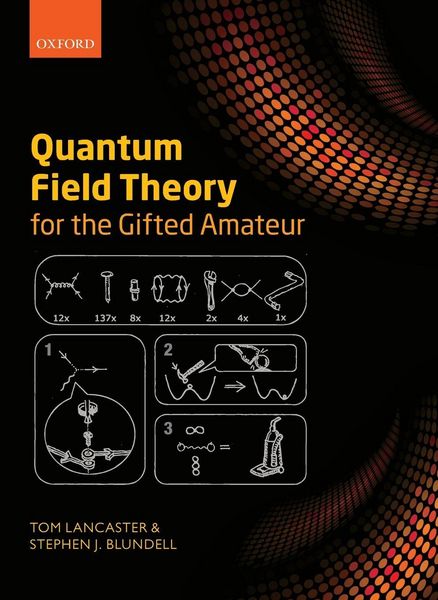
  • Produktbild: Quantum Field Theory for the Gifted Amateur
  • Produktbild: Quantum Field Theory for the Gifted Amateur

Quantum Field Theory for the Gifted Amateur

129,00 €

inkl. gesetzl. MwSt., Versandkostenfrei


Beschreibung

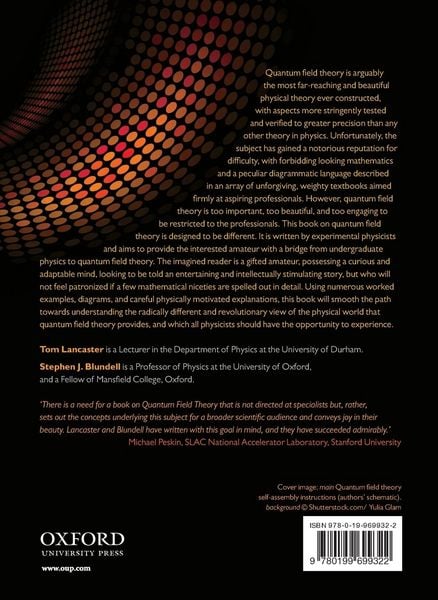
Quantum field theory provides the theoretical backbone to most modern physics. This book is designed to bring quantum field theory to a wider audience of physicists. It is packed with worked examples, witty diagrams, and applications intended to introduce a new audience to this revolutionary theory....

Beschreibung

Quantum field theory provides the theoretical backbone to most modern physics. This book is designed to bring quantum field theory to a wider audience of physicists. It is packed with worked examples, witty diagrams, and applications intended to introduce a new audience to this revolutionary theory.

Rezension

A refreshing hands-on approach ... [and] a tremendous resource to have to hand or perhaps to use as a textbook for a first course on QFT to a mixed audience. Clifford V. Johnson, Physics Today

Produktdetails

Einband

Gebundene Ausgabe

Erscheinungsdatum

26.01.2012

Abbildungen

242 b/w illustrations

Verlag KNV Besorgung

Produktdetails

Einband

Gebundene Ausgabe

Erscheinungsdatum

26.01.2012

Abbildungen

242 b/w illustrations

Verlag KNV Besorgung
Seitenzahl

504

Maße (L/B/H)

25,2/19,4/3,1 cm

Gewicht

1102 g

Farbe

Schwarz

Sprache

Englisch

ISBN

978-0-19-969932-2

Herstelleradresse

Libri GmbH
Europaallee 1
36244 Bad Hersfeld
DE

Email: gpsr@libri.de

Ein neues Kapitel für Ihre Bücher

Ein neues Kapitel für Ihre Bücher

Schenken Sie Ihren alten Schätzen ein zweites Leben und erhalten Sie dafür eine Thalia Geschenkkarte.

Jetzt verkaufen
Jetzt verkaufen

Noch keine Bewertungen vorhanden

Verfassen Sie die erste Bewertung zu diesem Artikel

Helfen Sie anderen Kundinnen und Kunden durch Ihre Meinung.

Kundinnen und Kunden meinen

Bewertungen (0)

  • Produktbild: Quantum Field Theory for the Gifted Amateur
  • Produktbild: Quantum Field Theory for the Gifted Amateur
    • Overture
    • I: The Universe as a set of harmonic oscillators
    • 1: Lagrangians
    • 2: Simple harmonic oscillators
    • 3: Occupation number representation
    • 4: Making second quantization work
    • II: Writing down Lagrangians
    • 5: Continuous systems
    • 6: A first stab at relativistic quantum mechanics
    • 7: Examples of Lagrangians, or how to write down a theory
    • III: The need for quantum fields
    • 8: The passage of time
    • 9: Quantum mechanical transformations
    • 10: Symmetry
    • 11: Canonical quantization of fields
    • 12: Examples of canonical quantization
    • 13: Fields with many components and massive electromagnetism
    • 14: Gauge fields and gauge theory
    • 15: Discrete transformations
    • IV: Propagators and perturbations
    • 16: Ways of doing quantum mechanics: propagators and Green's functions
    • 17: Propagators and Fields
    • 18: The S-matrix
    • 19: Expanding the S-matrix: Feynman diagrams
    • 20: Scattering theory
    • V: Interlude: wisdom from statistical physics
    • 21: Statistical physics: a crash course
    • 22: The generating functional for fields
    • VI: Path Integrals
    • 23: Path Integrals: I said to him, "You're crazy"
    • 24: Field Integrals
    • 25: Statistical field theory
    • 26: Broken symmetry
    • 27: Coherent states
    • 28: Grassmann numbers: coherent states and the path integral for fermions
    • VII: Topological ideas
    • 29: Topological objects
    • 30: Topological field theory
    • VIII: Renormalization: taming the infinite
    • 31: Renormalization, quasiparticles and the Fermi surface
    • 32: Renormalization: the problem and its solution
    • 33: Renormalization in action: propagators and Feynman diagrams
    • 34: The renormalization group
    • 35: Ferromagnetism: a renormalization group tutorial
    • IX: Putting a spin on QFT
    • 36: The Dirac equation
    • 37: How to transform a spinor
    • 38: The quantum Dirac field
    • 39: A rough guide to quantum electrodynamics
    • 40: QED scattering: three famous cross sections
    • 41: The renormalization of QED and two great results
    • X: Some applications from the world of condensed matter
    • 42: Superfluids
    • 43: The many-body problem and the metal
    • 44: Superconductors
    • 45: The fractional quantum Hall fluid
    • XI: Some applications from the world of particle physics
    • 46: Non-abelian gauge theory
    • 47: The Weinberg-Salam model
    • 48: Majorana fermions
    • 49: Magnetic monopoles
    • 50: Instantons, tunnelling and the end of the world
    • Appendix A: Further reading
    • Appendix B: Useful complex analysis