















































KI-Beratung Beta

Gutscheinbedingungen

Gültig bis 30.11.2026 | Gültig für nicht preisgebundene fremdsprachige Bücher | Einzelne Artikel können ausgeschlossen sein | Online auf thalia.de und in der Thalia App einlösbar | Click & Collect nur mit Online-Zahlung (Paypal/Kreditkarte) vorab | Nicht kombinierbar mit anderen Gutscheinen oder Preisaktionen | Nur einmal pro Einkauf einlösbar | Gutschein wird auf max. 500€ Bestellwert angerechnet | Keine Barauszahlung | Nicht gültig für Versandkosten und Services

Produktbild: Seven AVMs
- 13%

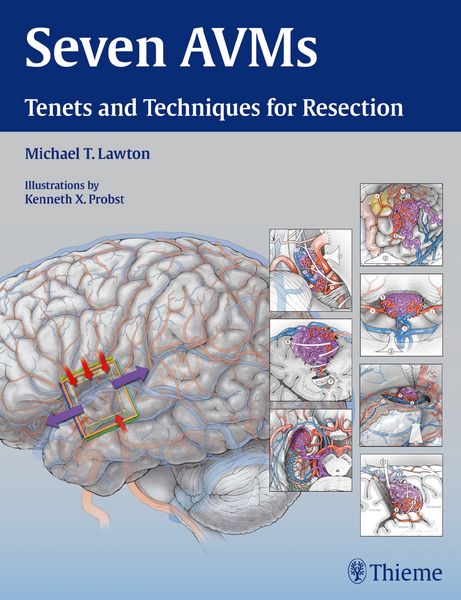
Seven AVMs Tenets and Techniques for Resection

13% sparen

155,99 € UVP 180,00 €

inkl. gesetzl. MwSt., Versandkostenfrei


Beschreibung

An exquisitely illustrated guide to AVMs Honorable Mention at 2015 PROSE Awards! This sequel to Dr. Lawton's best-selling Seven Aneurysms focuses on microsurgical resection techniques for AVMs found in the lobes and deep regions of the brain. It categorizes the techniques into subtypes to simplify the...

Beschreibung

An exquisitely illustrated guide to AVMs
Honorable Mention at 2015 PROSE Awards!
This sequel to Dr. Lawton's best-selling Seven Aneurysms focuses on microsurgical resection techniques for AVMs found in the lobes and deep regions of the brain. It categorizes the techniques into subtypes to simplify the broad spectrum of brain AVMs neurosurgeons may encounter. The book is organized into three sections: The Tenets, which establishes eight steps for AVM resection; The Seven Arteriovenous Malformations, which describes the anatomical terrain and surgical strategies for thirty-two AVM subtypes; and The Selection section, in which Dr. Lawton discusses what he believes to be the keys to successful AVM surgery: good patient selection and best application of multiple treatment modalities.
Key Features:
- Includes more than 700 spectacular full-color illustrations developed exclusively for this book- Creates a system for conceptualizing and approaching AVMs- Illustrates a stepwise process for AVM resection using strategic "battle plans"
Summarizing the common AVMs encountered in practice, neurosurgeons and neurosurgical residents will find this hybrid atlas-text to be an essential part of their armamentarium.

Produktdetails

Einband

Gebundene Ausgabe

Erscheinungsdatum

05.03.2014

Abbildungen

869 Abb.

Herausgeber Michael T. Lawton

Produktdetails

Einband

Gebundene Ausgabe

Erscheinungsdatum

05.03.2014

Abbildungen

869 Abb.

Herausgeber Michael T. Lawton
Verlag Thieme Medical Publishers
Seitenzahl

352

Maße (L/B/H)

28,7/21,7/2,5 cm

Gewicht

1270 g

Farbe

Cool Grey / Marine

Auflage

1. Auflage

Sprache

Englisch

ISBN

978-1-60406-875-7

EU-Ansprechpartner

Georg Thieme Verlag KG
Oswald-Hesse-Straße 50
70469 Stuttgart
DE
info@thieme.de

Herstelleradresse

Thieme Medical Publishers
333 Seventh Avenue, 18th Floor
10001 New York
US
customerservice@thieme.com

Ein neues Kapitel für Ihre Bücher

Ein neues Kapitel für Ihre Bücher

Schenken Sie Ihren alten Schätzen ein zweites Leben und erhalten Sie dafür eine Thalia Geschenkkarte.

Jetzt verkaufen
Jetzt verkaufen

Noch keine Bewertungen vorhanden

Verfassen Sie die erste Bewertung zu diesem Artikel

Helfen Sie anderen Kundinnen und Kunden durch Ihre Meinung.

Kundinnen und Kunden meinen

Bewertungen (0)

Die Leseprobe wird geladen.
  • Produktbild: Seven AVMs
  • Section I: The Tenets
    1 Exposure
    2 Subarachnoid Dissection
    3 Draining Veins
    4 Feeding Arteries
    5 Pial Dissection
    6 Parenchymal Dissection
    7 Ependymal/Deep Dissection
    8 Arteriovenous Malformation Resections
    9 Intraoperative Arteriovenous Malformation Rupture
    10 Surgeon Factors
    Section II: The Seven Arteriovenous Malformations
    11 Frontal Arteriovenous Malformations
    12 Temporal Arteriovenous Malformations
    13 Parieto-Occipital Arteriovenous Malformations
    14 Ventricular and Periventricular Arteriovenous Malformations
    15 Deep Arteriovenous Malformations
    16 Brainstem Arteriovenous Malformations
    17 Cerebellar Arteriovenous Malformations
    Section III: Selection Strategies
    18 Patient Selection
    19 Multimodality Management Strategies and Treatment Selection
    Conclusion