















































KI-Beratung Beta

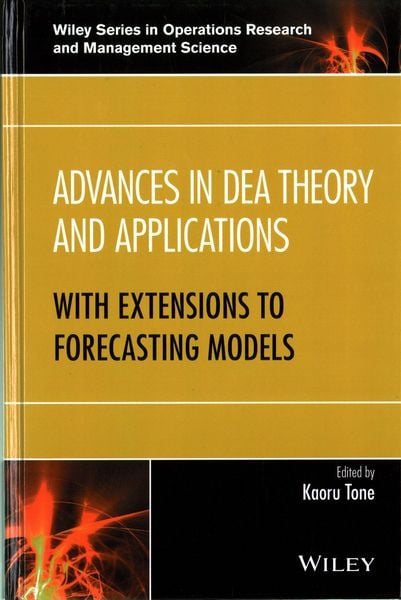
Produktbild: Advances in Dea Theory and Applications

Advances in Dea Theory and Applications With Extensions to Forecasting Models

137,99 €

inkl. gesetzl. MwSt., Versandkostenfrei


Beschreibung

A key resource and framework for assessing the performance of competing entities, including forecasting models   Advances in DEA Theory and Applications provides a much-needed framework for assessing the performance of competing entities with special emphasis on forecasting models. It helps readers to...

Beschreibung

A key resource and framework for assessing the performance of competing entities, including forecasting models
 
Advances in DEA Theory and Applications provides a much-needed framework for assessing the performance of competing entities with special emphasis on forecasting models. It helps readers to determine the most appropriate methodology in order to make the most accurate decisions for implementation. Written by a noted expert in the field, this text provides a review of the latest advances in DEA theory and applications to the field of forecasting.
 
Designed for use by anyone involved in research in the field of forecasting or in another application area where forecasting drives decision making, this text can be applied to a wide range of contexts, including education, health care, banking, armed forces, auditing, market research, retail outlets, organizational effectiveness, transportation, public housing, and manufacturing. This vital resource:
* Explores the latest developments in DEA frameworks for the performance evaluation of entities such as public or private organizational branches or departments, economic sectors, technologies, and stocks
* Presents a novel area of application for DEA; namely, the performance evaluation of forecasting models
* Promotes the use of DEA to assess the performance of forecasting models in a wide area of applications
* Provides rich, detailed examples and case studies
 
Advances in DEA Theory and Applications includes information on a balanced benchmarking tool that is designed to help organizations examine their assumptions about their productivity and performance.

Produktdetails

Einband

Gebundene Ausgabe

Erscheinungsdatum

05.07.2017

Herausgeber Kaoru Tone
Verlag John Wiley & Sons Inc

Produktdetails

Einband

Gebundene Ausgabe

Erscheinungsdatum

05.07.2017

Herausgeber Kaoru Tone
Verlag John Wiley & Sons Inc
Seitenzahl

576

Maße (L/B/H)

23,1/15,5/3,3 cm

Gewicht

839 g

Auflage

1. Auflage

Sprache

Englisch

ISBN

978-1-118-94562-9

Herstelleradresse

Libri GmbH
Europaallee 1
36244 Bad Hersfeld
DE

Email: gpsr@libri.de

Ein neues Kapitel für Ihre Bücher

Ein neues Kapitel für Ihre Bücher

Schenken Sie Ihren alten Schätzen ein zweites Leben und erhalten Sie dafür eine Thalia Geschenkkarte.

Jetzt verkaufen
Jetzt verkaufen

Noch keine Bewertungen vorhanden

Verfassen Sie die erste Bewertung zu diesem Artikel

Helfen Sie anderen Kundinnen und Kunden durch Ihre Meinung.

Kundinnen und Kunden meinen

Bewertungen (0)

Die Leseprobe wird geladen.
  • Produktbild: Advances in Dea Theory and Applications
  • LIST OF CONTRIBUTORS xx
     
    ABOUT THE AUTHORS xxii
     
    PREFACE xxxii
     
    PART I DEA THEORY 1
     
    1 Radial DEA Models 3
    Kaoru Tone
     
    1.1 Introduction 3
     
    1.2 Basic Data 3
     
    1.3 Input-Oriented CCR Model 4
     
    1.4 The Input-Oriented BCC Model 6
     
    1.5 The Output-Oriented Model 7
     
    1.6 Assurance Region Method 8
     
    1.7 The Assumptions Behind Radial Models 8
     
    1.8 A Sample Radial Model 8
     
    References 10
     
    2 Non-Radial DEA Models 11
    Kaoru Tone
     
    2.1 Introduction 11
     
    2.2 The SBM Model 12
     
    2.3 An Example of an SBM Model 15
     
    2.4 The Dual Program of the SBM Model 17
     
    2.5 Extensions of the SBM Model 17
     
    2.6 Concluding Remarks 18
     
    References 19
     
    3 Directional Distance DEA Models 20
    Hirofumi Fukuyama and William L. Weber
     
    3.1 Introduction 20
     
    3.2 Directional Distance Model 20
     
    3.3 Variable-Returns-to-Scale DD Models 23
     
    3.4 Slacks-Based DD Model 23
     
    3.5 Choice of Directional Vectors 25
     
    References 26
     
    4 Super-Efficiency DEA Models 28
    Kaoru Tone
     
    4.1 Introduction 28
     
    4.2 Radial Super-Efficiency Models 28
     
    4.3 Non-Radial Super-Efficiency Models 29
     
    4.4 An Example of a Super-Efficiency Model 31
     
    References 32
     
    5 Determining Returns to Scale in the VRS DEA Model 33
    Biresh K. Sahoo and Kaoru Tone
     
    5.1 Introduction 33
     
    5.2 Technology Specification and Scale Elasticity 34
     
    5.3 Summary 37
     
    References 37
     
    6 Malmquist Productivity Index Models 40
    Kaoru Tone and Miki Tsutsui
     
    6.1 Introduction 40
     
    6.2 Radial Malmquist Model 43
     
    6.3 Non-Radial and Oriented Malmquist Model 45
     
    6.4 Non-Radial and Non-Oriented Malmquist Model 47
     
    6.5 Cumulative Malmquist Index (CMI) 48
     
    6.6 Adjusted Malmquist Index (AMI) 49
     
    6.7 Numerical Example 50
     
    6.8 Concluding Remarks 55
     
    References 55
     
    7 The Network DEA Model 57
    Kaoru Tone and Miki Tsutsui
     
    7.1 Introduction 57
     
    7.2 Notation and Production Possibility Set 58
     
    7.3 Description of Network Structure 59
     
    7.4 Objective Functions and Efficiencies 61
     
    Reference 63
     
    8 The Dynamic DEA Model 64
    Kaoru Tone and Miki Tsutsui
     
    8.1 Introduction 64
     
    8.2 Notation and Production Possibility Set 65
     
    8.3 Description of Dynamic Structure 67
     
    8.4 Objective Functions and Efficiencies 69
     
    8.5 Dynamic Malmquist Index 71
     
    References 73
     
    9 The Dynamic Network DEA Model 74
    Kaoru Tone and Miki Tsutsui
     
    9.1 Introduction 74
     
    9.2 Notation and Production Possibility Set 75
     
    9.3 Description of Dynamic Network Structure 77
     
    9.4 Objective Function and Efficiencies 80
     
    9.5 Dynamic Divisional Malmquist Index 82
     
    References 84
     
    10 Stochastic DEA: The Regression-Based Approach 85
    Andrew L. Johnson
     
    10.1 Introduction 85
     
    10.2 Review of Literature on Stochastic DEA 87
     
    10.3 Conclusions 96
     
    References 96
     
    11 A Comparative Study of AHP and DEA 100
    Kaoru Tone
     
    11.1 Introduction 100
     
    11.2 A Glimpse of Data Envelopment Analysis 100
     
    11.3 Benefit/Cost Analysis by Analytic Hierarchy Process 102
     
    11.4 Efficiencies in AHP and DEA 104
     
    11.5 Concluding Remarks 105
     
    References 106
     
    12 A Computational Method for Solving DEA Problems with Infinitely Many DMUs 107
    Abraham Charnes and Kaoru Tone
    &nb