















































KI-Beratung Beta

Gutscheinbedingungen

Gültig bis 30.11.2026 | Gültig für nicht preisgebundene fremdsprachige Bücher | Einzelne Artikel können ausgeschlossen sein | Online auf thalia.de und in der Thalia App einlösbar | Click & Collect nur mit Online-Zahlung (Paypal/Kreditkarte) vorab | Nicht kombinierbar mit anderen Gutscheinen oder Preisaktionen | Nur einmal pro Einkauf einlösbar | Gutschein wird auf max. 500€ Bestellwert angerechnet | Keine Barauszahlung | Nicht gültig für Versandkosten und Services

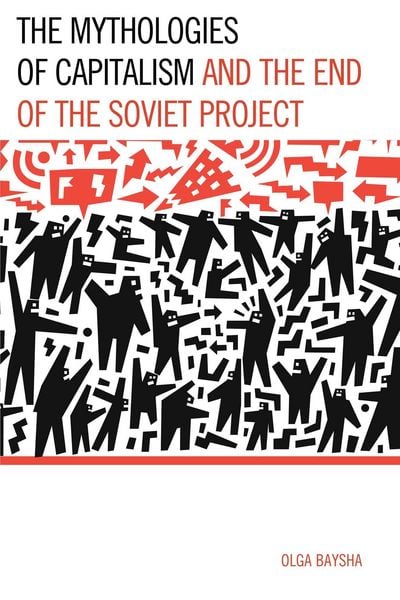
  • Produktbild: Mythologies of Capitalism and the End of the Soviet Project
  • Produktbild: Mythologies of Capitalism and the End of the Soviet Project

Mythologies of Capitalism and the End of the Soviet Project

139,99 €

inkl. gesetzl. MwSt., Versandkostenfrei


Beschreibung

The purpose of The Mythologies of Capitalism and the End of the Soviet Project is to show that in order to understand popular disillusionment with democratization, liberalization, and other transformations associated with the attempts of non-Western societies to appropriate the ideas of Western modernity,...

Beschreibung

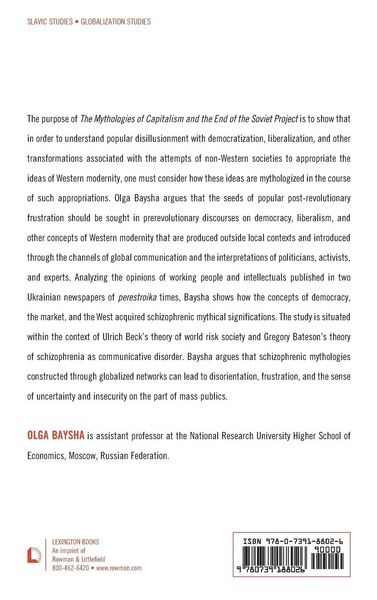
The purpose of The Mythologies of Capitalism and the End of the Soviet Project is to show that in order to understand popular disillusionment with democratization, liberalization, and other transformations associated with the attempts of non-Western societies to appropriate the ideas of Western modernity, one must consider how these ideas are mythologized in the course of such appropriations. Olga Baysha argues that the seeds of popular post-revolutionary frustration should be sought in pre-revolutionary discourses on democracy, liberalism, and other concepts of Western modernity that are produced outside local contexts and introduced through the channels of global communication and the interpretations of politicians, activists, and experts. Analyzing the opinions of working people and intellectuals published in two Ukrainian newspapers of perestroika times, the author shows how the concepts of democracy, the market, and the West acquired schizophrenic mythical significations. The study is situated within the context of Ulrich Beck’s theory of world risk society and Gregory Bateson’s theory of schizophrenia as communicative disorder. The author argues that schizophrenic mythologies constructed through globalized networks can lead to disorientation, frustration, and the sense of uncertainty and insecurity on the part of mass publics.

Produktdetails

Einband

Gebundene Ausgabe

Erscheinungsdatum

14.08.2014

Abbildungen

12 Tables

Verlag Ingram Publishers Services

Produktdetails

Einband

Gebundene Ausgabe

Erscheinungsdatum

14.08.2014

Abbildungen

12 Tables

Verlag Ingram Publishers Services
Seitenzahl

184

Maße (L/B/H)

23,5/15,7/1,5 cm

Gewicht

378 g

Sprache

Englisch

ISBN

978-0-7391-8802-6

Herstelleradresse

Libri GmbH
Europaallee 1
36244 Bad Hersfeld
DE

Email: gpsr@libri.de

Ein neues Kapitel für Ihre Bücher

Ein neues Kapitel für Ihre Bücher

Schenken Sie Ihren alten Schätzen ein zweites Leben und erhalten Sie dafür eine Thalia Geschenkkarte.

Jetzt verkaufen
Jetzt verkaufen

Noch keine Bewertungen vorhanden

Verfassen Sie die erste Bewertung zu diesem Artikel

Helfen Sie anderen Kundinnen und Kunden durch Ihre Meinung.

Kundinnen und Kunden meinen

Bewertungen (0)

Die Leseprobe wird geladen.
  • Produktbild: Mythologies of Capitalism and the End of the Soviet Project
  • Produktbild: Mythologies of Capitalism and the End of the Soviet Project
  • CONTENTS
    INTRODUCTION
    PART I. MODERNITY AND MYTH
    CHAPTER 1. Modernity and Its Projects
    Modernity, Colonization, and Globalization
    Multiple Modernities and Cultural Hybridization
    Modernization through Internal Colonization
    The Myth of Enlightenment
    CHAPTER 2. Deconstructing Mythologies
    Roland Barthes's Mythologies
    The Schizophrenia of the Network
    The Idea of Framing
    Frame Analysis of Modernization Myths
    PART II. SOVIET MODERNITY
    CHAPTER 3. The Rise and Fall of an Alternative Project
    Great Transformation
    Stagnation and Gorbachev Reforms
    CHAPTER 4. The Discourses of Perestroika
    Democracy
    Market
    The United States
    PART III. THE VERNACULAR VS. THE ELITE
    On Methodology
    CHAPTER 5. Mythologizing Democracy
    Intellectual Mythology: The Highway of Civilization
    Vernacular Mythology: Power to the People!
    CHAPTER 6. Mythologizing the Market
    Intellectual Mythology: The invisible Hand
    Vernacular Mythology: Enriching Working People
    CHAPTER 7. Mythologizing the United States: The Horn of Plenty
    PART IV. THE SCHIZOPHRENIA OF PERESTROIKA
    CHAPTER 8. The Twilight Zone
    The Spirit of Hopelessness
    World Risk Society
    The Logic of Both / And
    CHAPTER 9. Schizophrenia as a Communicative Disorder
    Double Bind
    Network Schizophrenia and the Public Sphere
    CHAPTER 10. Personal Reflections
    CONCLUSION
    BIBLIOGRAPHY
    Primary Sources: Media Articles
    Secondary Sources
    APPENDIX A. Research Design
    Data Collecting
    Coding
    APPENDIX B. Statistical Results