
















































KI-Beratung Beta

Gutscheinbedingungen

Gültig bis 30.11.2026 | Gültig für nicht preisgebundene fremdsprachige Bücher | Einzelne Artikel können ausgeschlossen sein | Online auf thalia.de und in der Thalia App einlösbar | Click & Collect nur mit Online-Zahlung (Paypal/Kreditkarte) vorab | Nicht kombinierbar mit anderen Gutscheinen oder Preisaktionen | Nur einmal pro Einkauf einlösbar | Gutschein wird auf max. 500€ Bestellwert angerechnet | Keine Barauszahlung | Nicht gültig für Versandkosten und Services

  • Produktbild: Markov Chains with Stationary Transition Probabilities
  • Produktbild: Markov Chains with Stationary Transition Probabilities
Band 104

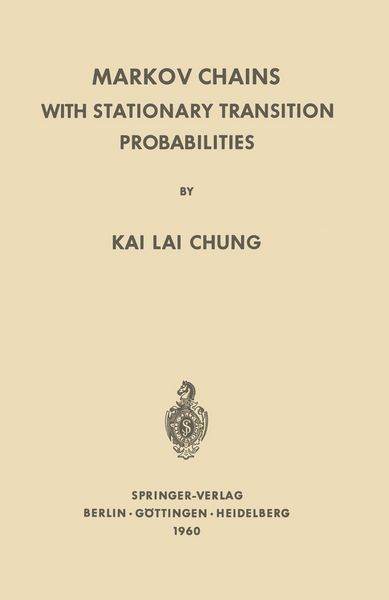
Markov Chains with Stationary Transition Probabilities

49,99 €

inkl. gesetzl. MwSt., Versandkostenfrei


Beschreibung

The theory of Markov chains, although a special case of Markov processes, is here developed for its own sake and presented on its own merits. In general, the hypothesis of a denumerable state space, which is the defining hypothesis of what we call a "chain" here, generates more clear-cut questions and...

Beschreibung

The theory of Markov chains, although a special case of Markov processes, is here developed for its own sake and presented on its own merits. In general, the hypothesis of a denumerable state space, which is the defining hypothesis of what we call a "chain" here, generates more clear-cut questions and demands more precise and definitive an swers. For example, the principal limit theorem (§§ 1. 6, II. 10), still the object of research for general Markov processes, is here in its neat final form; and the strong Markov property (§ 11. 9) is here always applicable. While probability theory has advanced far enough that a degree of sophistication is needed even in the limited context of this book, it is still possible here to keep the proportion of definitions to theorems relatively low. . From the standpoint of the general theory of stochastic processes, a continuous parameter Markov chain appears to be the first essentially discontinuous process that has been studied in some detail. It is common that the sample functions of such a chain have discontinuities worse than jumps, and these baser discontinuities play a central role in the theory, of which the mystery remains to be completely unraveled. In this connection the basic concepts of separability and measurability, which are usually applied only at an early stage of the discussion to establish a certain smoothness of the sample functions, are here applied constantly as indispensable tools.

Produktdetails

Einband

Taschenbuch

Erscheinungsdatum

01.01.1960

Abbildungen

X, 278 p. 1 illus.

Herausgeber R. Grammel + weitere

Produktdetails

Einband

Taschenbuch

Erscheinungsdatum

01.01.1960

Abbildungen

X, 278 p. 1 illus.

Herausgeber
Verlag Springer Berlin
Seitenzahl

278

Maße (L/B/H)

23,5/15,5/1,6 cm

Gewicht

446 g

Auflage

Softcover reprint of the original 1st ed. 1960

Sprache

Englisch

ISBN

978-3-642-49408-6

Herstelleradresse

Springer-Verlag KG
Sachsenplatz 4-6
1201 Wien
AT

Email: ProductSafety@springernature.com

Ein neues Kapitel für Ihre Bücher

Ein neues Kapitel für Ihre Bücher

Schenken Sie Ihren alten Schätzen ein zweites Leben und erhalten Sie dafür eine Thalia Geschenkkarte.

Jetzt verkaufen
Jetzt verkaufen

Noch keine Bewertungen vorhanden

Verfassen Sie die erste Bewertung zu diesem Artikel

Helfen Sie anderen Kundinnen und Kunden durch Ihre Meinung.

Kundinnen und Kunden meinen

Bewertungen (0)

  • Produktbild: Markov Chains with Stationary Transition Probabilities
  • Produktbild: Markov Chains with Stationary Transition Probabilities
  • I. Discrete Parameter.- § 1. Fundamental definitions.- § 2. Transition probabilities.- § 3. Classification of states.- § 4. Recurrence.- § 5. Criteria and examples.- § 6. The main limit theorem.- § 7. Various complements.- § 8. Repetitive pattern and renewal process.- § 9. Taboo probabilities.- § 10. The generating function.- § 11. The moments of first entrance time distributions.- § 12. A random walk example.- § 13. System theorems.- § 14. Functionals and associated random variables.- § 15. Ergodic theorems.- § 16. Further limit theorems.- § 17. Almost closed and sojourn sets.- II. Continuous Parameter.- § 1. Transition matrix: basic properties.- § 2. Standard transition matrix.- § 3. Differentiability.- § 4. Definitions and measure-theoretic foundations.- § 5. The sets of constancy.- § 6. Continuity properties of sample functions.- § 7. Further specifications of the process.- § 8. Optional random variable.- § 9. Strong Markov property.- § 10. Classification of states.- § 11. Taboo probability functions.- § 12. Ratio limit theorems.- § 13. Discrete approximations.- § 14. Functionals.- § 15. Post-exit process.- § 16. Imbedded renewal process.- § 17. The two systems of differential equations.- § 18. The minimal solution.- § 19. The first infinity.- § 20 Examples.- Addenda.