















































KI-Beratung Beta

Gutscheinbedingungen

Gültig bis 30.11.2026 | Gültig für nicht preisgebundene fremdsprachige Bücher | Einzelne Artikel können ausgeschlossen sein | Online auf thalia.de und in der Thalia App einlösbar | Click & Collect nur mit Online-Zahlung (Paypal/Kreditkarte) vorab | Nicht kombinierbar mit anderen Gutscheinen oder Preisaktionen | Nur einmal pro Einkauf einlösbar | Gutschein wird auf max. 500€ Bestellwert angerechnet | Keine Barauszahlung | Nicht gültig für Versandkosten und Services

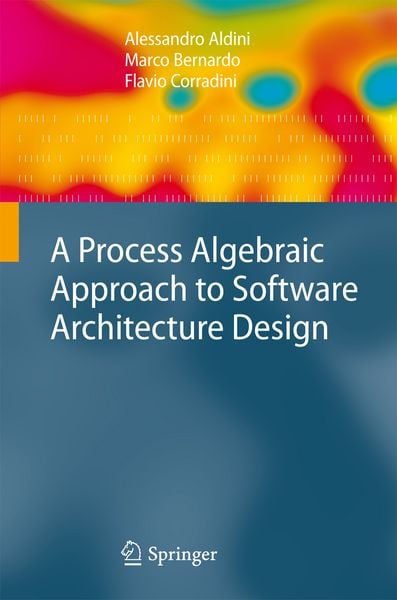
  • Produktbild: A Process Algebraic Approach to Software Architecture Design
  • Produktbild: A Process Algebraic Approach to Software Architecture Design

A Process Algebraic Approach to Software Architecture Design

49,99 €

inkl. gesetzl. MwSt., Versandkostenfrei


Beschreibung

Inthe?eldofformalmethodsincomputerscience,concurrencytheoryisreceivinga constantlyincreasinginterest.Thisisespeciallytrueforprocessalgebra.Althoughit had been originally conceived as a means for reasoning about the semantics of c- current programs, process algebraic formalisms like CCS, CSP, ACP, ?-calculus,...

Beschreibung

Inthe?eldofformalmethodsincomputerscience,concurrencytheoryisreceivinga constantlyincreasinginterest.Thisisespeciallytrueforprocessalgebra.Althoughit had been originally conceived as a means for reasoning about the semantics of c- current programs, process algebraic formalisms like CCS, CSP, ACP, ?-calculus, and their extensions (see, e.g., [154,119,112,22,155,181,30]) were soon used also for comprehendingfunctionaland nonfunctionalaspects of the behaviorof com- nicating concurrent systems. The scienti?c impact of process calculi and behavioral equivalences at the base of process algebra is witnessed not only by a very rich literature. It is in fact worth mentioningthe standardizationprocedurethat led to the developmentof the process algebraic language LOTOS [49], as well as the implementation of several modeling and analysis tools based on process algebra, like CWB [70] and CADP [93], some of which have been used in industrial case studies. Furthermore, process calculi and behavioral equivalencesare by now adopted in university-levelcourses to teach the foundations of concurrent programming as well as the model-driven design of concurrent, distributed, and mobile systems. Nevertheless, after 30 years since its introduction, process algebra is rarely adopted in the practice of software development. On the one hand, its technica- ties often obfuscate the way in which systems are modeled. As an example, if a process term comprises numerous occurrences of the parallel composition operator, it is hard to understand the communicationscheme among the varioussubterms. On the other hand, process algebra is perceived as being dif?cult to learn and use by practitioners, as it is not close enough to the way they think of software systems.

Produktdetails

Einband

Taschenbuch

Erscheinungsdatum

20.10.2014

Abbildungen

XV, 304 p.

Verlag Springer London

Produktdetails

Einband

Taschenbuch

Erscheinungsdatum

20.10.2014

Abbildungen

XV, 304 p.

Verlag Springer London
Seitenzahl

304

Maße (L/B/H)

23,5/15,5/1,8 cm

Gewicht

487 g

Auflage

2010

Sprache

Englisch

ISBN

978-1-4471-5766-3

Herstelleradresse

Springer-Verlag KG
Sachsenplatz 4-6
1201 Wien
AT

Email: ProductSafety@springernature.com

Ein neues Kapitel für Ihre Bücher

Ein neues Kapitel für Ihre Bücher

Schenken Sie Ihren alten Schätzen ein zweites Leben und erhalten Sie dafür eine Thalia Geschenkkarte.

Jetzt verkaufen
Jetzt verkaufen

Noch keine Bewertungen vorhanden

Verfassen Sie die erste Bewertung zu diesem Artikel

Helfen Sie anderen Kundinnen und Kunden durch Ihre Meinung.

Kundinnen und Kunden meinen

Bewertungen (0)

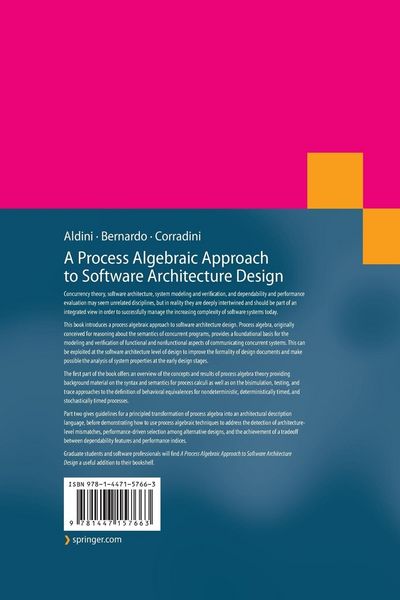
  • Produktbild: A Process Algebraic Approach to Software Architecture Design
  • Produktbild: A Process Algebraic Approach to Software Architecture Design
  • Process Calculi and Behavioral Equivalences.- Process Algebra.- Deterministically Timed Process Algebra.- Stochastically Timed Process Algebra.- Process Algebra for Software Architecture.- Component-Oriented Modeling.- Component-Oriented Functional Verification.- Component-Oriented Performance Evaluation.- Trading Dependability and Performance.