















































KI-Beratung Beta

Gutscheinbedingungen

Gültig bis 11.11.2026 | Gültig für Spielzeug, Filme, Musik, Software, Games, Geschenke & Trends, Schreibwaren, Hörbücher und Hörbuch-Downloads (außer Abo & Shelfies), gebrauchte Bücher, nicht preisgebundene Bücher und Kalender | Einlösbar unter thalia.de und in der Thalia App | Click & Collect nur mit Online-Zahlung (Paypal/Kreditkarte) vorab | Einzelne Artikel können ausgeschlossen sein | Nicht kombinierbar mit anderen Gutscheinen oder Preisaktionen | Nur einmal pro Einkauf einlösbar | Gutschein wird auf max. 500€ Bestellwert angerechnet | Keine Barauszahlung | Digitale Hörbücher nur für Android  | Nicht gültig für preisgebundene Artikel (aufgrund der Buchpreisbindung sind Gutscheine nicht auf Bücher, eBooks, Presse einlösbar), tolino eReader & Zubehör, Abonnements & Flatrates, Geschenkkarten, Versandkosten und Services

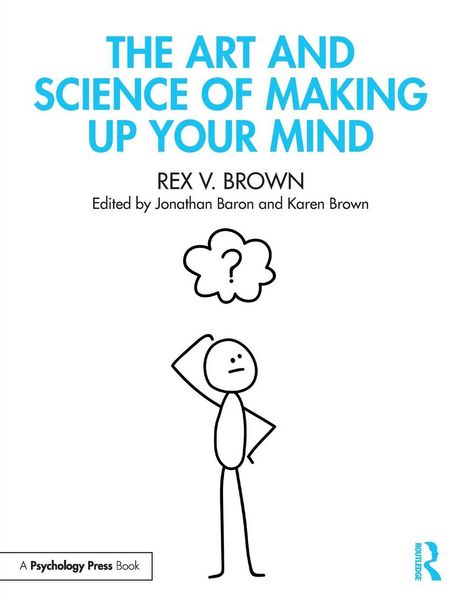
  • Produktbild: The Art and Science of Making Up Your Mind
  • Produktbild: The Art and Science of Making Up Your Mind

The Art and Science of Making Up Your Mind

77,99 €

inkl. gesetzl. MwSt., Versandkostenfrei


Beschreibung

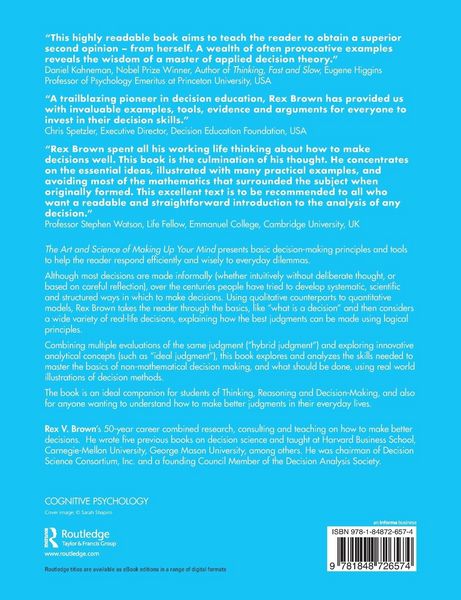
The Art and Science of Making Up Your Mind presents basic decision-making principles and tools to help the reader respond efficiently and wisely to everyday dilemmas. Although most decisions are made informally (whether intuitively without deliberate thought, or based on careful reflection), over the...

Beschreibung

The Art and Science of Making Up Your Mind presents basic decision-making principles and tools to help the reader respond efficiently and wisely to everyday dilemmas. Although most decisions are made informally (whether intuitively without deliberate thought, or based on careful reflection), over the centuries people have tried to develop systematic, scientific and structured ways in which to make decisions. Using qualitative counterparts to quantitative models, Rex Brown takes the reader through the basics, like 'what is a decision' and then considers a wide variety of real-life decisions, explaining how the best judgments can be made using logical principles.¿ Combining multiple evaluations of the same judgment ("hybrid judgment") and exploring innovative analytical concepts (such as "ideal judgment"), this book explores and analyzes the skills needed to master the basics of non-mathematical decision making, and what should be done, using real world illustrations of decision methods. The book is an ideal companion for students of Thinking, Reasoning and Decision-Making, and also for anyone wanting to understand how to make better judgments in their everyday lives.

Produktdetails

Einband

Taschenbuch

Erscheinungsdatum

18.06.2019

Herausgeber Jonathan Baron + weitere
Verlag Taylor & Francis

Produktdetails

Einband

Taschenbuch

Erscheinungsdatum

18.06.2019

Herausgeber
Verlag Taylor & Francis
Seitenzahl

116

Maße (L/B/H)

24,6/18,9/0,7 cm

Gewicht

242 g

Sprache

Englisch

ISBN

978-1-84872-657-4

Herstelleradresse

Libri GmbH
Europaallee 1
36244 Bad Hersfeld
DE

Email: gpsr@libri.de

Ein neues Kapitel für Ihre Bücher

Ein neues Kapitel für Ihre Bücher

Schenken Sie Ihren alten Schätzen ein zweites Leben und erhalten Sie dafür eine Thalia Geschenkkarte.

Jetzt verkaufen
Jetzt verkaufen

Noch keine Bewertungen vorhanden

Verfassen Sie die erste Bewertung zu diesem Artikel

Helfen Sie anderen Kundinnen und Kunden durch Ihre Meinung.

Kundinnen und Kunden meinen

Bewertungen (0)

Die Leseprobe wird geladen.
  • Produktbild: The Art and Science of Making Up Your Mind
  • Produktbild: The Art and Science of Making Up Your Mind
  • Chapter 1 - Introduction

    Chapter 2 - Decision making

    Chapter 3 - Term project: Evaluating a policy proposal

    Chapter 4 - Qualitative decision aids

    Chapter 5 - Hip surgery case

    Chapter 6 - Quantitative ADT modeling

    Chapter 7 - Family case study: C-section vs. "natural" child-birth?

    Chapter 8 - Using ADT models

    Chapter 9 - A civic case: Voting for president

    Chapter 10 - Information value case: Life-saving diagnosis

    Chapter 11 - Expanded view: Should we teach decision making in school?

    Chapter 12 - Epilogue - What next?

    Bibliography

    Index