















































KI-Beratung Beta

Gutscheinbedingungen

Gültig bis 30.11.2026 | Gültig für nicht preisgebundene fremdsprachige Bücher | Einzelne Artikel können ausgeschlossen sein | Online auf thalia.de und in der Thalia App einlösbar | Click & Collect nur mit Online-Zahlung (Paypal/Kreditkarte) vorab | Nicht kombinierbar mit anderen Gutscheinen oder Preisaktionen | Nur einmal pro Einkauf einlösbar | Gutschein wird auf max. 500€ Bestellwert angerechnet | Keine Barauszahlung | Nicht gültig für Versandkosten und Services

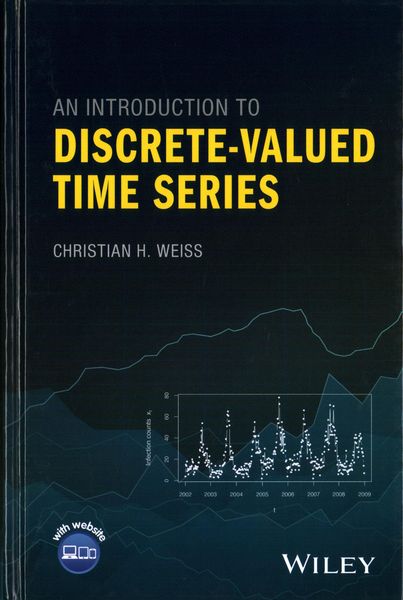
Produktbild: An Introduction to Discrete-Valued Time Series

An Introduction to Discrete-Valued Time Series

107,99 €

inkl. gesetzl. MwSt., Versandkostenfrei


Beschreibung

A much-needed introduction to the field of discrete-valued time series, with a focus on count-data time series   Time series analysis is an essential tool in a wide array of fields, including business, economics, computer science, epidemiology, finance, manufacturing and meteorology, to name just a few....

Beschreibung

A much-needed introduction to the field of discrete-valued time series, with a focus on count-data time series
 
Time series analysis is an essential tool in a wide array of fields, including business, economics, computer science, epidemiology, finance, manufacturing and meteorology, to name just a few. Despite growing interest in discrete-valued time series--especially those arising from counting specific objects or events at specified times--most books on time series give short shrift to that increasingly important subject area. This book seeks to rectify that state of affairs by providing a much needed introduction to discrete-valued time series, with particular focus on count-data time series.
 
The main focus of this book is on modeling. Throughout numerous examples are provided illustrating models currently used in discrete-valued time series applications. Statistical process control, including various control charts (such as cumulative sum control charts), and performance evaluation are treated at length. Classic approaches like ARMA models and the Box-Jenkins program are also featured with the basics of these approaches summarized in an Appendix. In addition, data examples, with all relevant R code, are available on a companion website.
* Provides a balanced presentation of theory and practice, exploring both categorical and integer-valued series
* Covers common models for time series of counts as well as for categorical time series,
* and works out their most important stochastic properties
* Addresses statistical approaches for analyzing discrete-valued time series and illustrates their implementation with numerous data examples
* Covers classical approaches such as ARMA models, Box-Jenkins program and how to generate functions
* Includes dataset examples with all necessary R code provided on a companion website
 
An Introduction to Discrete-Valued Time Series is a valuable working resource for researchers and practitioners in a broad range of fields, including statistics, data science, machine learning, and engineering. It will also be of interest to postgraduate students in statistics, mathematics and economics.

Produktdetails

Einband

Gebundene Ausgabe

Erscheinungsdatum

12.02.2018

Verlag John Wiley & Sons Inc
Seitenzahl

304

Produktdetails

Einband

Gebundene Ausgabe

Erscheinungsdatum

12.02.2018

Verlag John Wiley & Sons Inc
Seitenzahl

304

Maße (L/B/H)

23,6/15,4/2,2 cm

Gewicht

518 g

Auflage

1. Auflage

Sprache

Englisch

ISBN

978-1-119-09696-2

Herstelleradresse

Libri GmbH
Europaallee 1
36244 Bad Hersfeld
DE

Email: gpsr@libri.de

Ein neues Kapitel für Ihre Bücher

Ein neues Kapitel für Ihre Bücher

Schenken Sie Ihren alten Schätzen ein zweites Leben und erhalten Sie dafür eine Thalia Geschenkkarte.

Jetzt verkaufen
Jetzt verkaufen

Noch keine Bewertungen vorhanden

Verfassen Sie die erste Bewertung zu diesem Artikel

Helfen Sie anderen Kundinnen und Kunden durch Ihre Meinung.

Kundinnen und Kunden meinen

Bewertungen (0)

Die Leseprobe wird geladen.
  • Produktbild: An Introduction to Discrete-Valued Time Series
  • Preface xi
     
    About the CompanionWebsite xv
     
    1 Introduction 1
     
    Part I Count Time Series 9
     
    2 A First Approach for Modeling Time Series of Counts: The
     
    Thinning-based INAR(1)Model 11
     
    2.0 Preliminaries: Notation and Characteristics of Count Distributions 11
     
    2.1 The INAR(1) Model for Time-dependent Counts 16
     
    2.1.1 Definition and Basic Properties 17
     
    2.1.2 The Poisson INAR(1) Model 20
     
    2.1.3 INAR(1) Models with More General Innovations 22
     
    2.2 Approaches for Parameter Estimation 26
     
    2.2.1 Method of Moments 26
     
    2.2.2 Maximum Likelihood Estimation 28
     
    2.3 Model Identification 29
     
    2.4 Checking for Model Adequacy 32
     
    2.5 A Real-data Example 34
     
    2.6 Forecasting of INAR(1) Processes 37
     
    3 Further Thinning-based Models for Count Time Series 43
     
    3.1 Higher-order INARMA Models 43
     
    3.2 Alternative Thinning Concepts 54
     
    3.3 The Binomial AR Model 59
     
    3.4 Multivariate INARMA Models 64
     
    4 INGARCH Models for Count Time Series 73
     
    4.1 Poisson Autoregression 73
     
    4.2 Further Types of INGARCH Models 85
     
    4.3 Multivariate INGARCH Models 93
     
    5 Further Models for Count Time Series 95
     
    5.1 Regression Models 95
     
    5.2 Hidden-Markov Models 107
     
    5.3 Discrete ARMA Models 116
     
    Part II Categorical Time Series 119
     
    6 Analyzing Categorical Time Series 121
     
    6.1 Introduction to Categorical Time Series Analysis 122
     
    6.2 Marginal Properties of Categorical Time Series 126
     
    6.3 Serial Dependence of Categorical Time Series 128
     
    7 Models for Categorical Time Series 133
     
    7.1 Parsimoniously Parametrized Markov Models 133
     
    7.2 Discrete ARMA Models 139
     
    7.3 Hidden-Markov Models 146
     
    7.4 Regression Models 151
     
    Part III Monitoring Discrete-Valued Processes 161
     
    8 Control Charts for Count Processes 163
     
    8.1 Introduction to Statistical Process Control 163
     
    8.2 Shewhart Charts for Count Processes 165
     
    8.2.1 Shewhart Charts for i.i.d. Counts 166
     
    8.2.2 Shewhart Charts for Markov-Dependent Counts 171
     
    8.3 Advanced Control Charts for Count Processes 177
     
    8.3.1 CUSUM Charts for i.i.d. Counts 178
     
    8.3.2 CUSUM Charts for Markov-dependent Counts 182
     
    8.3.3 EWMA Charts for Count Processes 186
     
    9 Control Charts for Categorical Processes 193
     
    9.1 Sample-based Monitoring of Categorical Processes 194
     
    9.1.1 Sample-based Monitoring: Binary Case 194
     
    9.1.2 Sample-based Monitoring: Categorical Case 198
     
    9.2 Continuously Monitoring Categorical Processes 203
     
    9.2.1 Continuous Monitoring: Binary Case 203
     
    9.2.2 Continuous Monitoring: Categorical Case 209
     
    Part IV Appendices 213
     
    A Examples of Count Distributions 215
     
    A.1 Count Models for an Infinite Range 215
     
    A.2 Count Models for a Finite Range 221
     
    A.3 Multivariate Count Models 223
     
    B Basics about Stochastic Processes and Time Series 229
     
    B.1 Stochastic Processes: Basic Terms and Concepts 229
     
    B.2 Discrete-Valued Markov Chains 233
     
    B.2.1 Basic Terms and Concepts 233
     
    B.2.2 Stationary Markov Chains 236
     
    B.3 ARMA Models: Definition and Properties 238
     
    B.4 Further Selected Models for Continuous-valued Time Series 243
     
    B.4.1 GARCH Models 243
     
    B.4.2 VARMA Models 245
     
    C Computational Aspects 249
     
    C.1 Some Comments about the Use of R 250
     
    C.2 List of R Codes 253
     
    C.3 Li