















































KI-Beratung Beta

Gutscheinbedingungen

Gültig bis 30.11.2026 | Gültig für nicht preisgebundene fremdsprachige Bücher | Einzelne Artikel können ausgeschlossen sein | Online auf thalia.de und in der Thalia App einlösbar | Click & Collect nur mit Online-Zahlung (Paypal/Kreditkarte) vorab | Nicht kombinierbar mit anderen Gutscheinen oder Preisaktionen | Nur einmal pro Einkauf einlösbar | Gutschein wird auf max. 500€ Bestellwert angerechnet | Keine Barauszahlung | Nicht gültig für Versandkosten und Services

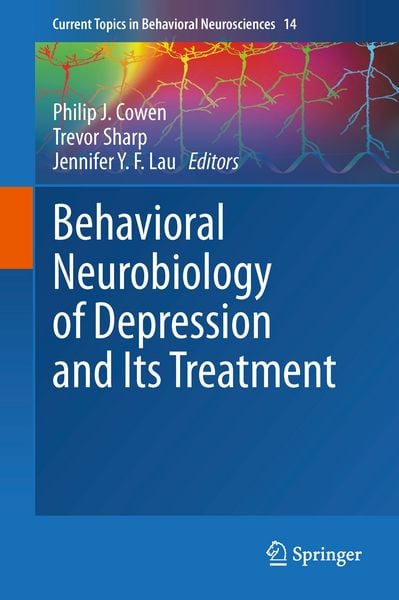
Produktbild: Behavioral Neurobiology of Depression and Its Treatment
Band 14 - 10%

Behavioral Neurobiology of Depression and Its Treatment

10% sparen

191,99 € UVP 213,99 €

inkl. gesetzl. MwSt., Versandkostenfrei


Beschreibung

The book highlights important new research using current state-of-the-art approaches by prominent researchers in the field of depression. A broad range of topics is covered, beginning with a description of the phenotypic features of clinical depression, followed by chapters on the cellular and molecular...

Beschreibung

The book highlights important new research using current state-of-the-art approaches by prominent researchers in the field of depression. A broad range of topics is covered, beginning with a description of the phenotypic features of clinical depression, followed by chapters on the cellular and molecular basis, functional neuroimaging correlates and information-processing accounts. Finally, existing and novel treatment approaches are covered. In this way the volume brings together the key disciplines involved in the neurobiological understanding of depression to provide an update of the field and outlook to the future. Together, the volume chapters provide focused and critical reviews that span a broad range of topics suitable for both students and established investigators interested in the present state of depression research.

Rezension

From the reviews:

“This book addresses the recent advances in the neurobiological understanding of mood and how that neurobiology changes with depression. … The intended audience includes researchers and clinicians in the field.” (Michael Joel Schrift, Doody’s Book Reviews, August, 2013)

Produktdetails

Einband

Taschenbuch

Erscheinungsdatum

03.04.2015

Abbildungen

X, 344 p.

Herausgeber Philip J. Cowen + weitere

Produktdetails

Einband

Taschenbuch

Erscheinungsdatum

03.04.2015

Abbildungen

X, 344 p.

Herausgeber
Verlag Springer Berlin
Seitenzahl

344

Maße (L/B/H)

23,5/15,5/2 cm

Gewicht

540 g

Sprache

Englisch

ISBN

978-3-642-43227-9

Herstelleradresse

Springer-Verlag KG
Sachsenplatz 4-6
1201 Wien
AT

Email: ProductSafety@springernature.com

Ein neues Kapitel für Ihre Bücher

Ein neues Kapitel für Ihre Bücher

Schenken Sie Ihren alten Schätzen ein zweites Leben und erhalten Sie dafür eine Thalia Geschenkkarte.

Jetzt verkaufen
Jetzt verkaufen

Noch keine Bewertungen vorhanden

Verfassen Sie die erste Bewertung zu diesem Artikel

Helfen Sie anderen Kundinnen und Kunden durch Ihre Meinung.

Kundinnen und Kunden meinen

Bewertungen (0)

  • Produktbild: Behavioral Neurobiology of Depression and Its Treatment

  • Preface.- Part 1. Phenotypic features.- Classification of mood disorders. Developmental aspects of depression. Animal models of depression vulnerability. Genetic mouse models of depression.- Part 2. Cellular and Molecular Basis.- The Genetic basis of depression. Neurochemical Imaging and Depressive Behaviours. Inflammation and Depression. Major Depression: A Role for Hippocampal Neurogenesis? Neurobiological Markers of Familial Risk for Depression.- Part 3. Cognitive accounts.- Emotional Processing and Antidepressant Action. What Can Fear and Reward Learning Teach Us About Depression? The Use of Cognitive Bias Modification and Imagery in the Understanding and Treatment of Depression.- Part 4. Treatment.- Pharmacological Treatment of Unipolar Depression. New Approaches in the Treatment of Bipolar Depression. Molecular and Cellular Mechanisms of Antidepressant Action. Neurosurgical treatments of depression - clinical and preclinical studies.