















































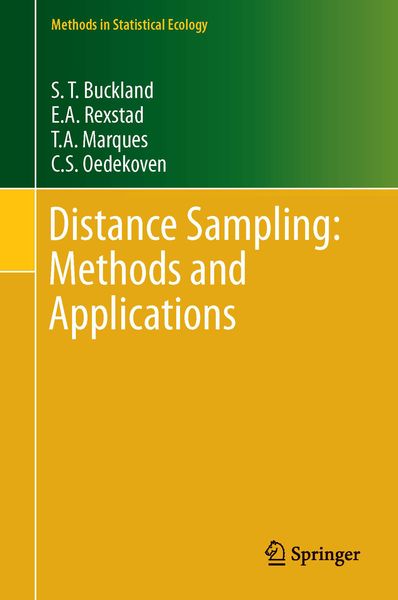
Distance Sampling: Methods and Applications
-
- Hardcover ausgewählt
- Taschenbuch
- eBook
-
Sprache:Englisch
134,99 €
inkl. gesetzl. MwSt.,
Beschreibung
Produktdetails
Einband
Gebundene Ausgabe
Erscheinungsdatum
24.08.2015
Abbildungen
XV, 277 p. 80 illus.
Verlag
SpringerSeitenzahl
277
Maße (L/B/H)
24,1/16/2,1 cm
Gewicht
620 g
Auflage
1st ed. 2015
Sprache
Englisch
ISBN
978-3-319-19218-5
In this book, the authors cover the basic methods and advances within distance sampling that are most valuable to practitioners and in ecology more broadly. This is the fourth book dedicated to distance sampling. In the decade since the last book published, there have been a number of new developments. The intervening years have also shown which advances are of most use. This self-contained book covers topics from the previous publications, while also including recent developments in method, software and application.
Distance sampling refers to a suite of methods, including line and point transect sampling, in which animal density or abundance is estimated from a sample of distances to detected individuals. The book illustrates these methods through case studies; data sets and computer code are supplied to readers through the book’s accompanying website. Some of the case studies use the software Distance, while others use R code. The book is in three parts. The first part addresses basic methods, the design of surveys, distance sampling experiments, field methods and data issues. The second part develops a range of modelling approaches for distance sampling data. The third part describes variations in the basic method; discusses special issues that arise when sampling different taxa (songbirds, seabirds, cetaceans, primates, ungulates, butterflies, and plants); considers advances to deal with failures of the key assumptions; and provides a check-list for those conducting surveys.
Ein neues Kapitel für Ihre Bücher
Ein neues Kapitel für Ihre Bücher
Schenken Sie Ihren alten Schätzen ein zweites Leben und erhalten Sie dafür eine Thalia Geschenkkarte.
Noch keine Bewertungen vorhanden
Verfassen Sie die erste Bewertung zu diesem Artikel
Helfen Sie anderen Kundinnen und Kunden durch Ihre Meinung.
Kurze Frage zu unserer Seite
Vielen Dank für Ihr Feedback
Wir nutzen Ihr Feedback, um unsere Produktseiten zu verbessern. Bitte haben Sie Verständnis, dass wir Ihnen keine Rückmeldung geben können. Falls Sie Kontakt mit uns aufnehmen möchten, können Sie sich aber gerne an unseren Kund*innenservice wenden.
zum Kundenservice