KI-Beratung Beta

Gutscheinbedingungen

Gültig bis 30.11.2026 | Gültig für nicht preisgebundene fremdsprachige Bücher | Einzelne Artikel können ausgeschlossen sein | Online auf thalia.de und in der Thalia App einlösbar | Click & Collect nur mit Online-Zahlung (Paypal/Kreditkarte) vorab | Nicht kombinierbar mit anderen Gutscheinen oder Preisaktionen | Nur einmal pro Einkauf einlösbar | Gutschein wird auf max. 500€ Bestellwert angerechnet | Keine Barauszahlung | Nicht gültig für Versandkosten und Services

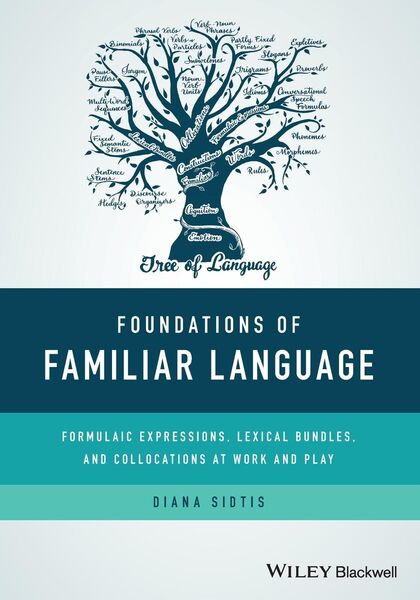
Produktbild: Foundations of Familiar Language

Foundations of Familiar Language Formulaic Expressions, Lexical Bundles, and Collocations at Work and Play

59,99 €

inkl. gesetzl. MwSt., Versandkostenfrei


Beschreibung

A broad overview of the many kinds of unitary expressions found in everyday verbal and written communication, including their signature meaning, form, and usage, authored by a renowned scholar in the field

Foundations of Familiar Language is renowned scholar Diana Sidtis's new contribution to the study...

Beschreibung

A broad overview of the many kinds of unitary expressions found in everyday verbal and written communication, including their signature meaning, form, and usage, authored by a renowned scholar in the field

Foundations of Familiar Language is renowned scholar Diana Sidtis's new contribution to the study of formulaic language through a wide-ranging overview of a large group of language behaviors that share characteristics of cohesion and familiarity, featuring a rational classification of fixed, familiar expressions into formulaic expressions, lexical bundles, and collocations. This unique volume offers a new approach to linguistic classification and construction grammar through a dual-process model of language competence rooted in linguistic, psycholinguistic, and neurolinguistic observations, combining insights drawn from foundational studies of psychology and neurology with contemporary theories of the differences between formulaic and propositional language. This approach offers a distinct and innovative contribution to scholarship in the field. The text contains resources for further study and research such as examples, research protocols, and lists of fixed, familiar expressions from the past and present. This authoritative volume:

  • Describes the current state of knowledge and reviews experimental results, proposals, and models in a clear and straightforward manner
  • Offers up-to-date surveys of the role of fixed expressions in education, social sciences, cognitive psychology, and brain science
  • Features a wealth of engaging and relatable examples of formulaic expressions (conversational speech formulas, expletives, idioms, and proverbs), lexical bundles, and collocations
  • Includes discussion of the use of fixed, familiar expressions in second language learning
  • Presents new research data on the neurological foundations of familiar language drawn from clinical observations and experimental studies of stroke, dementia, and Parkinson's disease
  • Contains material from social media, magazines, newspapers, speeches, and other sources to illustrate the importance, abundance, and value of familiar language

Sufficiently in-depth for specialists, while accessible to students and non-specialists, Foundations of Familiar Language is an essential resource for a wide range of readers, including linguists, child language specialists, psychologists, social scientists, neuroscientists, philosophers, educators, teachers of English as a second language, and those working in artificial intelligence and speech synthesis.

Produktdetails

Einband

Taschenbuch

Erscheinungsdatum

09.12.2021

Verlag John Wiley & Sons
Seitenzahl

464

Produktdetails

Einband

Taschenbuch

Erscheinungsdatum

09.12.2021

Verlag John Wiley & Sons
Seitenzahl

464

Maße (L/B/H)

25,4/17,8/2,5 cm

Gewicht

869 g

Auflage

1. Auflage

Sprache

Englisch

ISBN

978-1-119-16332-9

Herstelleradresse

Libri GmbH
Europaallee 1
36244 Bad Hersfeld
DE

Email: gpsr@libri.de

Ein neues Kapitel für Ihre Bücher

Ein neues Kapitel für Ihre Bücher

Schenken Sie Ihren alten Schätzen ein zweites Leben und erhalten Sie dafür eine Thalia Geschenkkarte.

Jetzt verkaufen
Jetzt verkaufen

Noch keine Bewertungen vorhanden

Verfassen Sie die erste Bewertung zu diesem Artikel

Helfen Sie anderen Kundinnen und Kunden durch Ihre Meinung.

Kundinnen und Kunden meinen

Bewertungen (0)

Die Leseprobe wird geladen.
  • Produktbild: Foundations of Familiar Language
  • Acknowledgments xi

    Preface xii

    1 Introduction 1

    Incidence of Familiar Language Exemplars 12

    Where Do Fixed, Familiar Expressions Come From? 16

    2 Classification 26

    Identification 36

    Three Classes of Familiar Expressions: Formulaic Expressions, Lexical Bundles, Collocations 37

    Formulaic Expressions 40

    Lexical Bundles 80

    Collocations 86

    Overview of Characteristics and Functions of Familiar Language 104

    How Formulaic Expressions, Lexical Bundles, and Collocations Differ 114

    3 How Is Familiar Language Acquired? 117

    Frequency of Exposure: History and Veridicality 118

    Acquisition: Role of Emotion and Familiarity 123

    Acquisition: Memory for Speech and Language 127

    4 Acquisition 131

    Several Conditions Converge to Promote Acquisition 132

    Acquisition of Fixed, Familiar Expressions in the First Language 136

    Acquisition of Fixed, Familiar Expressions in the Second Language 143

    Familiar Language Representation Compared in First and Second Language 150

    5 Prosodic and Phonetic Characteristics of Fixed, Familiar Expressions 155

    Stereotyped Prosodic Form in Fixed Expressions 157

    Detailed Knowledge of Prosodic Features 160

    Acoustic Studies 163

    6 Familiar Language in Psychiatric and Neurologic Disorders 169

    Psychiatric Disorders 170

    The Neurology of Familiar Language 181

    Stroke: Residual Speech and Familiar Phrases 187

    Familiar Phrases in Speech Therapy 203

    Specialized Functions of the Cerebral Hemispheres 217

    The Right Hemisphere and Familiar Language 222

    Cortical-Subcortical Dimension 224

    Functional Imaging Studies of Fixed Expressions 241

    7 Summing Up: Dual- or Multiprocess Model of Language Function? 251

    The Linguistic View 251

    The Psychological Perspective 253

    Observations from Cerebral Processing 255

    Familiar Language - Its Daunting Heterogeneity 258

    Appendix I: Listing Accumulated by C. Fillmore, 1973 (2050 items) 263

    Appendix II: Russell Baker: New York Times, the 1978 Commandments 287

    Appendix III: Selected Familiar Expressions Listed in Chiardi, 1987 289

    Appendix IV: Familiar Expressions Contributed by Students as Heard in Daily Communicative Interactions 291

    Appendix Va: Formulaic Expressions as Encountered Every Day Over a Few Years 295

    Appendix Vb: Lexical Bundles Encountered Every Day Over the Past Few Years 302

    Appendix Vc: Collocations Encountered Every Day in the Past Few Years 305

    Appendix VI: Schemata Accumulated from Current Communications 309

    Appendix VII: German Proverbs Drawn from Hain (1951), Set Up in Survey Style to Assess Knowledge of Current Native Speakers of German 317

    Appendix VIII: A Dialogue Composed Entirely of Movie Titles 321

    Appendix IX: Formulaic Expressions Captured from On-line Viewing of the Film "Some Like It Hot" 323

    Appendix X: Familiar Expressions from Newspapers: Class, Subset, Provenance, and Change of Form or Meaning 331

    Appendix XI: Essential Nomenclature for Cerebral Structures: Definition, Location, and Function 343

    Appendix XII: Matched Novel and Familiar Expressions; Stimuli for Rammell, Pisoni, and Van Lancker Sidtis (2018) Study 345

    Appendix XIIIa: Northridge Evaluation of Formulas, Idioms, and Proverbs in Social Situations 348

    Appendix XIIIb: Northridge Evaluation of Formulas, Idioms, and Proverbs in Social Situations 351

    Appendix XIV: Familiar and Novel Language Comprehension Protocol: Instructions and Answer Sheet 355

    Appendix XV: Test Format for Survey: Some Like It Hot Protocol 365

    Appendix XVI: Sample "Grid" from 2006 Used in Preliminary Studies to Document Subsets of Familiar Expressions in Healthy and Neurologic