















































KI-Beratung Beta

Gutscheinbedingungen

Gültig bis 30.11.2026 | Gültig für nicht preisgebundene fremdsprachige Bücher | Einzelne Artikel können ausgeschlossen sein | Online auf thalia.de und in der Thalia App einlösbar | Click & Collect nur mit Online-Zahlung (Paypal/Kreditkarte) vorab | Nicht kombinierbar mit anderen Gutscheinen oder Preisaktionen | Nur einmal pro Einkauf einlösbar | Gutschein wird auf max. 500€ Bestellwert angerechnet | Keine Barauszahlung | Nicht gültig für Versandkosten und Services

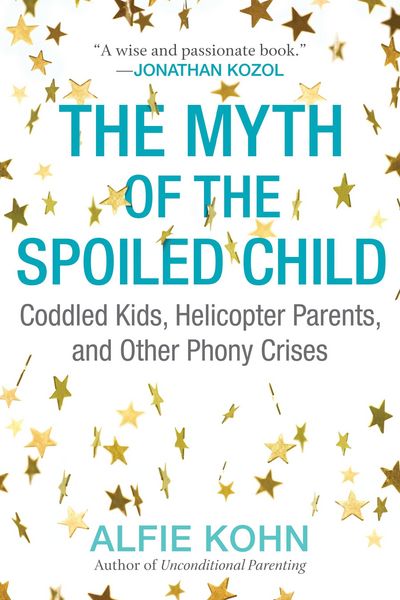
Produktbild: The Myth of the Spoiled Child

The Myth of the Spoiled Child Coddled Kids, Helicopter Parents, and Other Phony Crises

19,99 €

inkl. gesetzl. MwSt., Versandkostenfrei


Beschreibung

A prominent and esteemed critic challenges widely held beliefs about children and parenting, revealing that underlying each myth is a deeply conservative ideology that is, ironically, often adopted by liberal parents. Somehow a set of deeply conservative assumptions about children—what they’re like and...

Beschreibung

A prominent and esteemed critic challenges widely held beliefs about children and parenting, revealing that underlying each myth is a deeply conservative ideology that is, ironically, often adopted by liberal parents.
Somehow a set of deeply conservative assumptions about children—what they’re like and how they should be raised—has congealed into the conventional wisdom in our society. Parents are accused of being both permissive and overprotective, unwilling to set limits and afraid to let their kids fail. Alfie Kohn systematically debunks these beliefs, not only challenging erroneous factual claims but also exposing the troubling ideology that underlies them. Complaints about pushover parents and coddled kids are hardly new, he shows, and there is no evidence that either phenomenon is especially widespread today—let alone more common than in previous generations. Moreover, new research reveals that helicopter parenting is quite rare and, surprisingly, may do more good than harm when it does occur. The major threat to healthy child development, Kohn argues, is parenting that is too controlling rather than too indulgent.
With the same lively, contrarian style that marked his influential books about rewards, competition, and education, Kohn relies on a vast collection of social science data, as well as on logic and humor, to challenge assertions that appear with numbing regularity in the popular press and are often accepted uncritically, even by people who are politically liberal. These include claims that young people
   • suffer from inflated self-esteem
   • are entitled and narcissistic
   • receive trophies, praise, and A’s too easily
   • are in need of more self-discipline and “grit”
Kohn’s invitation to reexamine these and other assumptions is particularly timely; his book has the potential to change our culture’s conversation about kids and the people who raise them.

Produktdetails

Einband

Taschenbuch

Erscheinungsdatum

08.03.2016

Verlag Random House N.Y.
Seitenzahl

280

Produktdetails

Einband

Taschenbuch

Erscheinungsdatum

08.03.2016

Verlag Random House N.Y.
Seitenzahl

280

Maße (L/B/H)

22,6/15,1/2,2 cm

Gewicht

423 g

Sprache

Englisch

ISBN

978-0-8070-7388-9

Herstelleradresse

Libri GmbH
Europaallee 1
36244 Bad Hersfeld
DE

Email: gpsr@libri.de

Ein neues Kapitel für Ihre Bücher

Ein neues Kapitel für Ihre Bücher

Schenken Sie Ihren alten Schätzen ein zweites Leben und erhalten Sie dafür eine Thalia Geschenkkarte.

Jetzt verkaufen
Jetzt verkaufen

Noch keine Bewertungen vorhanden

Verfassen Sie die erste Bewertung zu diesem Artikel

Helfen Sie anderen Kundinnen und Kunden durch Ihre Meinung.

Kundinnen und Kunden meinen

Bewertungen (0)

Weitere Artikel finden Sie in

Die Leseprobe wird geladen.
  • Produktbild: The Myth of the Spoiled Child
  • Introduction

    CHAPTER 1: Permissive Parents, Coddled Kids, and Other Reliable Bogeymen

    CHAPTER 2: Parenting in Perspective

    CHAPTER 3: Overstating Overparenting

    CHAPTER 4: Getting Hit on the Head Lessons: Motivation, Failure, and the Outrage over Participation Trophies

    CHAPTER 5: The Underlying Values: Conditionality, Scarcity, and Deprivation

    CHAPTER 6: The Attack on Self-Esteem

    CHAPTER 7: Why Self-Discipline Is Overrated: A Closer Look at Grit, Marshmallows, and Control from Within

    CHAPTER 8: Raising Rebels

    Notes

    References

    Index