















































KI-Beratung Beta

Gutscheinbedingungen

Gültig bis 30.11.2026 | Gültig für nicht preisgebundene fremdsprachige Bücher | Einzelne Artikel können ausgeschlossen sein | Online auf thalia.de und in der Thalia App einlösbar | Click & Collect nur mit Online-Zahlung (Paypal/Kreditkarte) vorab | Nicht kombinierbar mit anderen Gutscheinen oder Preisaktionen | Nur einmal pro Einkauf einlösbar | Gutschein wird auf max. 500€ Bestellwert angerechnet | Keine Barauszahlung | Nicht gültig für Versandkosten und Services

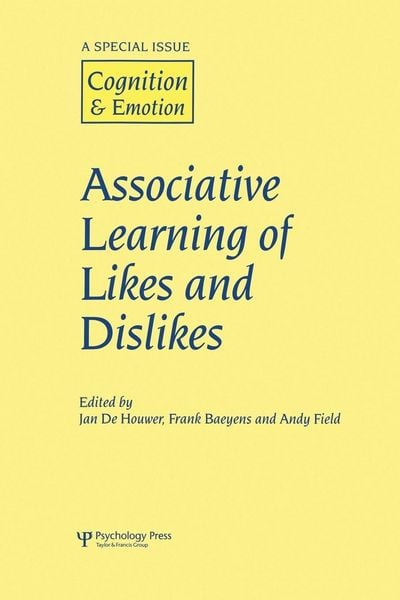
Produktbild: Associative Learning of Likes and Dislikes

Associative Learning of Likes and Dislikes A Special Issue of Cognition and Emotion

79,99 €

inkl. gesetzl. MwSt., Versandkostenfrei


Beschreibung

Preferences are assumed to play a crucial role in many phenomena that are studied in learning psychology, social psychology, consumer science, emotion research, and clinical psychology. Given the pervasive impact that preferences have on behaviour, it is important to know where these likes and dislikes...

Beschreibung

Preferences are assumed to play a crucial role in many phenomena that are studied in learning psychology, social psychology, consumer science, emotion research, and clinical psychology. Given the pervasive impact that preferences have on behaviour, it is important to know where these likes and dislikes come from. Although some preferences are genetically determined, most stem from learning that took place during the lifetime of the individual. In this special issue, the editors focus on one such type of learning: associative learning of likes and dislikes, that is, changes in liking that are due to the pairing of stimuli. Prior studies on evaluative conditioning have shown that pairing an affectively neutral stimulus with an affectively positive or negative stimulus will change the liking of the originally neutral stimulus. The papers that are part of this special issue explore the relevance of evaluative conditioning for social psychology, provide new data about the impact of contingency awareness, attention, and extinction trials on evaluative conditioning, and examine whether pairing stimuli can also result in the transfer of non-evaluative stimulus properties.

Produktdetails

Einband

Taschenbuch

Erscheinungsdatum

25.06.2015

Herausgeber Jan De Houwer + weitere
Verlag Taylor and Francis

Produktdetails

Einband

Taschenbuch

Erscheinungsdatum

25.06.2015

Herausgeber
Verlag Taylor and Francis
Seitenzahl

156

Maße (L/B/H)

23,4/15,6/0,9 cm

Gewicht

248 g

Sprache

Englisch

ISBN

978-1-138-87795-5

Herstelleradresse

Libri GmbH
Europaallee 1
36244 Bad Hersfeld
DE

Email: gpsr@libri.de

Ein neues Kapitel für Ihre Bücher

Ein neues Kapitel für Ihre Bücher

Schenken Sie Ihren alten Schätzen ein zweites Leben und erhalten Sie dafür eine Thalia Geschenkkarte.

Jetzt verkaufen
Jetzt verkaufen

Noch keine Bewertungen vorhanden

Verfassen Sie die erste Bewertung zu diesem Artikel

Helfen Sie anderen Kundinnen und Kunden durch Ihre Meinung.

Kundinnen und Kunden meinen

Bewertungen (0)

  • Produktbild: Associative Learning of Likes and Dislikes
  • J. De Houwer, F. Baeyens, A. Field, Associative Learning of Likes and Dislikes: Some Current Controversies and Possible Ways Forward. E. Walther, B. Nagengast, C. Trasselli, Evaluative Conditioning in Social Psychology: Facts and Speculations. M. Hammerl, E.P. Fulcher, Reactance in Affective-evaluative Learning: Outside of Conscious Control? A.P. Field, A.C. Moore, Dissociating the Effects of Attention and Contingency Awareness on Evaluative Conditioning Effects in the Visual Paradigm. E. Diaz, G. Ruis, F. Baeyens, Resistance to Extinction of Human Evaluative Conditioning Using a Between-subjects Design. O.V. Lipp, H.M. Purkis, No Support for Dual Process Accounts of Human Affective Learning in Simple Pavlovian Conditioning. T. Meersmans, J. De Houwer, F. Baeyens, T. Randell, P. Eelen, Beyond Evaluative Conditioning: Searching for Associative Transfer of Non-evaluative Stimulus Properties.