















































KI-Beratung Beta

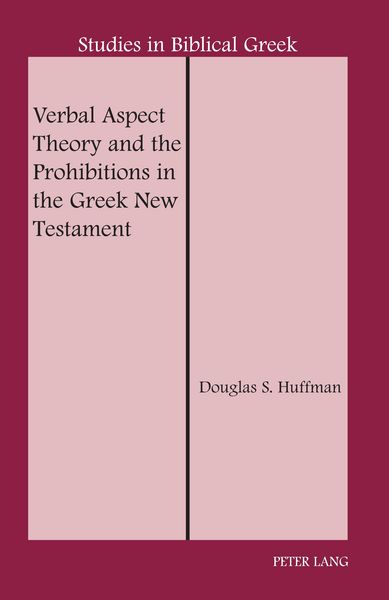
Produktbild: Verbal Aspect Theory and the Prohibitions in the Greek New Testament
Band 16

Verbal Aspect Theory and the Prohibitions in the Greek New Testament

56,49 €

inkl. gesetzl. MwSt.

Beschreibung

The end of the twentieth and the beginning of the twenty-first centuries have involved much discussion on overhauling and refining a scholarly understanding of the verbal system for first-century Greek. These discussions have included advances in verbal aspect theory and other linguistic approaches to...

Beschreibung

The end of the twentieth and the beginning of the twenty-first centuries have involved much discussion on overhauling and refining a scholarly understanding of the verbal system for first-century Greek. These discussions have included advances in verbal aspect theory and other linguistic approaches to describing the grammatical phenomena of ancient languages. This volume seeks to apply some of that learning to the narrow realm of how prohibitions were constructed in the first-century Greek of the New Testament.
Part 1 «The Great Prohibition Debate» seeks to demonstrate that verbal aspect theory has a better explanation than traditional Aktionsart theory for authorial choices between the negated present imperative and the negated aorist subjunctive in expressing prohibitions in the Greek New Testament.
Part 2 «All the Prohibitions in the Greek NT» continues to examine prohibitions, but is more of an exercise in functional linguistics. That is, rather than apply verbal aspect theory to the grammar of prohibition constructions, Part 2 seeks only to survey the (initially surprising) wide variety of ways prohibitions can be expressed in koine Greek: more than a dozen different constructions. To do this, the NT prohibitions are grouped in their varying grammatical-syntactical and/or pragmatic constructions, all of which function - in varying degrees - in a prohibitory fashion. This taxonomy may prove to be the beginnings of further investigations into how biblical Greek communicates commands.

Produktdetails

Format

PDF

Kopierschutz

Ja

Family Sharing

Ja

Text-to-Speech

Nein

Produktdetails

Format

PDF

Format

eBooks im PDF-Format haben eine festgelegte Seitengröße und eignen sich daher nur bedingt zum Lesen auf einem tolino eReader oder Smartphone. Für den vollen Lesegenuss empfehlen wir Ihnen bei PDF-eBooks die Verwendung eines Tablets oder Computers.

Kopierschutz

Ja

Kopierschutz

Zum Lesen dieses eBooks auf Geräten der tolino Familie sowie auf sonstigen eReadern und am PC benötigen Sie eine ByteBook-ID. Weitere Hinweise zum Lesen von kopiergeschützten eBooks finden Sie unter Hilfe/Downloads.

Family Sharing

Ja

Family Sharing

Mit Family Sharing können Sie eBooks innerhalb Ihrer Familie (max. sechs Mitglieder im gleichen Haushalt) teilen. Sie entscheiden selbst, welches Buch Sie mit welchem Familienmitglied teilen möchten. Auch das parallele Lesen durch verschiedene Familienmitglieder ist durch Family Sharing möglich. Um eBooks zu teilen oder geteilt zu bekommen, muss jedes Familienmitglied ein Konto bei Thalia oder einem anderen tolino-Buchhändler haben. Weitere Informationen finden Sie unter Hilfe/Family-Sharing.

Text-to-Speech

Nein

Text-to-Speech

Bedeutet Ihnen Stimme mehr als Text? Mit der Funktion Text-to-Speech können Sie sich im tolino webReader und in der aktuellen Thalia – Lesen & Hören App das eBook vorlesen lassen. Weitere Informationen finden Sie unter Hilfe/Text-to-Speech.

Erscheinungsdatum

15.07.2014

Verlag Peter Lang Inc., International Academic Publishers
Seitenzahl

(Printausgabe)

Dateigröße

8205 KB

Sprache

Englisch

EAN

9781453914007

Barrierefreiheit
  • keine Information zur Barrierefreiheit bekannt

Noch keine Bewertungen vorhanden

Verfassen Sie die erste Bewertung zu diesem Artikel

Helfen Sie anderen Kundinnen und Kunden durch Ihre Meinung.

Kundinnen und Kunden meinen

Bewertungen (0)

Weitere Artikel finden Sie in

Die Leseprobe wird geladen.
  • Produktbild: Verbal Aspect Theory and the Prohibitions in the Greek New Testament