













































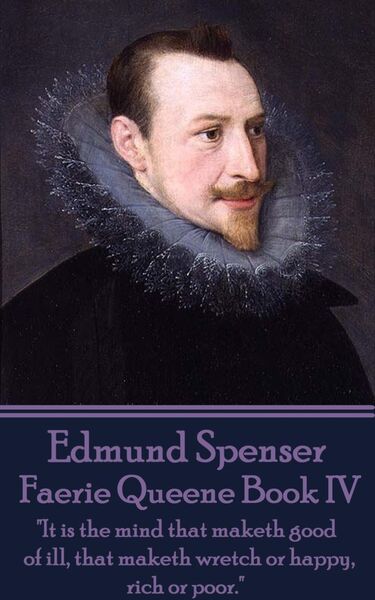
Faerie Queene Book IV "It is the mind that maketh good of ill, that maketh wretch or happy, rich or poor."
-
- Hardcover
- Taschenbuch
- eBook ausgewählt
-
Form:Einzelkauf Download
-
Sprache:Englisch
-
eBook Format:ePUB
- PDF 48,49 €
- ePUB ausgewählt
-
Verlag:Copyright Group
- Copyright Group ausgewählt
- Taylor & Francis eBooks 48,99 €
3,49 €
inkl. gesetzl. MwSt.Beschreibung
Produktdetails
Format
ePUB
Kopierschutz
Ja
Family Sharing
Nein
Text-to-Speech
Ja
Erscheinungsdatum
17.08.2015
Verlag
Copyright GroupSeitenzahl
138 (Printausgabe)
Dateigröße
119 KB
Sprache
Englisch
EAN
9781785433160
One of the greatest of English poets, Edmund Spenser was born in East Smithfield, London, in 1552. He was educated in London at the Merchant Taylors' School and later at Pembroke College, Cambridge. In 1579, he published The Shepheardes Calender, his first major work. Edmund journeyed to Ireland in July 1580, in the service of the newly appointed Lord Deputy, Arthur Grey, 14th Baron Grey de Wilton. His time included the terrible massacre at the Siege of Smerwick. The epic poem, The Faerie Queene, is acknowledged as Edmund's masterpiece. The first three books were published in 1590, and a second set of three books were published in 1596. Indeed the reality is that Spenser, through his great talents, was able to move Poetry in a different direction. It led to him being called a Poet's Poet and brought rich admiration from Milton, Raleigh, Blake, Wordsworth, Keats, Byron, and Lord Tennyson, among others. Spenser returned to Ireland and in 1591, Complaints, a collection of poems that voices complaints in mournful or mocking tones was published. In 1595, Spenser published Amoretti and Epithalamion. The volume contains eighty-nine sonnets. In the following year Spenser wrote a prose pamphlet titled A View of the Present State of Ireland, a highly inflammatory argument for the pacification and destruction of Irish culture. On January 13th 1599 Edmund Spenser died at the age of forty-six. His coffin was carried to his grave in Westminster Abbey by other poets, who threw many pens and pieces of poetry into his grave followed with many tears.
Noch keine Bewertungen vorhanden
Verfassen Sie die erste Bewertung zu diesem Artikel
Helfen Sie anderen Kundinnen und Kunden durch Ihre Meinung.
Kurze Frage zu unserer Seite
Vielen Dank für Ihr Feedback
Wir nutzen Ihr Feedback, um unsere Produktseiten zu verbessern. Bitte haben Sie Verständnis, dass wir Ihnen keine Rückmeldung geben können. Falls Sie Kontakt mit uns aufnehmen möchten, können Sie sich aber gerne an unseren Kund*innenservice wenden.
zum Kundenservice