















































KI-Beratung Beta

Gutscheinbedingungen

Gültig bis 11.11.2026 | Gültig für Spielzeug, Filme, Musik, Software, Games, Geschenke & Trends, Schreibwaren, Hörbücher und Hörbuch-Downloads (außer Abo & Shelfies), gebrauchte Bücher, nicht preisgebundene Bücher und Kalender | Einlösbar unter thalia.de und in der Thalia App | Click & Collect nur mit Online-Zahlung (Paypal/Kreditkarte) vorab | Einzelne Artikel können ausgeschlossen sein | Nicht kombinierbar mit anderen Gutscheinen oder Preisaktionen | Nur einmal pro Einkauf einlösbar | Gutschein wird auf max. 500€ Bestellwert angerechnet | Keine Barauszahlung | Digitale Hörbücher nur für Android  | Nicht gültig für preisgebundene Artikel (aufgrund der Buchpreisbindung sind Gutscheine nicht auf Bücher, eBooks, Presse einlösbar), tolino eReader & Zubehör, Abonnements & Flatrates, Geschenkkarten, Versandkosten und Services

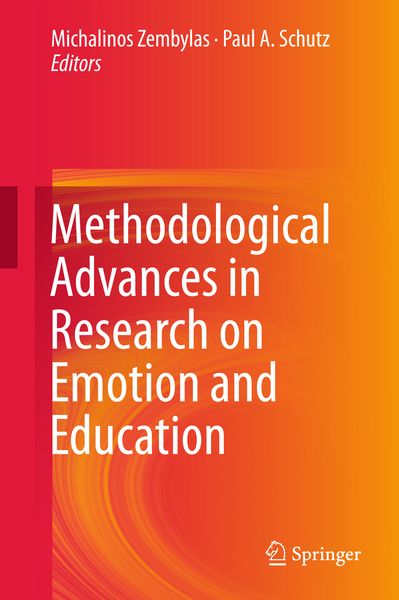
  • Produktbild: Methodological Advances in Research on Emotion and Education
  • Produktbild: Methodological Advances in Research on Emotion and Education
- 10%

Methodological Advances in Research on Emotion and Education

10% sparen

162,99 € UVP 181,89 €

inkl. gesetzl. MwSt., Versandkostenfrei


Beschreibung

Produktdetails

Einband

Gebundene Ausgabe

Erscheinungsdatum

22.03.2016

Abbildungen

XIV, 299 p. 9 illus. in color.

Herausgeber

Michalinos Zembylas + weitere

Verlag

Springer

Seitenzahl

299

Maße (L/B/H)

24,1/16/2,3 cm

Gewicht

589 g

Auflage

1st ed. 2016

Sprache

Englisch

ISBN

978-3-319-29047-8

Beschreibung

Portrait


Michalinos Zembylas
is Associate Professor of Educational Theory and Curriculum
Studies at the Open University of Cyprus. He is also
Visiting Professor
and Research Fellow

at the

Institute for
Reconciliation and Social Justice, 

University of the Free State,
South Africa.
He has written
extensively on emotion and affect in relation to social justice pedagogies, intercultural and peace education, human
rights education and citizenship education. His forthcoming book is titled
Emotion and Traumatic Conflict: Re-claiming Healing in Education
(Oxford, 2015).

Paul Schutz
is currently a
professor in the Department of Educational Psychology at the University of
Texas at San Antonio. His research interests include the nature of emotion,
emotional regulation, and teachers’ understandings of emotion in the classroom.
He is a past president for Division 15: Educational Psychology of the American
Psychological Association and a former co-editor of the 
Educational
Researcher: Research News and Comment, a
lead journal for the
American Educational Research Association.

Produktdetails

Einband

Gebundene Ausgabe

Erscheinungsdatum

22.03.2016

Abbildungen

XIV, 299 p. 9 illus. in color.

Herausgeber

Verlag

Springer

Seitenzahl

299

Maße (L/B/H)

24,1/16/2,3 cm

Gewicht

589 g

Auflage

1st ed. 2016

Sprache

Englisch

ISBN

978-3-319-29047-8

Herstelleradresse

Springer-Verlag KG
Sachsenplatz 4-6
1201 Wien
AT

Email: ProductSafety@springernature.com

Ein neues Kapitel für Ihre Bücher

Ein neues Kapitel für Ihre Bücher

Schenken Sie Ihren alten Schätzen ein zweites Leben und erhalten Sie dafür eine Thalia Geschenkkarte.

Jetzt verkaufen
Jetzt verkaufen

Noch keine Bewertungen vorhanden

Verfassen Sie die erste Bewertung zu diesem Artikel

Helfen Sie anderen Kundinnen und Kunden durch Ihre Meinung.

Kundinnen und Kunden meinen

Bewertungen (0)

Weitere Artikel finden Sie in

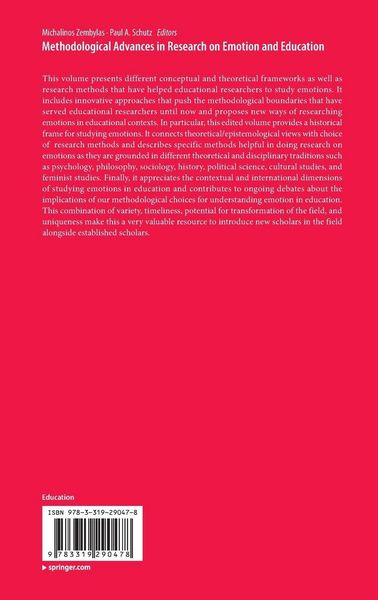
  • Produktbild: Methodological Advances in Research on Emotion and Education
  • Produktbild: Methodological Advances in Research on Emotion and Education

  • I. Introduction.- 1. Introduction to Methodological Advances in Research on Emotion and Education, Michalinos
    Zembylas and Paul A. Schutz.- II. Early Work and Reflections on Researching
    Emotions in Education.- 2. Interview
    with Megan Boler: From ‘Feminist Politics of Emotions’
    to the ‘Affective Turn’, Megan
    Boler (with Michalinos Zembylas.- 3. The
    Emotional Dimension in Teachers’ Work Lives: A Narrative-Biographical
    Perspective, Geert Keltchtermans.- 4. Using Self-Report to Assess Emotions
    in Education, Reinhard Pekrun.- 5.
    Understanding and Planning Emotions Research, Christopher Day and Belinda
    Harris.- III. Affective Terrains While Conducting Research on Emotion in
    Educational Contexts.- 6. Gauging the Affective: Becoming Attuned to Its Impact
    in Education, Megan Watkins.- 7. Navigating
    the Emotional Terrain of Research: Affect and Reason by Way of   Imagination, Kathleen Gallagher.- 8. Contemplative
    Engagement with Emotion: Embodied Strategies for Transformation and Change, Amy
    Winans and Elizabeth Dorman.- 9. Emerging Emotions in Post-structural
    Participant Ethnography in Education, Maija Lanas.- IV. Foregrounding Conceptual
    and Theoretical Frameworks While Researching Emotion in Educational Contexts.- 10.
    Emotions as Situated, Embodied, and Fissured: Methodological Implications of
    Thinking with Theories, Candace Kuby.- 11. Emotion as Mediated Action in Doing
    Research on Learning, Cynthia
    Lewis and Anne Crampton.- 12.
    Emotional Geographies and the Study of Education Spaces, Peter Kraftl.- 13.
    Measuring Affect in Educational Contexts: A Circumplex Approach, Lisa
    Linnenbrink-Garcia, Stephanie V. Wormington, and John Ranellucci.- 14. Where Race, Emotions and Research Meet:
    Moving Towards a Framework of Race Critical Researcher Praxis.- Keffrelyn
    Brown.- 15. A Political Ethics of Care Perspective in Researching Emotions, Vivienne
    Bozalek, 16. Affect Theory and Judith Butler: Methodological Implications for
    Educational Research, Michalinos Zembylas.- V.
    Foregrounding Research Methods While Investigating Emotions in Educational
    Contexts.- 17. Using Multiple and Mixed Methods to Investigate Emotions in
    Educational Contexts, Paul A. Schutz, Jessica T. DeCuir-Gunby, and Meca R. Williams-Johnson.-
    18. Interdisciplinary Research Methods Used to Investigate Emotions with
    Advanced Learning Technologies, Roger Azevedo, Michelle Taub, Nicholas Mudrick,
    Jesse Farnsworth, and Seth A. Martin.- 19. Assessing Academic Emotions via the
    Experience Sampling Method, Thomas Goetz and Madeleine Bieg.- 20. `Exploring
    Emotions at School with Children: Reflections on the Role of the Visual and Performative
    in Engaging with Children’s Constructed and Embodied Meanings of Emotion, Lisa
    Procter.- 21. Researching Emotion Through Oral Histories of Educational and
    Personal Change: Memory and Teacher Narratives, Julie McLeod.- VI. A Future
    Agenda for Research Methods on Emotions and Education.- 22. Where Do We Go From Here? Implications and Future Directions
    for Research Methods on Emotion and Education, Paul A. Schutz and Michalinos Zembylas.