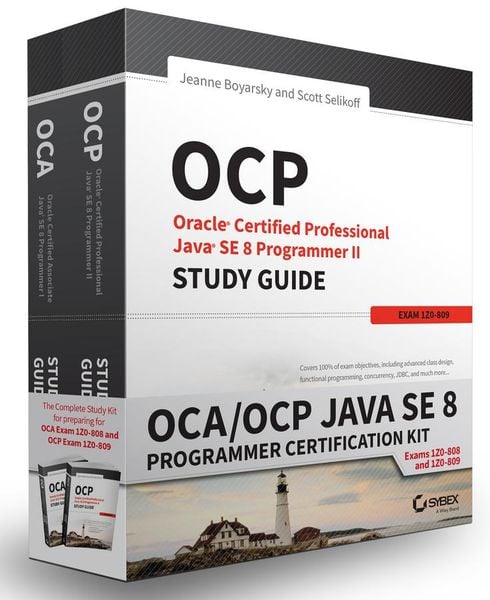
OCA: Oracle Certified Associate Java SE 8 Programmer I Study Guide: Exam 1Z0-808
Introduction xxi
Assessment Test xxxi
Chapter 1 Java Building Blocks 1
Understanding the Java Class Structure 2
Fields and Methods 2
Comments 4
Classes vs. Files 5
Writing a main() Method 6
Understanding Package Declarations and Imports 9
Wildcards 10
Redundant Imports 11
Naming Conflicts 12
Creating a New Package 13
Code Formatting on the Exam 16
Creating Objects 16
Constructors 17
Reading and Writing Object Fields 18
Instance Initializer Blocks 18
Order of Initialization 19
Distinguishing Between Object References and Primitives 20
Primitive Types 20
Reference Types 24
Key Differences 25
Declaring and Initializing Variables 25
Declaring Multiple Variables 26
Identifiers 27
Understanding Default Initialization of Variables 29
Local Variables 29
Instance and Class Variables 30
Understanding Variable Scope 31
Ordering Elements in a Class 34
Destroying Objects 36
Garbage Collection 36
finalize() 38
Benefits of Java 39
Summary 40
Exam Essentials 41
Review Questions 42
Chapter 2 Operators and Statements 51
Understanding Java Operators 52
Working with Binary Arithmetic Operators 53
Arithmetic Operators 53
Numeric Promotion 55
Working with Unary Operators 57
Logical Complement and Negation Operators 57
Increment and Decrement Operators 58
Using Additional Binary Operators 60
Assignment Operators 60
Compound Assignment Operators 62
Relational Operators 63
Logical Operators 64
Equality Operators 65
Understanding Java Statements 66
The if-then Statement 67
The if-then-else Statement 68
The switch Statement 72
The while Statement 76
The do-while Statement 78
The for Statement 80
Understanding Advanced Flow Control 86
Nested Loops 87
Adding Optional Labels 87
The break Statement 88
The continue Statement 90
Summary 92
Exam Essentials 92
Review Questions 94
Chapter 3 Core Java APIs 101
Creating and Manipulating Strings 102
Concatenation 102
Immutability 104
The String Pool 105
Important String Methods 105
Method Chaining 110
Using the StringBuilder Class 111
Mutability and Chaining 112
Creating a StringBuilder 113
Important StringBuilder Methods 114
StringBuilder vs. StringBuffer 117
Understanding Equality 117
Understanding Java Arrays 119
Creating an Array of Primitives 119
Creating an Array with Reference Variables 121
Using an Array 123
Sorting 124
Searching 125
Varargs 126
Multidimensional Arrays 126
Understanding an ArrayList 129
Creating an ArrayList 129
Using an ArrayList 130
Wrapper Classes 134
Autoboxing 136
Converting Between array and List 136
Sorting 138
Working with Dates and Times 138
Creating Dates and Times 138
Manipulating Dates and Times 142
Working with Periods 145
Formatting Dates and Times 148
Parsing Dates and Times 151
Summary 151
Exam Essentials 152
Review Questions 153
Chapter 4 Methods and Encapsulation 165
Designing Methods 166
Optional Specifiers 168
Return Type 169
Method Name 170
Parameter List 171
Optional Exception List 171
Method Body 171
Working with Varargs 172
Applying Access Modifiers 173
Private Access 173
Default (Package Private) Access 175
Protected Access 176
Public Access 180
Designing Static Methods and Fields 181
Calling a Static Variable or Method 182
Static vs. Instance 183
Static Variables 185
Static Initialization 186
Static Imports 187
Passing Data Among Methods 188
Overloading Methods 191
Creating Constructors 196
Default Constructor 197
Overloading Constructors 199
Final Fields 202
Order of Initialization 202
Encapsulating Data 205
Creating Immutable Classes 207
Writing Simple Lambdas 208
Lambda Example 209
Lambda Syntax 211
Predicates 214
Summary 215
Exam Essentials 216
Review Questions 218
Chapter 5 Class Design 233
Introducing Class Inheritance 234
Extending a Class 235
Applying Class Access Modifiers 237
Creating Java Objects 237
Defining Constructors 238
Calling Inherited Class Members 244
Inheriting Methods 246
Inheriting Variables 257
Creating Abstract Classes 259
Defining an Abstract Class 260
Creating a Concrete Class 262
Extending an Abstract Class 263
Implementing Interfaces 266
Defining an Interface 267
Inheriting an Interface 269
Interface Variables 273
Default Interface Methods 274
Static Interface Methods 278
Understanding Polymorphism 279
Object vs. Reference 281
Casting Objects 282
Virtual Methods 284
Polymorphic Parameters 285
Polymorphism and Method Overriding 287
Summary 288
Exam Essentials 289
Review Questions 291
Chapter 6 Exceptions 299
Understanding Exceptions 300
The Role of Exceptions 300
Understanding Exception Types 302
Throwing an Exception 304
Using a try Statement 305
Adding a finally Block 307
Catching Various Types of Exceptions 309
Throwing a Second Exception 311
Recognizing Common Exception Types 313
Runtime Exceptions 314
Checked Exceptions 317
Errors 317
Calling Methods That Throw Exceptions 318
Subclasses 319
Printing an Exception 321
Summary 323
Exam Essentials 324
Review Questions 325
Appendix A Answers to Review Questions 333
Chapter 1: Java Building Blocks 334
Chapter 2: Operators and Statements 336
Chapter 3: Core Java APIs 339
Chapter 4: Methods and Encapsulation 342
Chapter 5: Class Design 346
Chapter 6: Exceptions 349
Appendix B Study Tips 353
Studying for the Test 354
Creating a Study Plan 354
Creating and Running Sample Applications 355
Taking the Test 359
Understanding the Question 359
Applying Process of Elimination 362
Optimizing Your Time 364
Getting a Good Night's Rest 366
Index 367
OCP: Oracle Certified Professional Java SE 8 Programmer II Study Guide: Exam 1Z0-809
Introduction xix
Assessment Test xxxviii
Chapter 1 Advanced Class Design 1
Reviewing OCA Concepts 2
Access Modifiers 2
Overloading and Overriding 4
Abstract Classes 5
Static and Final 6
Imports 6
Using instance of 7
Understanding Virtual Method Invocation 9
Annotating Overridden Methods 11
Coding equals, hashCode, and toString 13
toString 13
equals 15
hashCode 18
Working with Enums 20
Using Enums in Switch Statements 21
Adding Constructors, Fields, and Methods 22
Creating Nested Classes 24
Member Inner Classes 25
Local Inner Classes 27
Anonymous Inner Classes 29
Static Nested Classes 31
Summary 33
Exam Essentials 34
Review Questions 36
Chapter 2 Design Patterns and Principles 47
Designing an Interface 48
Purpose of an Interface 51
Introducing Functional Programming 52
Defining a Functional Interface 53
Implementing Functional Interfaces with Lambdas 55
Applying the Predicate Interface 60
Implementing Polymorphism 61
Distinguishing between an Object and a Reference 63
Casting Object References 64
Understanding Design Principles 66
Encapsulating Data 66
Creating JavaBeans 69
Applying the Is?]a Relationship 71
Applying the Has?]a Relationship 73
Composing Objects 74
Working with Design Patterns 75
Applying the Singleton Pattern 76
Creating Immutable Objects 82
Using the Builder Pattern 86
Creating Objects with the Factory Pattern 89
Summary 93
Exam Essentials 93
Review Questions 95
Chapter 3 Generics and Collections 103
Reviewing OCA Collections 104
Array and ArrayList 104
Searching and Sorting 105
Wrapper Classes and Autoboxing 106
The Diamond Operator 107
Working with Generics 108
Generic Classes 109
Generic Interfaces 112
Generic Methods 114
Interacting with Legacy Code 114
Bounds 117
Putting It All Together 122
Using Lists, Sets, Maps, and Queues 124
Common Collections Methods 125
Using the List Interface 127
Using the Set Interface 132
Using the Queue Interface 134
Map 138
Comparing Collection Types 140
Comparator vs. Comparable 143
Comparable 143
Comparator 146
Searching and Sorting 150
Additions in Java 8 152
Using Method References 152
Removing Conditionally 154
Updating All Elements 155
Looping through a Collection 155
Using New Java 8 Map APIs 155
Summary 159
Exam Essentials 161
Review Questions 162
Chapter 4 Functional Programming 171
Using Variables in Lambdas 172
Working with Built-In Functional Interfaces 173
Implementing Supplier 174
Implementing Consumer and BiConsumer 175
Implementing Predicate and BiPredicate 177
Implementing Function and BiFunction 178
Implementing UnaryOperator and BinaryOperator 180
Checking Functional Interfaces 181
Returning an Optional 182
Using Streams 185
Creating Stream Sources 188
Using Common Terminal Operations 189
Using Common Intermediate Operations 196
Putting Together the Pipeline 200
Printing a Stream 204
Working with Primitives 205
Creating Primitive Streams 205
Using Optional with Primitive Streams 208
Summarizing Statistics 210
Learning the Functional Interfaces for Primitives 210
Working with Advanced Stream Pipeline Concepts 213
Linking Streams to the Underlying Data 213
Chaining Optionals 214
Collecting Results 217
Summary 223
Exam Essentials 224
Review Questions 226
Chapter 5 Dates, Strings, and Localization 233
Working with Dates and Times 234
Creating Dates and Times 235
Manipulating Dates and Times 241
Working with Periods 244
Working with Durations 247
Accounting for Daylight Savings Time 251
Reviewing the String class 253
Adding Internationalization and Localization 255
Picking a Locale 256
Using a Resource Bundle 258
Formatting Numbers 267
Formatting Dates and Times 270
Summary 273
Exam Essentials 274
Review Questions 276
Chapter 6 Exceptions and Assertions 283
Reviewing Exceptions 284
Exceptions Terminology 284
Categories of Exceptions 285
Exceptions on the OCP 286
Try Statement 288
Throw vs. Throws 289
Creating Custom Exceptions 289
Using Multi-catch 291
Using Try-With-Resources 296
Try-With-Resources Basics 298
AutoCloseable 300
Suppressed Exceptions 302
Putting It Together 305
Rethrowing Exceptions 305
Working with Assertions 308
The assert Statement 308
Enabling Assertions 309
Using Assertions 310
Summary 314
Exam Essentials 315
Review Questions 316
Chapter 7 Concurrency 325
Introducing Threads 327
Distinguishing Thread Types 328
Understanding Thread Concurrency 328
Introducing Runnable 330
Creating a Thread 331
Polling with Sleep 334
Creating Threads with the ExecutorService 335
Introducing the Single-Thread Executor 335
Shutting Down a Thread Executor 337
Submitting Tasks 338
Waiting for Results 340
Scheduling Tasks 345
Increasing Concurrency with Pools 348
Synchronizing Data Access 350
Protecting Data with Atomic Classes 352
Improving Access with Synchronized Blocks 354
Synchronizing Methods 356
Understanding the Cost of Synchronization 357
Using Concurrent Collections 358
Introducing Concurrent Collections 358
Understanding Memory Consistency Errors 359
Working with Concurrent Classes 360
Obtaining Synchronized Collections 365
Working with Parallel Streams 366
Creating Parallel Streams 366
Processing Tasks in Parallel 367
Processing Parallel Reductions 372
Managing Concurrent Processes 377
Creating a CyclicBarrier 377
Applying the Fork/Join Framework 381
Identifying Threading Problems 387
Understanding Liveness 387
Managing Race Conditions 391
Summary 392
Exam Essentials 393
Review Questions 394
Chapter 8 IO 405
Understanding Files and Directories 406
Conceptualizing the File System 406
Introducing the File Class 407
Introducing Streams 411
Stream Fundamentals 411
Stream Nomenclature 412
Common Stream Operations 418
Working with Streams 420
The FileInputStream and FileOutputStream Classes 420
The FileReader and FileWriter classes 424
The ObjectInputStream and ObjectOutputStream Classes 426
The PrintStream and PrintWriter Classes 432
Review of Stream Classes 435
Interacting with Users 437
The Old Way 437
The New Way 438
Summary 442
Exam Essentials 443
Review Questions 445
Chapter 9 NIO.2 453
Introducing NIO.2 454
Introducing Path 455
Creating Paths 456
Interacting with Paths and Files 460
Providing Optional Arguments 461
Using Path Objects 462
Interacting with Files 471
Understanding File Attributes 478
Discovering Basic File Attributes 478
Improving Access with Views 483
Presenting the New Stream Methods 487
Conceptualizing Directory Walking 487
Walking a Directory 488
Searching a Directory 490
Listing Directory Contents 491
Printing File Contents 492
Comparing Legacy File and NIO.2 Methods 494
Summary 495
Exam Essentials 495
Review Questions 497
Chapter 10 JDBC 505
Introducing Relational Databases and SQL 507
Identifying the Structure of a Relational Database 508
Writing Basic SQL Statements 510
Introducing the Interfaces of JDBC 511
Connecting to a Database 513
Building a JDBC URL 513
Getting a Database Connection 515
Obtaining a Statement 518
Choosing a ResultSet Type 519
Choosing a ResultSet Concurrency Mode 520
Executing a Statement 520
Getting Data from a ResultSet 524
Reading a ResultSet 524
Getting Data for a Column 526
Scrolling ResultSet 529
Closing Database Resources 533
Dealing with Exceptions 535
Summary 536
Exam Essentials 537
Review Questions 539
Appendix A Answers to Review Questions 547
Chapter 1: Advanced Class Design 548
Chapter 2: Design Patterns and Principles 550
Chapter 3: Generics and Collections 553
Chapter 4: Functional Programming 556
Chapter 5: Dates, Strings, and Localization 558
Chapter 6: Exceptions and Assertions 560
Chapter 7: Concurrency 561
Chapter 8: IO 565
Chapter 9: NIO.2 568
Chapter 10: JDBC 571
Appendix B Study Tips 575
Studying for the Test 576
Creating a Study Plan 576
Comparing Previous Exams 578
Creating and Running Sample Applications 579
Taking the Test 582
Understanding the Question 582
Taking Advantage of the Exam Software 587
Using the Provided Writing Material 587
Choosing the Best Answer 590
Optimizing Your Time 591
Getting a Good Night's Rest 593
Appendix C Upgrading from Java 6 or Earlier 595
Enhancing the Java Language 596
Using the Diamond Operator 596
Creating Literals 597
Making Decisions with Switch 598
Formatting and Parsing 603
Using DecimalFormat Flags 603
Using DateFormat 603
Formatting 604
Parsing 605
Custom Date Formats 606
Applying Locks 607
Understanding the Lock Framework 607
Using a ReentrantLock 610
Understanding Read/Write Locks 614
Using a ReentrantReadWriteLock 615
Working with Directories 617
Traversing Directories 618
Monitoring a Directory for Changes 625
Summary 633
Exam Essentials 633
Review Questions 635
Answers to Practice Test 645
Index 649